


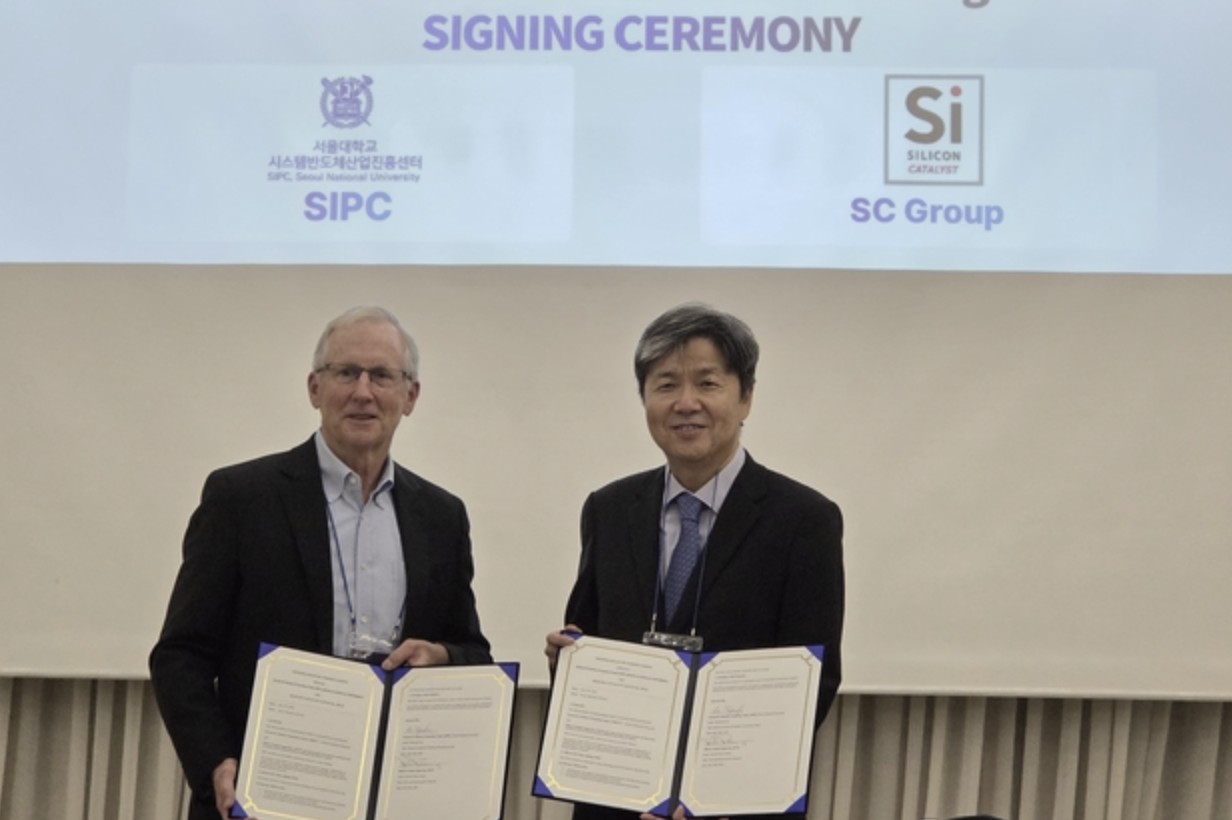
Hyuk-jae, Director of the Center for System Semiconductor Industry Promotion at Seoul National University (Professor, Department of Electrical and Computer Engineering; right), and Paul Pickering, Managing Partner of Silicon Catalyst in the U.S., signed a
SNU’s SIPC and Silicon Catalyst Japan sign an MOU to fast-track Korean system-semiconductor startups into a global incubation
SEOUL, SOUTH KOREA, June 15, 2026 /EINPresswire.com/ -- SNU’s SIPC partners with Silicon Catalyst to globalize Korean chip startupsSIPC signs MOU with Silicon Catalyst Japan; Xenoscube, Itda Semiconductor and VitalIC named incubation candidates
June 10, 2026 · Seoul National University Faculty Club, Gwanak, Seoul
Seoul National University’s System-IC Industry Promotion Center (SIPC) has joined forces with Silicon Catalyst, the world’s largest semiconductor-focused accelerator. The deal gives Korea’s early-stage system-semiconductor and deep-tech startups a direct on-ramp to an incubation and investment network spanning the US and Japan.
SIPC signed a memorandum of understanding (MOU) with Silicon Catalyst Japan (SCJ) on June 10 at its Global Strategic Partnership Day, held at the Seoul National University Faculty Club in Gwanak, Seoul. SIPC will recommend promising domestic firms, and Silicon Catalyst will select investment and incubation targets from among them. The two sides will back startups across the full lifecycle — development, verification, funding, patents and global networking.
The tie-up targets a weak link common to Korean chip startups. From the design stage, a system-semiconductor firm must absorb EDA tools, IP royalties and MPW fabrication costs running into the hundreds of thousands of dollars, plus access to global foundries and investors for production and fundraising. For early-stage firms short on capital and connections, that becomes an entry barrier unrelated to technical merit. Silicon Catalyst’s model covers those costs in kind.
Founded in 2015 in Silicon Valley, Silicon Catalyst has incubated more than 158 portfolio companies with a combined valuation above USD 3 billion. It works with 70-plus in-kind partners — TSMC, Synopsys, Arm and others — along with more than 350 advisors and 400 investors. Selected companies receive at least two years of in-kind EDA, IP and MPW support.
SCJ, the Korean-facing arm, is Silicon Catalyst’s Asia hub. Set up in July 2025 in Nihonbashi, Tokyo and led by CEO Kay Enjoji, a former Tokyo Electron corporate-VC executive, it pairs “Asia Origination” — sourcing startups and carve-outs from Korea, Japan and Taiwan — with “Global Acceleration” via Silicon Catalyst’s US, UK and EU networks, focused on deep tech in materials, photonics and advanced manufacturing.
SIPC leads the semiconductor sector of Korea’s national DIPS Project, providing system-semiconductor startups with up to KRW 200 million a year for three years, plus Arm IP and EDA access, MPW fabrication, consulting, joint R&D and investor matchmaking. In 2026 the program backs 629 companies across 12 sectors with a KRW 145.6 billion budget.
Ten Korean startups pitched at the event: AY Innovative, Xenoscube, Itda Semiconductor, Good Intelligence, Articron, PhotoniSol, VitalIC, Multiscale Instruments, Neuro Reality Vision (NRV) and Supergate. Xenoscube, Itda Semiconductor and VitalIC were named potential Silicon Catalyst incubation candidates; criteria were not disclosed.
The lineup ranged widely. Xenoscube showed XPU semiconductor IP and data-center AI acceleration systems; Itda Semiconductor presented “SOC Canvas,” which automates power, clock and DFT design to cut tape-out time by 25%; and VitalIC pitched ultra-low-power bio-signal chips combining TinyML with precision analog for wearables and medical devices. AY Innovative offered an automotive intrusion-detection chip for UN R155 compliance, PhotoniSol a silicon-photonics optical isolator chip addressing a 50-year industry challenge, and SNU spin-off Multiscale Instruments a non-contact atomic force microscope.
“We will contribute to Korea’s semiconductor industry through funding and technical support,” said Paul Pickering, Managing Partner at Silicon Catalyst. On investment, the firm said early-stage backing is its strategy: it runs no large fund of its own but can form a syndicate with other investors when the technology is strong.
“By combining SIPC’s domestic network with Silicon Catalyst’s global incubation experience, we will build a strong semiconductor ecosystem,” said Lee Hyuk-jae, SIPC director and a professor at Seoul National University. The event was supported by the Ministry of SMEs and Startups, the Korea Institute of Startup and Entrepreneurship Development (KISED) and the DIPS program office.
Jonwon Bae
3stripestudio
+82 10-9070-3906
jw@3svs.com
Legal Disclaimer:
EIN Presswire provides this news content "as is" without warranty of any kind. We do not accept any responsibility or liability for the accuracy, content, images, videos, licenses, completeness, legality, or reliability of the information contained in this article. If you have any complaints or copyright issues related to this article, kindly contact the author above.
