


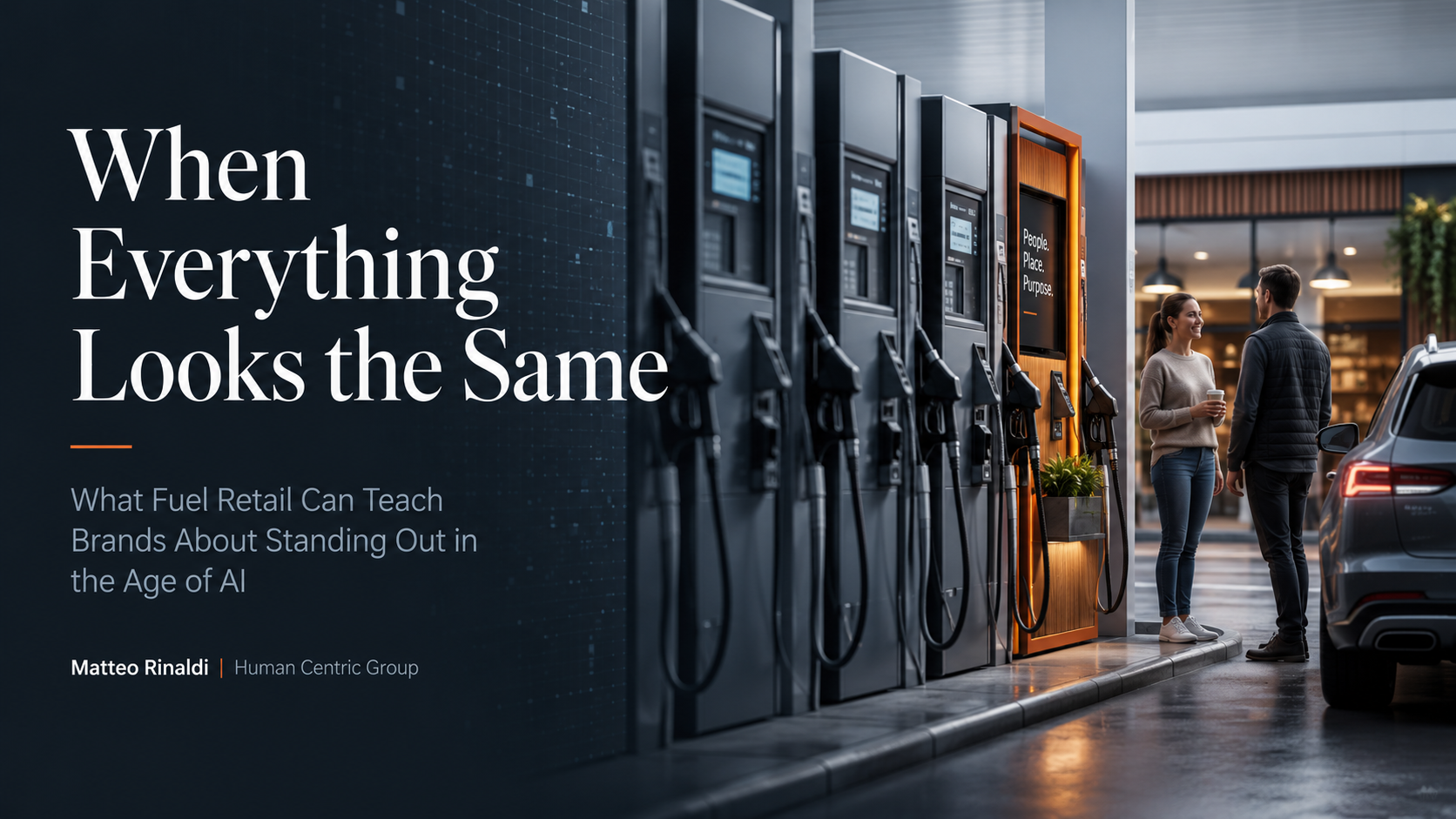
Conceptual illustration: As AI makes brand execution easier to imitate, fuel retail shows how companies can move beyond price and differentiate through identity, community, experience and human connection. Insights by Matteo Rinaldi, Co-Founder of Human C

Matteo Rinaldi, Co-Founder of Human Centric Group, Adjunct Professor at Luiss Business School, and author of two best-selling marketing books.
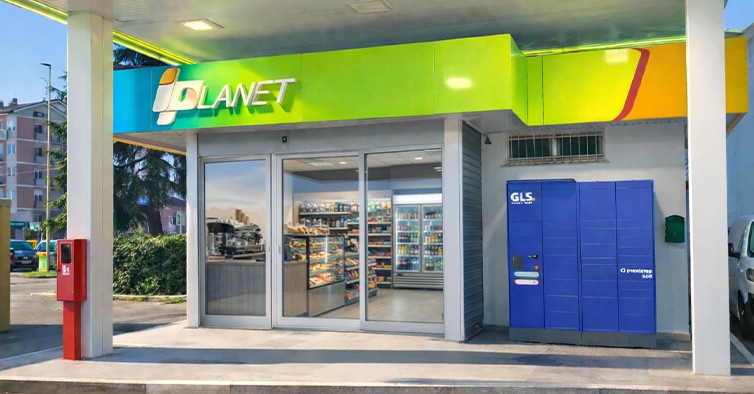
An iPlanet fuel-station shop combines convenience retail with a GLS parcel locker, illustrating how forecourts are evolving beyond fuel.
Matteo Rinaldi explains why identity, community and human connection become more valuable as brands grow easier to imitate.
That is the central argument of “Pump Fiction,” a new article by Matteo Rinaldi, Adjunct Professor at Luiss Business School and Co-Founder of the London-based boutique branding consultancy Human Centric Group.
Using petrol as one of the clearest examples of a commodity, Rinaldi examines a challenge that extends far beyond fuel retail. Airlines, banks, telecom operators, utilities and many consumer categories increasingly offer products that customers perceive as broadly interchangeable.
When that happens, a lower price may generate a transaction, but it rarely creates lasting preference.
The article argues that selling additional products is not, by itself, enough to create meaningful differentiation. Fuel stations have added convenience stores, coffee, food-to-go, car washes and parcel services, while electric-vehicle charging is extending the time customers spend on site.
These services can increase revenue, but competitors can usually replicate them. Rinaldi instead identifies four more defensible sources of competitive advantage.
Understand the communities behind the transaction
Motorists may all purchase the same fuel, but they are not simply anonymous drivers. They may be business travellers, cyclists, football supporters, pet owners, gamers or young families.
Their purchase may look identical, but their interests, motivations and sense of identity are different. Recognising these communities allows brands to create propositions, partnerships and experiences that feel relevant to particular groups rather than generic to everyone.
Make loyalty memorable, not merely valuable
Many loyalty programmes continue to depend on cashback, fuel discounts and generic vouchers. These rewards may provide financial value, but they are easy to compare and quickly forgotten.
Rewards connected to customers’ passions can instead become symbols, stories and reasons to prefer one brand.
Rinaldi recalls Esso’s limited-edition green mountain bike designed by Pininfarina. Millions of Italians still remember the bicycle decades later, even though very few could remember the price of fuel at the time.
The difference is that a discount disappears after it is redeemed. A meaningful symbol can become part of a customer’s personal story.
Look beyond demographics
Age, income and postcode may describe who is buying, but often reveal little about why they choose one company over another.
Two motorists of the same age and income may purchase the same amount of fuel while attaching completely different meanings to driving. One may associate it with freedom, performance and status. The other may view it purely as transportation.
Understanding behaviours, aspirations, passions and attitudes can therefore be more valuable than traditional demographic segmentation. It can influence targeting, loyalty design, brand partnerships, communication and the wider customer experience.
Treat human interaction as a competitive advantage
In increasingly automated and self-service environments, a brief interaction with an employee may be the customer’s only direct human contact with the brand.
A friendly greeting, a useful recommendation or simply recognising a regular customer can build trust in ways that technology and discounts cannot reproduce overnight.
Rinaldi argues that frontline employees should therefore be viewed not only as an operational cost, but as one of the few genuinely difficult-to-copy sources of differentiation.
The wider lesson is that commoditisation does not eliminate differentiation. It relocates it.
Competitive advantage moves away from the physical product and towards the ecosystem surrounding it: the communities a brand serves, the experiences it creates, the information it chooses to understand and the human relationships it enables.
The implications extend well beyond petrol stations. Any organisation facing price-based competition or increasingly interchangeable offers should ask the same question:
If the product is no longer distinctive, what else can customers choose us for?
The full article, “Pump Fiction: When Every Litre Is the Same, Everything Else Matters,” is available on the Human Centric Group website.
About Matteo Rinaldi
Matteo Rinaldi is a Senior Marketing Strategy Consultant and Co-Founder of Human Centric Group, with global experience driving double-digit growth for brands like Danone, Carlsberg, Revlon, PepsiCo, and Visa. Having worked across multiple continents, he specializes in leveraging cultural insights for impactful brand strategies. A passionate educator, Matteo teaches marketing worldwide, shaping future industry leaders. Previously, he worked with L’Oréal and Coca-Cola HBC. He is also a best-selling author in marketing.
About Human Centric Group
Human Centric Group is a London-based boutique branding and strategy consultancy.
The firm helps organisations uncover growth opportunities by understanding customers as people, through their behaviours, motivations, cultures and communities, and translating those insights into brand, commercial and activation strategies.
Media Contact
Media Enquiries
HUMAN CENTRIC GROUP LTD
+44 20 3693 4480
email us here
Visit us on social media:
LinkedIn
Instagram
TikTok
Legal Disclaimer:
EIN Presswire provides this news content "as is" without warranty of any kind. We do not accept any responsibility or liability for the accuracy, content, images, videos, licenses, completeness, legality, or reliability of the information contained in this article. If you have any complaints or copyright issues related to this article, kindly contact the author above.
