


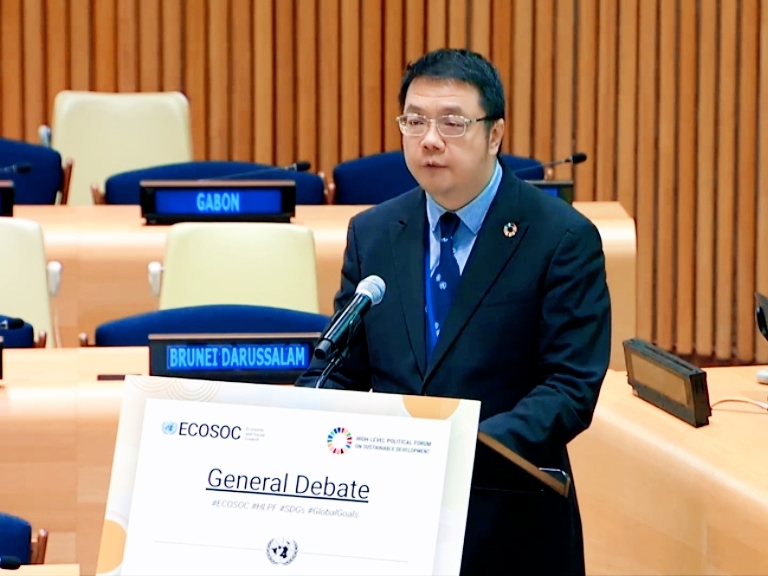
Grouphorse Chairman Xing Tang speaks during the general debate of the HLPF ministerial segment.
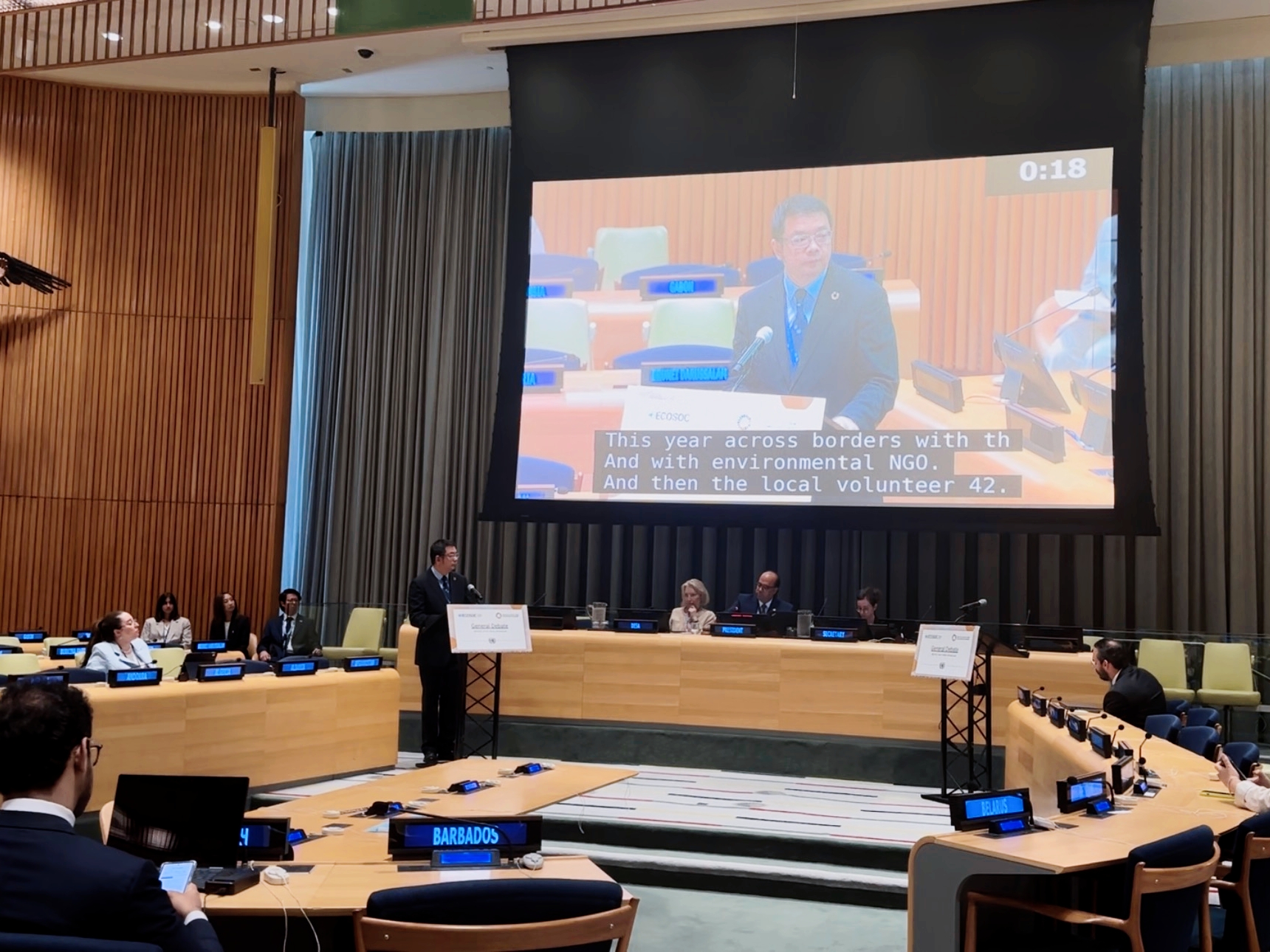
Grouphorse Chairman Xing Tang speaks during the general debate of the HLPF ministerial segment.
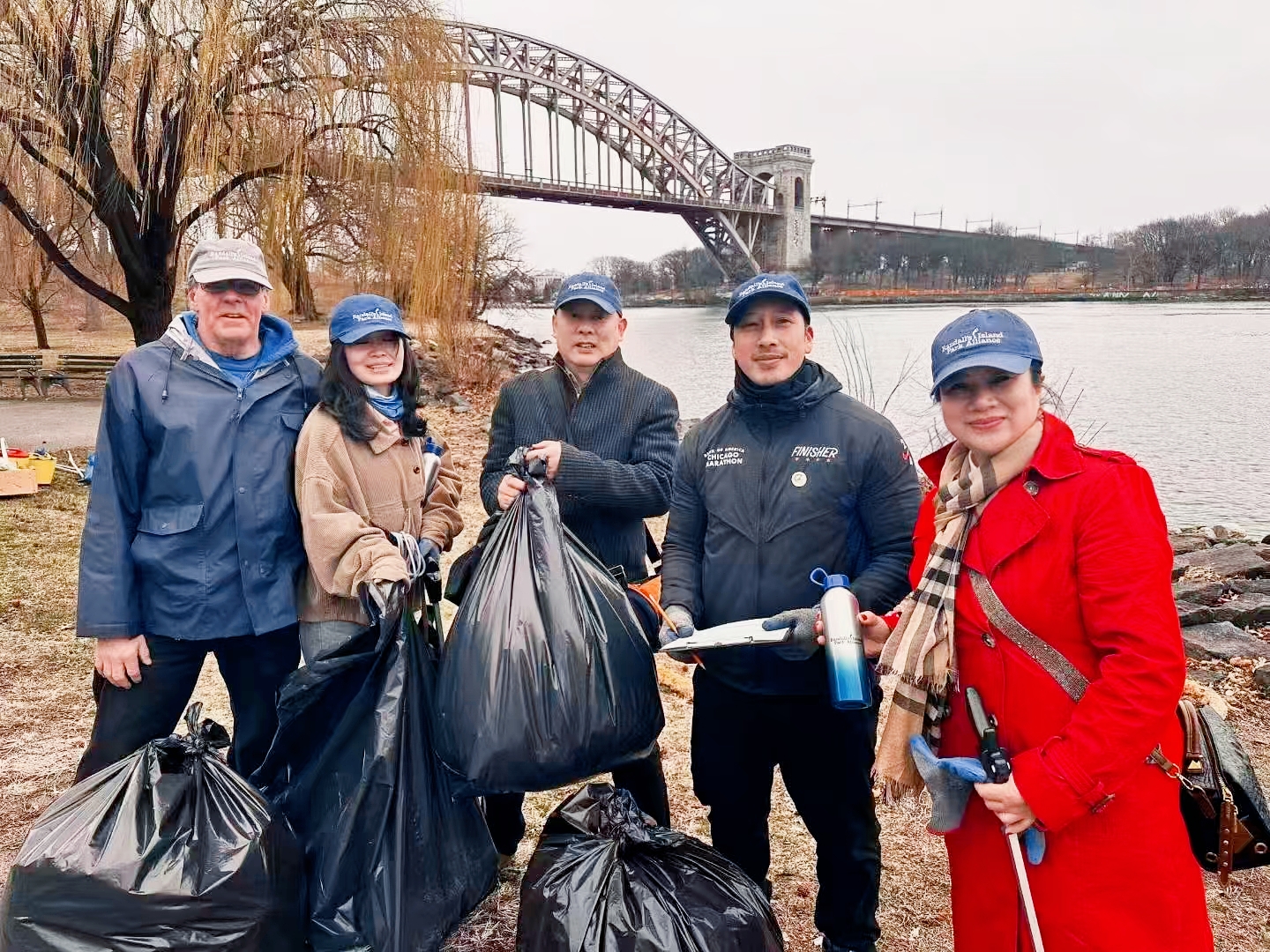
Green Friends conducts a shoreline cleanup in New York.
In his remarks, Tang highlighted Green Friends’ “Blue Guardians Across Borders” initiative and called for the development of a global network to support locally led coastal protection.
The HLPF is the United Nations’ central platform for following up on and reviewing implementation of the 2030 Agenda for Sustainable Development and its 17 Sustainable Development Goals. The 2026 forum was convened in New York from July 6 to 15 under the auspices of the U.N. Economic and Social Council.
The general debate was held during the High-level Segment of ECOSOC and the three-day ministerial segment of the HLPF. It provided a formal platform for governments, U.N. entities and civil society stakeholders to present implementation experience, policy priorities and action proposals related to the 2030 Agenda.
Green Friends is a Chinese nonprofit organization that has spent 26 years promoting ecological protection, public participation and volunteer action. Tang said the Blue Guardians Across Borders project had been selected for inclusion in China’s Compilation of Cases on Social Organizations’ Contributions to the 2030 Agenda for Sustainable Development.
The initiative brought the organization’s environmental work from China to Randall’s Island in New York, where Green Friends and local volunteers collected 42.6 kilograms, or about 94 pounds, of shoreline litter. Tang described it as the first shoreline cleanup initiative launched in the United States by a Chinese environmental nongovernmental organization.
The Randall’s Island project was designed not only to remove waste from one stretch of waterfront, but also to test a cooperation model combining cross-border volunteer coordination with locally led implementation. International partners helped connect resources, experience and volunteers, while local participants contributed knowledge of the site, community relationships and the ability to carry out the work on the ground.
The project was presented as more than a one-day cleanup. It created a practical setting for trust-building, partnership development and knowledge-sharing. The cleanup total offered a concrete measure of the volunteers’ work, while the cooperation process provided experience that other communities could study and adapt when developing their own shoreline initiatives.
Building on the New York experience, Tang proposed developing Blue Guardians Across Borders into a global network for coastal action. Under the proposal, environmental organizations, community groups, young volunteers and other partners in different countries and cities could build partnerships, exchange tested approaches and organize shoreline projects tailored to local conditions.
The proposed network would connect organizations with shared goals while preserving local leadership and allowing each project to reflect the environmental, social and cultural conditions of its own coastline. Tang said Green Friends was prepared to share its model and experience and connect communities committed to protecting coastal areas around the world.
The statement also highlighted the role civil society organizations can play in the HLPF process. While governments retain primary responsibility for implementing the Sustainable Development Goals, nonprofit organizations and community groups often help translate international commitments into tangible local action. Their participation can bring field experience, volunteer networks and evidence from specific communities into global policy discussions.
Coastal protection illustrates the interconnected nature of sustainable development. A community cleanup can involve environmental education, youth participation, responsible consumption, healthier urban spaces, marine protection and international partnership. Although a single activity may be local in scale, its relevance can extend across several Sustainable Development Goals when it is linked to longer-term learning, public engagement and cooperation.
Tang’s HLPF appearance also reflected a long-standing partnership between Green Friends and Grouphorse Group. The two organizations have worked together on environmental public-interest initiatives, sustainability education, youth engagement and international exchange. Their cooperation has included jointly organizing the 2025 United Nations Ocean Conference side event “Ocean Education 2030: Empowering Youth for Marine Governance” and supporting the Tianjin stop of China’s ninth national public-benefit shoreline cleanup campaign.
Those efforts created a continuum from community-based shoreline action and youth education to cross-border volunteering and multilateral dialogue. For Green Friends, the Randall’s Island cleanup marked an expansion from domestic environmental work into international, project-based cooperation. For Grouphorse, Tang’s participation reflected the group’s continuing engagement in sustainable development and its efforts to connect nonprofit organizations, educational institutions, businesses and young people.
Within Grouphorse, the same emphasis on turning sustainability principles into practical capacity has developed into a broader ESG strategy spanning standards, education, data governance and international communication. The group has helped establish a network of ESG industry colleges and centers, including China’s first ESG industrial college, the Tianjin Foreign Studies University Grouphorse ESG Industrial College, the Sichuan International Studies University Grouphorse ESG Global Governance Talent Industrial College, and China’s first ESG data-governance industry center at East China Jiaotong University. Grouphorse also led drafting of an ESG capacity-building training standard.
This work has also received external recognition. Forbes China included Tang in its 2025 ESG Influential Business Leaders list and its 2025 Top 100 Most Influential Chinese Elites. In its citation, Forbes China highlighted his efforts to bring Chinese language services and ESG education into the United Nations system and to expand the international exchange of knowledge in global governance.
Seen in that broader context, the HLPF statement was not an isolated appearance, but the latest step in a sustained collaboration that has moved from local environmental action toward cross-border practice and international dialogue. By bringing field-tested experience into a global forum, Green Friends and Grouphorse sought to connect community action with wider cooperation across organizations, cities and borders.
Tang closed with the appeal contained in his statement:
“Let us work together to build a shared, borderless blue future,” he said.
Bill TANG
Grouphorse
email us here
Legal Disclaimer:
EIN Presswire provides this news content "as is" without warranty of any kind. We do not accept any responsibility or liability for the accuracy, content, images, videos, licenses, completeness, legality, or reliability of the information contained in this article. If you have any complaints or copyright issues related to this article, kindly contact the author above.
