
.jpeg)

Addressing quality-control bottlenecks to advance reproducible stem-cell research and pre-clinical translation
HUSTON, TX, UNITED STATES, November 26, 2026 /EINPresswire.com/ -- Mesenchymal stem cells (MSCs) represent one of the most extensively studied adult stem-cell types for regenerative medicine and immunomodulation research. Despite substantial research progress, inconsistent product quality remains a major barrier to reliable laboratory outcomes and pre-clinical translation. This press release outlines core biological features, functional mechanisms and key quality-control criteria for MSCs, and highlights standardized MSC resources and supporting solutions offered by Cloud-Clone for global research communities.
Over the past two decades, mesenchymal stem cells (MSCs) have attracted broad research interest for regenerative and immune-modulatory investigations. Free from ethical concerns associated with embryonic stem cells and distinct from blood-specialized hematopoietic stem cells, MSCs act as endogenous repair and immune-regulatory agents within tissues. Nevertheless, their research and translational value hinges not on broad hypothetical multipotency alone, but on standardized manufacturing, characterization and functional regulation. Rigorous quality assurance enables MSCs to evolve from broadly-acting repair agents into reliable precision laboratory tools for basic studies, pre-clinical animal assays and future cell-drug development.
What Are Mesenchymal Stem Cells
Mesenchymal stem cells are mesoderm-derived adult multipotent stem cells widely isolated from bone marrow, adipose tissue, umbilical cord, placenta, synovium and other tissues. In 2006, the International Society for Cell Therapy (ISCT) published minimum characterization criteria for MSCs: ≥95 % positive expression of CD73, CD90 and CD105; ≤2 % positive expression of CD34, CD45, CD14, CD19 and HLA-DR; together with documented trilineage differentiation potential toward osteogenic, adipogenic and chondrogenic lineages.
Three core biological properties define MSCs: self-renewal capacity, multi-lineage differentiation potential and low immunogenicity. These features underpin their utility in research work and also form fundamental dimensions for quality evaluation.
Mechanisms of MSC Action: Paracrine Signaling as the Primary Driver
A common misconception assumes infused MSCs exert therapeutic effects chiefly by differentiating to replace damaged tissue. In fact, differentiation accounts for only a minor fraction of MSC bioactivity. Three principal mechanisms are well-recognized within the research community:
1.Homing effect: MSCs migrate toward sites of inflammation or tissue injury guided by chemical signaling released from damaged tissue.
2.Paracrine activity (dominant mechanism): Upon arrival at injury sites, MSCs secrete a wide spectrum of growth factors, cytokines and extracellular vesicles to suppress inflammation, promote tissue repair and activate endogenous resident cells.
3.Immunomodulation: MSCs interact with T-cells, B-cells, macrophages and other immune populations to moderate immune-response intensity.
A randomized phase 2b clinical study published in Stem Cell Reports demonstrated that single MSC infusion improved walking distance in older adults with frailty in a dose-dependent manner, with serum sTIE2 levels correlating with administered cell dosage. Findings illustrated systemic impacts of MSCs on vascular and inflammatory status. Studies of this kind are only feasible when each cell batch undergoes thorough quality characterization.
Quality-Control Step 1: Cell-Surface Marker Profiling
The first quality-control checkpoint confirms cell identity. Although marker expression varies across tissue sources, combined detection of core positive markers (CD73, CD90, CD105, CD29, CD44) and negative markers (CD34, CD45, CD19, HLA-DR) serves as baseline identity verification.
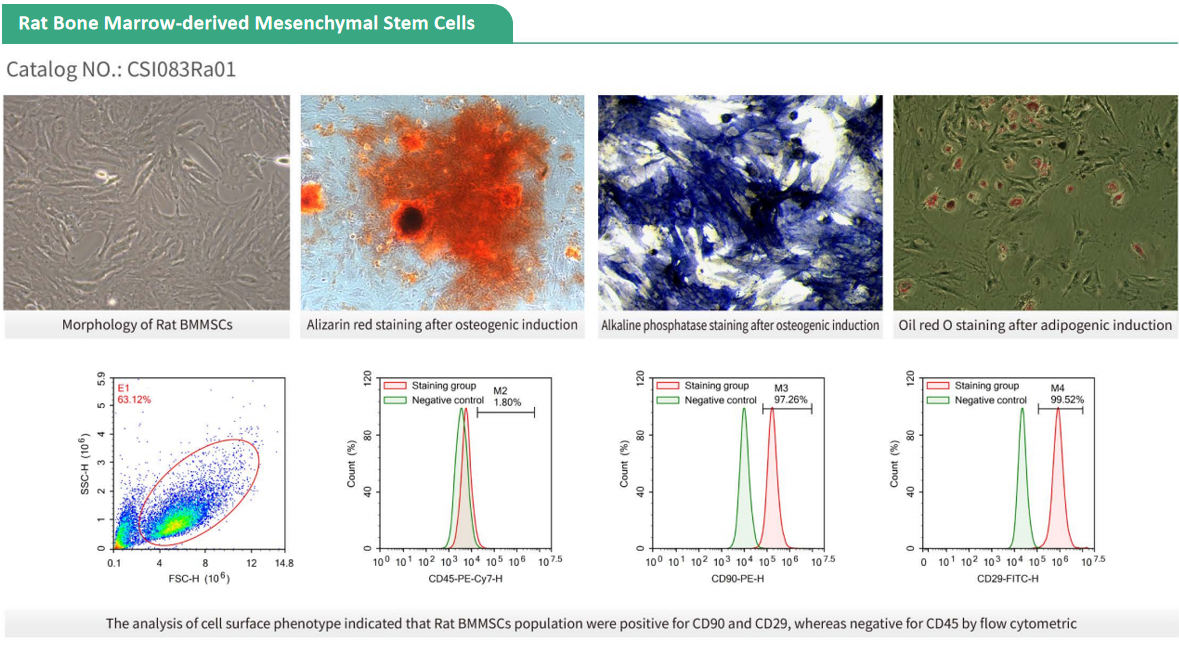
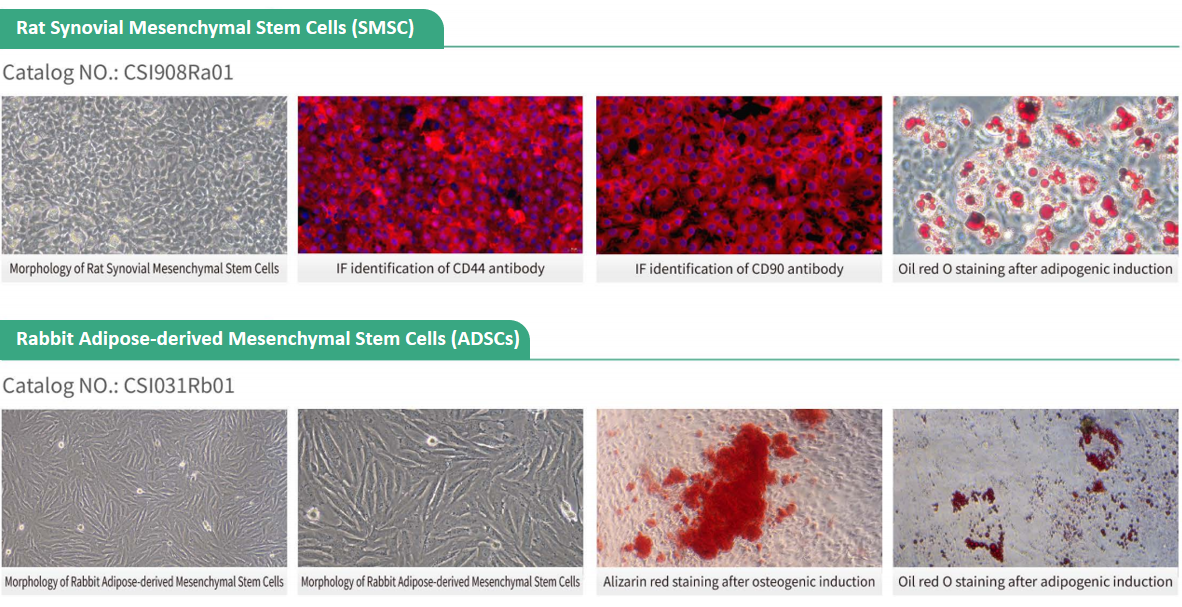
Cloud-Clone rat bone-marrow-derived MSCs are characterized via flow cytometry, showing 98.20 % negativity for CD45, 97.26 % positivity for CD90 and 99.52 % positivity for CD29, consistent with ISCT specifications. Rat synovial-tissue-derived MSCs are validated by immunofluorescence for CD90 and CD44 expression. Canine umbilical-cord-derived MSCs are also assessed with immunofluorescence targeting CD90.
These characterization datasets underpin experimental reproducibility. Phenotypic drift will invalidate downstream differentiation assays and in-vivo animal studies.
Figure 1. Characterization of Rat Bone-Marrow-Derived Mesenchymal Stem Cells (Catalog No. CSI083Ra01).
Figure 2. Characterization of rat synovial-derived and rabbit adipose-derived mesenchymal stem cells.
Quality-Control Step 2: Verification of Trilineage-Differentiation Capacity
Surface-marker profiling confirms cell identity but cannot verify functional potency. Functional testing is required to validate multipotent differentiation capacity.
- Osteogenic induction: orange-red calcium nodules visible under alizarin-red staining
- Adipogenic induction: red lipid droplets observable with Oil-Red-O staining
- Chondrogenic induction: blue glycosaminoglycan deposition shown by Alcian-blue staining
These three staining assays represent the standard functional benchmark for MSC stemness validation. Cloud-Clone rabbit adipose-derived MSCs exhibit distinct red lipid droplets upon adipogenic induction. Rat bone-marrow-derived MSCs supply complete trilineage datasets including alizarin-red, alkaline-phosphatase and Oil-Red-O results.
Differentiation performance is closely related to cell passage number. Low-passage primary MSCs maintain superior stem-cell properties, whereas high-passage cultures tend toward phenotypic shift and reduced differentiation potential. For research-grade MSC products, clear documentation of passage information and expansion stability is essential.
Quality-Control Step 3: Scalable Expansion and Batch Consistency
Basic laboratory work may use small-scale cell preparations, yet pre-clinical animal experiments and drug-screening workflows demand large-volume, batch-consistent cell material. Conventional terminally-differentiated primary cells can only sustain 1-3 passages in-vitro with minimal expansion potential.
Cloud-Clone low-passage primary MSCs can be stably expanded for up to 10 passages, retaining normal karyotypes without chromosomal aberration or tumor-transformation risk. Post-thaw cell viability consistently exceeds 85 %, supporting large-batch manufacturing and master-cell-bank cryopreservation. Stable batches minimize data variability across parallel experimental groups.
Cloud-Clone also operates an approximately 1100 m² SPF-grade animal facility, enabling traceable animal-strain genetic background. Full-chain quality control starting from source-animal husbandry delivers advantages difficult to achieve for laboratories performing only cell-isolation procedures.
Cloud-Clone MSC Solutions: Integrated Research-Enabling Ecosystem
Cloud-Clone delivers more than isolated MSC preparations, building an integrated research framework combining cell products, specialized culture media and contract-research services.
Product portfolio: Cloud-Clone offers primary MSCs derived from human, rat, mouse, rabbit, canine, feline and other species, sourced from bone marrow, adipose tissue, umbilical cord, synovium, liver and amniotic membrane. All products originate from primary tissues without cell-line transformation, with complete marker characterization, high purity and rigorous pathogen testing.
Supporting reagents: Optimized in-house formulated complete medium for MSCs sustains cell proliferation and stem-cell properties, improving cell viability and passaging stability.
CRO services: Leveraging standardized in-house animal-model platforms, Cloud-Clone provides end-to-end contract research services covering MSC in-vivo administration, disease-model establishment, drug intervention, histopathological assessment and molecular-mechanism analysis. Custom-isolation services are available for rare species or special-tissue-derived MSCs, tailored for investigations including heart-failure modeling, cerebral-ischemia injury, joint degeneration and autoimmune-disease studies.
Rational Perspective on MSC Research Progress
While MSC research yields encouraging outputs, realistic expectations remain necessary. The vast majority of MSC-related applications are still confined to clinical-trial stages, with only a limited number of approved commercial products. Challenges including low post-infusion cell survival and sub-optimal homing efficiency persist. Ongoing research explores genetic modification, cell pre-conditioning and extracellular-vesicle delivery strategies to boost therapeutic performance.
Selecting well-characterized low-passage primary MSCs forms the foundation for reproducible experiments. Drawing on nearly two decades of primary-cell technical accumulation, Cloud-Clone implements full-workflow quality control from animal facilities to CRO project delivery. Its MSC products satisfy ISCT phenotypic standards alongside validated trilineage-differentiation performance.
The translational journey of mesenchymal stem cells, from multifunctional repair agents to precise experimental instruments, depends fundamentally on consistent quality management. Cloud-Clone strives to supply reliable, well-validated MSC resources and integrated supporting services, helping global researchers generate robust, repeatable data to advance regenerative-medicine discoveries.
About Cloud-Clone Corp.
Cloud-Clone Corp. is dedicated to the development and production of high-quality immunoassay reagents and detection solutions. With a focus on antibody engineering, multiplex assay development, and cross-platform compatibility, the company provides research tools designed to support precision medicine and advanced biomedical investigation globally. Our core products and services include the research and development of proteins, antibodies, ELISA kits, primary cells, and multiplex cytokine assay kits, as well as professional CRO services to fully meet the diverse needs of biomedical research and related fields.
For more information about Cloud-Clone Corp, visit www.cloud-clone.com.
CLOUD-CLONE CORP.(CCC)
Tel: 001-832-538-0970, 0086-27-8425-9552
Email: mail@cloud-clone.com, sales@cloud-clone.us
Visit us on social media:
LinkedIn: https://www.linkedin.com/company/cloud-clone-corp/
Instagram: https://www.instagram.com/cloudclone2026
TickTok: https://www.tiktok.com/@cloudclonecorp2026
SuKi Duan
CLOUD-CLONE CORP.WUHAN
Visit us on social media:
LinkedIn
Instagram
TikTok
X
Legal Disclaimer:
EIN Presswire provides this news content "as is" without warranty of any kind. We do not accept any responsibility or liability for the accuracy, content, images, videos, licenses, completeness, legality, or reliability of the information contained in this article. If you have any complaints or copyright issues related to this article, kindly contact the author above.
