
.jpeg)

Choosing a motorcycle intercom should not feel like reading an engineering textbook. New riders often face a confusing mix of Bluetooth specifications, Mesh features, battery claims, and conflicting advice.
For most beginners, the right helmet intercom should provide clear voice communication, simple helmet installation, reliable phone pairing, glove-friendly controls, sufficient battery life, and model-appropriate water and dust resistance.
Bluetooth is usually enough for solo riding or communication between a rider and passenger. Mesh becomes more useful when riders regularly travel in larger groups or need easier reconnection as riders move apart.
BLAISE designs motorcycle communicators around real riding conditions. The best choice is not necessarily the device with the longest specification list. It is the model that matches how, where, and with whom you ride.
Quick Answer: What Should New Riders Look for in a Motorcycle Intercom?
New riders should evaluate six core factors before comparing models:
•Voice clarity: Can you hear calls, navigation prompts, and fellow riders clearly?
•Helmet compatibility: Can the speakers and microphone fit your helmet comfortably?
•Connection type: Do you need simple Bluetooth pairing or larger-group Mesh communication?
•Ease of use: Can you operate the controls while wearing riding gloves?
•Battery life: Does the battery cover your normal commuting or touring time?
•Weather resistance: Does the product have an IP rating suitable for your riding conditions?
A solo commuter may only need a simple Bluetooth communicator. A rider who regularly joins group tours may benefit from a full-duplex Mesh intercom with longer battery life and easier group management.
What New Riders Should Look for Beyond Price
Entry-level Bluetooth intercoms can be attractive when keeping upfront costs low. However, a motorcycle intercom also needs to perform in environments affected by wind noise, engine vibration, road traffic, and changing weather.
When comparing products, look for:
•A documented IP rating rather than a general claim of “waterproofing”
•A secure mounting method that fits your helmet
•Speakers designed for helmet ear cavities
•A microphone suitable for your helmet type
•Controls that are easy to locate with gloves
•Battery life appropriate for your regular rides
•Compatibility with your phone and other Bluetooth devices
•Clear warranty and after-sales support
Beyond these basics, riders should consider three functional areas.
Balanced Audio for Navigation, Music, and Intercom
Motorcycle riding involves several audio sources at the same time. Riders may need to hear navigation prompts, music, phone calls, fellow riders, and important traffic sounds.
A well-designed communicator should make spoken information intelligible without creating unnecessary distraction. Actual performance depends on helmet fit, speaker placement, microphone position, road speed, wind conditions, and the rider’s listening preference.
Hands-Free Controls and Voice Commands
New riders should be able to adjust volume, answer calls, control music, or access navigation without repeatedly removing their hands from the handlebars.
Depending on the model, this may involve physical buttons, a rotary dial, a mobile app, voice assistants, or supported offline voice commands. The most suitable control method depends on the rider’s gloves, helmet, riding habits, and personal preference.
Controls Designed to Reduce Distraction
An intercom should make communication easier without creating unnecessary mental workload. Clear controls, predictable button functions, and straightforward audio behavior can help riders focus on the road.
A motorcycle intercom cannot replace safe riding judgment. It should be treated as a communication and audio tool that supports the riding experience.
Choose the Intercom Based on How You Ride
A practical choice begins with daily riding habits rather than a specification table.
Ask yourself:
1.How many people do you usually ride with?
2.Where do you spend most of your riding time?
3.Do you mainly need navigation, calls, music, rider communication, or video recording?
4.How long are your typical rides?
5.What type of helmet do you use?
6.Do you ride in changing weather conditions?
Clarifying these priorities can help you avoid paying for features you will not use while preventing you from choosing an intercom that is too limited for your riding style.
Choosing a Motorcycle Intercom by Riding Scenario
Solo Daily Riding
Solo commuters usually prioritize GPS navigation, hands-free calls, music playback, simple pairing, and comfortable helmet installation.
Rider and Passenger
Riders who usually travel with a passenger need a stable two-rider connection, clear voice communication, and controls that are easy to use during everyday trips.
A Bluetooth intercom is often sufficient for this scenario. It generally provides simpler pairing and operation than a larger group-oriented Mesh intercom.
Small Group Riding
Small riding groups need dependable rider-to-rider communication over the distances they normally travel.
Bluetooth group communication may be sufficient for some small groups, but riders should understand how the specific connection method works. Some Bluetooth group configurations rely on sequential or chain-based links, which may be affected when an intermediate rider moves out of range.
A small group should consider:
•The number of riders
•The distance between motorcycles
•Whether the group frequently separates
•Whether riders use the same brand
•How easily the group can reconnect
Long-Distance Touring
Long-distance touring places greater demands on battery life, microphone clarity, controls, weather resistance, and audio management.
Touring riders should look for:
•Extended battery endurance
•Clear rider-to-rider communication
•Comfortable speakers for long periods of use
•Easy controls with riding gloves
•Stable helmet mounting
•Suitable water and dust resistance
•Audio mixing for music, navigation, and intercom use
The actual performance of any intercom depends on riding speed, road conditions, helmet design, microphone placement, and the distance between riders.
Content-Creating Riders
Riders who record scenic tours or daily traffic may prefer a communicator with an integrated camera.
Bluetooth, Mesh, and Full-Duplex Communication Explained
Motorcycle intercoms use different technologies for pairing, group communication, and audio interaction. These technologies should be understood as separate functions rather than identical product categories.
Bluetooth Intercom
Bluetooth is commonly used for:
•Phone pairing
•Music playback
•GPS navigation
•Rider-passenger communication
•Point-to-point communication with compatible third-party devices
Bluetooth is usually the simplest choice for solo riders and rider-passenger pairs.
Some models also support multi-rider Bluetooth communication. Depending on the connection structure, riders may need to reconnect manually if the group separates.
Mesh Intercom
Mesh communication allows multiple compatible devices to form a self-organizing group network. Each device may act as a network node, helping the group maintain communication as rider positions change.
Mesh is especially useful for:
•Larger riding groups
•Club rides
•Long-distance tours
•Groups that may spread out during a ride
•Riders who want easier group management and reconnection
Full-Duplex Communication
Full-duplex communication allows riders to speak and listen at the same time. This creates a more natural conversation than a turn-taking connection.
Audio mixing, voice activation, and button-free operation depend on the specific product design and settings.
For BLAISE products:
•GTMESH™ manages how multiple riders connect and communicate within a group.
•Full-duplex communication describes how riders speak and listen during supported conversations.
•Bluetooth supports phone pairing, music playback, and compatible point-to-point communication.
•PeakReach™ extends communication through the BLAISE App, a smartphone, mobile data, and available network coverage.
•LocalVoice™ provides offline voice commands on supported models.
•
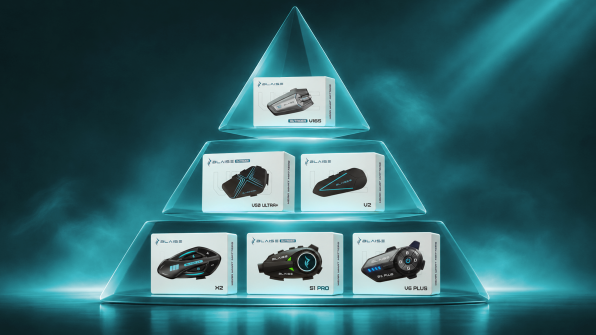
BLAISE Motorcycle Intercoms by Riding Scenario
BLAISE F1 and GT0: Solo Riding and Daily Commuting
The F1 and GT0 are positioned for riders who mainly need a simple personal communication device for commuting and everyday rides.
The F1 includes Bluetooth connectivity, up to 10 hours of talk time, slim speakers, and a compact installation format. It is suitable for riders who prioritize navigation, calls, music, and straightforward operation.
The GT0 belongs to the solo-riding range and is intended for riders who do not regularly need large-group Mesh communication.
BLAISE V1: Urban and Night Riding
For evening commuters and riders who want additional visibility-related features, the BLAISE V1 combines a two-rider intercom with ambient helmet lighting.
The V1 includes a 500-meter dual-rider intercom and an 800mAh battery. Actual communication range depends on terrain, rider positioning, interference, helmet fit, and riding conditions.
BLAISE GT1, X2, and V2: Paired Riding and Touring
The BLAISE GT1, X2, and V2 are suited to paired riding, passenger communication, and selected touring scenarios.
Environmental Noise Cancellation (ENC) is included across the BLAISE product range. Its real-world performance depends on microphone placement, helmet structure, wind conditions, riding speed, and speaker fit.
•BLAISE GT1: Designed for two-rider touring, with rider-to-passenger communication, music sharing, and direct external action-camera audio connectivity.
•BLAISE X2: Designed for riders who need extended connectivity, weather resistance, ENC, extended battery life, and multiple color options.
•BLAISE V2: Combines paired urban riding, ambient helmet lighting, two-rider communication, and ENC in a style-focused design.
BLAISE S1 Pro: Video Recording and Everyday Documentation
The BLAISE S1 Pro integrates a 1080p camera with a 120-degree wide-angle lens into the communicator housing.
Its 1500mAh battery supports longer recording and communication sessions, while loop recording helps manage continuous video capture.
The S1 Pro is suitable for riders who want one integrated device for communication and ride recording without installing a separate camera mount.
BLAISE V16S and V50 Ultra+: Group Riding and Touring
Organized club rides and multi-bike tours require a communication platform that can support changing rider positions and larger groups.
The BLAISE V16S launched in the first quarter of 2026. It uses BLAISE GTMESH™ networking with Private, Squad, and Fleet modes for different group communication needs.
PeakReach™ can extend communication through a smartphone, the BLAISE App, mobile data, and available network coverage. The V16S also includes LocalVoice™ offline voice commands on supported functions.
The V50 Ultra+ is designed as a flagship group-riding communicator. It supports an up-to-24-rider full-duplex Mesh network, with a stated communication range of approximately 500 to 950 meters depending on riding conditions and network configuration.
The V50 Ultra+ also includes:
•Simultaneous music and intercom use
•Multi-layer ENC noise reduction
•IP66-rated water and dust resistance
•An 1150mAh battery
•Up to 18 hours of intercom talk time
Actual range, battery life, and audio performance vary according to temperature, speed, terrain, network structure, helmet fit, and usage settings.
Audio, Usability and Long-Term Value
Beyond connection type, riders should consider audio clarity, controls, helmet fit, battery life, and durability.
ENC is included across all BLAISE models. The V16S and V50 Ultra+ are designed to maintain clear speech in high-wind conditions, although performance also depends on helmet fit, microphone placement, riding speed, and surrounding noise.
The V16S offers standard, vocal, and bass sound modes. The V50 Ultra+ supports full-duplex group communication, while the V16S provides Private, Squad, and Fleet modes. Audio mixing allows riders to manage music, navigation, calls, and intercom conversations, depending on the model and settings.
BLAISE models use different speaker and microphone configurations. Soft microphones are generally suitable for full-face and modular helmets, while hard boom microphones are better suited to open-face and half-face helmets. Riders should check speaker placement and microphone compatibility before purchase.
The V16S features a magnetic mounting base and rotary dial. The V1, V2, X2, and S1 Pro use larger tactile controls designed for gloved operation. The BLAISE App supports setup, pairing, and product management on supported models, while the V16S also includes LocalVoice™ offline voice commands.
Durability and Support
IP ratings indicate protection against dust and water. IPX6, IP66, and IP67 provide different levels of protection, so riders should check the rating of the specific model. Do not charge the communicator while it is wet or while the charging port is exposed to water.
Battery capacity and usage time vary by model:
•V1: 800mAh battery
•F1: up to 10 hours of talk time
•V50 Ultra+: 1150mAh battery
•S1 Pro: 1500mAh battery
Actual battery life depends on volume, music, recording, Bluetooth or Mesh use, temperature, and other settings.
Over-the-air firmware updates help maintain compatibility and support product improvements. Warranty terms vary by market, so buyers should review the applicable policy before purchase. BLAISE provides support for installation, troubleshooting, warranty guidance, and model-specific technical issues.
Common Buying Mistakes
New riders should not choose an intercom based only on its longest specification list. Before buying, check:
•Helmet and speaker compatibility
•Microphone position
•Glove-friendly controls
•Battery life
•IP rating
•Preferred rider group size
•Compatibility with third-party Bluetooth devices
Bluetooth may support point-to-point communication between different brands, but proprietary Mesh technologies are not automatically interchangeable.
The best motorcycle intercom is the one that fits your helmet, matches your riding style, and keeps the right people connected when it matters.
With balanced audio, practical controls, and flexible communication features, BLAISE helps riders focus on the moments that matter.
Hear What Matters.
Compare BLAISE motorcycle intercoms at:https://blaisesystem.com/
Frequently Asked Questions About Choosing a Beginner Motorcycle Intercom
Do I need a Mesh intercom if I only ride solo or with one friend?
Not necessarily. Solo commuters and rider-passenger pairs are usually well served by Bluetooth communicators such as the BLAISE F1, GT0, or GT1.
Bluetooth provides a simple way to connect a phone, listen to music and navigation, and communicate with one other rider or passenger.
Mesh becomes more useful when riders regularly travel in larger groups, need easier reconnection, or often move beyond the normal Bluetooth communication range.
Can BLAISE communicators connect with intercoms from other brands?
Many BLAISE communicators support Bluetooth pairing with compatible third-party devices for point-to-point communication.
However, compatibility, pairing steps, range, and audio behavior depend on the specific models and connection standards.
For larger group Mesh communication, using compatible BLAISE units is generally the most reliable option.
How should riders maintain lithium battery health during winter storage or extended off-seasons?
Follow the charging and storage instructions in the product manual.
As a general lithium-battery practice, avoid storing the communicator fully discharged or in extreme temperatures. A partial charge and a dry, room-temperature storage environment are generally preferable.
For long-term storage, check the battery every 60 to 90 days and recharge it if necessary. Do not leave the communicator connected to a charger indefinitely.
Can BLAISE headsets be safely charged using an on-bike USB port while riding in the rain?
No. Charging while riding in the rain is not recommended.
Although some BLAISE communicators have water- and dust-resistance ratings, inserting a charging cable requires opening the protective port cover and may expose the charging area to water.
Complete charging before departure or charge only during a sheltered stop. Make sure the charging port is dry before connecting the cable.
Can I use a fast charger to charge the intercom?
BLAISE recommends using a standard 5V USB power adapter or a compatible charger specified for the product.
Do not use a charger that supplies an incompatible voltage. Some fast chargers support standard 5V output, but riders should confirm the charger specifications before use.
When in doubt, use the cable and adapter recommended in the product documentation.
Can this intercom be installed on my motorcycle helmet?
BLAISE intercoms are compatible with many common motorcycle helmet designs, but exact compatibility depends on helmet shape, speaker recesses, liner structure, microphone position, and available mounting space.
A soft wired microphone is generally more suitable for full-face and modular helmets because it can be placed inside the chin area.
A hard boom microphone is generally more suitable for open-face and half-face helmets because it can be positioned closer to the rider’s
Ningbo Mohang Intelligent Technology Co., Ltd.
Ningbo Mohang Intelligent Technology Co., Ltd.
Legal Disclaimer:
EIN Presswire provides this news content "as is" without warranty of any kind. We do not accept any responsibility or liability for the accuracy, content, images, videos, licenses, completeness, legality, or reliability of the information contained in this article. If you have any complaints or copyright issues related to this article, kindly contact the author above.
