
.jpeg)

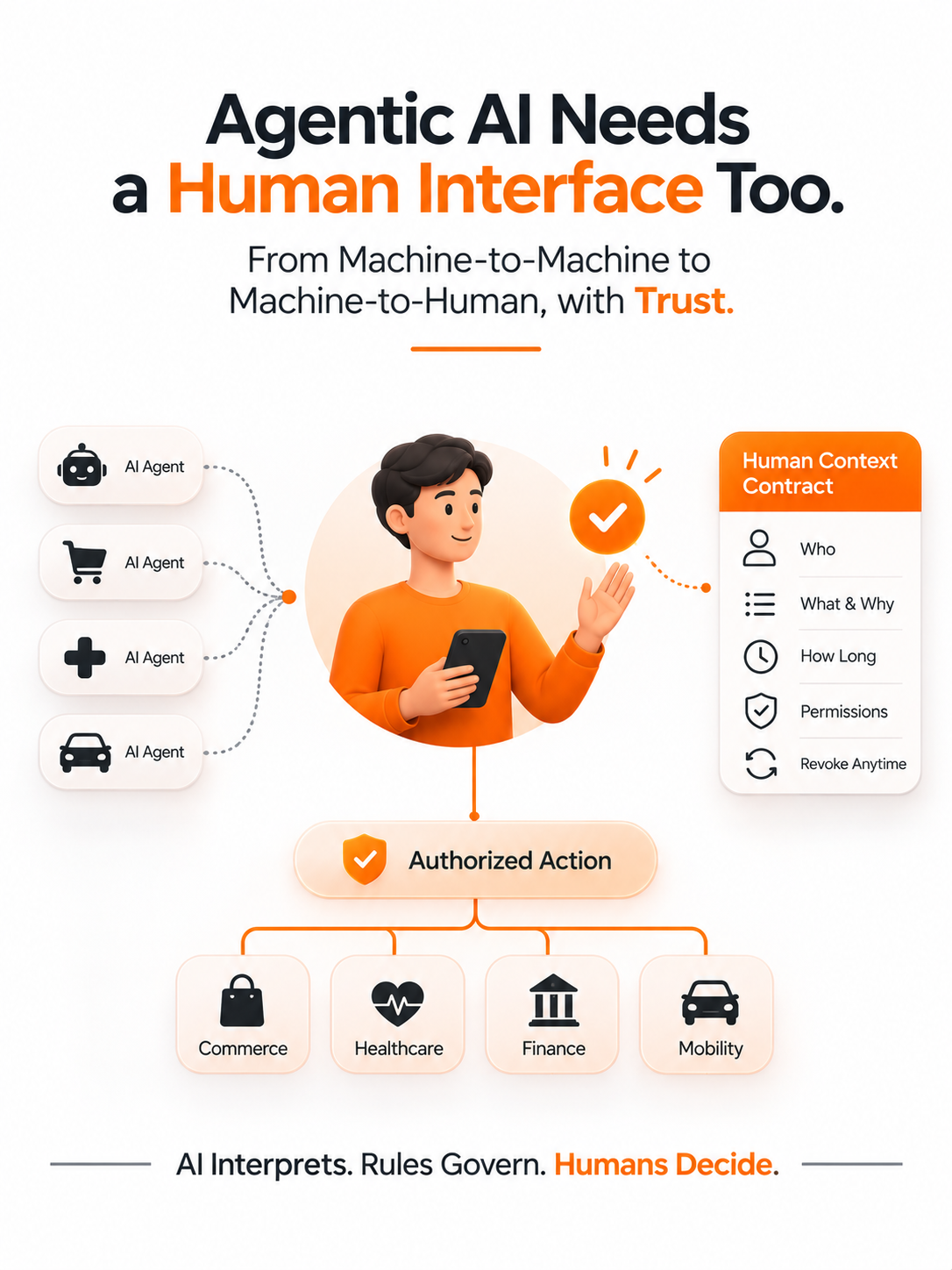
As AI agents gain autonomy, Human Context Contracts could establish a permission-based framework connecting machine interoperability with human agency.
Humans are not APIs. The fact that we can change our minds, attach conditions or simply say no is not an engineering defect. It is agency.”
BOSTON, MA, UNITED STATES, November 20, 2026 /EINPresswire.com/ -- The artificial intelligence industry is establishing technical standards that enable autonomous agents to interact with software, applications, enterprise systems and other AI agents. As these capabilities expand, the question of how AI systems obtain and respect human authorization is emerging as another important infrastructure consideration.— Prithwi R. Thakuria, Founder & CEO of mEinstein
The Model Context Protocol (MCP) provides a standardized mechanism for AI systems to connect with external tools, applications and data. The Agent2Agent (A2A) protocol enables agents developed on different platforms to discover, communicate and coordinate with one another. In April, the Linux Foundation reported that A2A had surpassed 150 supporting organizations and entered production use across multiple industries.
Meanwhile, identity providers and enterprise security platforms are developing mechanisms to assign AI agents distinct identities, permissions and task-specific authority.
These developments are contributing to an interoperable technology stack for agentic AI. However, machine interoperability does not necessarily establish how human intent, private context and authorization should be communicated to autonomous systems.
mEinstein, through its developing Human Intelligence Infrastructure framework, is addressing this distinction with an architecture called Human Context Contracts.
"We are rapidly creating protocols that let machines communicate with machines," said Prithwi Thakuria, Founder and CEO of mEinstein. "The harder interface may be the one between autonomous machines and human agency."
Human Context Contracts are designed to establish structured authorization between individuals and external AI-driven systems. The framework can represent the requesting entity, the information or action required, the intended purpose, authorization duration, permitted disclosure and the specific approval provided by an individual.
The approach addresses a growing distinction in agentic AI: permission to access an enterprise system does not automatically establish permission to use an individual's private information or act on an individual's behalf.
An application programming interface (API) can identify the operations supported by a software system. An agent identity framework can determine which enterprise resources an AI agent is permitted to access. Human Context Contracts address a separate requirement: establishing the context, conditions and authorization governing an interaction involving an individual.
Developments in agentic commerce demonstrate the importance of this distinction.
Google's Agent Payments Protocol (AP2) uses cryptographically signed mandates to represent consumer instructions, constraints and authorization during AI-driven transactions. Mastercard's Verifiable Intent similarly seeks to establish tamper-resistant evidence of consumer approval when an AI agent performs transactions on a consumer's behalf.
These initiatives address the need for reliable evidence of human intent when autonomous systems execute commercial activities without direct human interaction at every stage.
The same requirement may extend into other industries. Healthcare workflows could require verified clinical-trial eligibility and authorization for contact. Financial services applications may require confirmation of a specific readiness condition without accessing an individual's complete financial history. Transportation applications could require verified mobility information without unrestricted access to longitudinal location records.
"The enterprise often does not need the person's entire private history," Thakuria said. "It may need one authorized answer."
Under mEinstein's proposed architecture, an enterprise requirement is translated into a governed request. The relevant private context is evaluated against established permissions, and only an authorized result or action is returned.
The company describes the operating principle as: "AI interprets. Rules govern. Device executes."
Human Context Contracts form part of mEinstein's broader Human Intelligence Infrastructure concept, which connects enterprise AI systems with a private, user-controlled Algorithmic Self-Portrait through a permission layer.
The Algorithmic Self-Portrait represents an evolving model of an individual's real-world context, while the permission framework governs how selected information or authorized actions may be accessed by external systems.
"Humans are not APIs," Thakuria said. "The fact that we can change our minds, attach conditions or simply say no is not an engineering defect. It is agency."
The framework also addresses limitations associated with conventional human-in-the-loop approaches. Traditional systems often request human approval when an action reaches a particular level of consequence. A broader authorization architecture may additionally need to establish which information can be accessed, the purpose of access, applicable conditions, authorization duration and mechanisms for revocation.
As AI agents gain capabilities across information retrieval, inference, negotiation, purchasing and execution, these requirements may become increasingly relevant to enterprise security and AI governance.
The development of interoperable AI protocols has established important foundations for communication between autonomous systems. Human Context Contracts address a complementary infrastructure consideration: maintaining human authority over the context and actions that AI systems are permitted to use.
"Machines have protocols," Thakuria said. "Humans have agency. The missing infrastructure is what connects the two."
Prithwi Thakuria
mEinstein
+1 703-517-3442
Visit us on social media:
LinkedIn
Instagram
Facebook
YouTube
TikTok
X
Legal Disclaimer:
EIN Presswire provides this news content "as is" without warranty of any kind. We do not accept any responsibility or liability for the accuracy, content, images, videos, licenses, completeness, legality, or reliability of the information contained in this article. If you have any complaints or copyright issues related to this article, kindly contact the author above.
