
.jpeg)

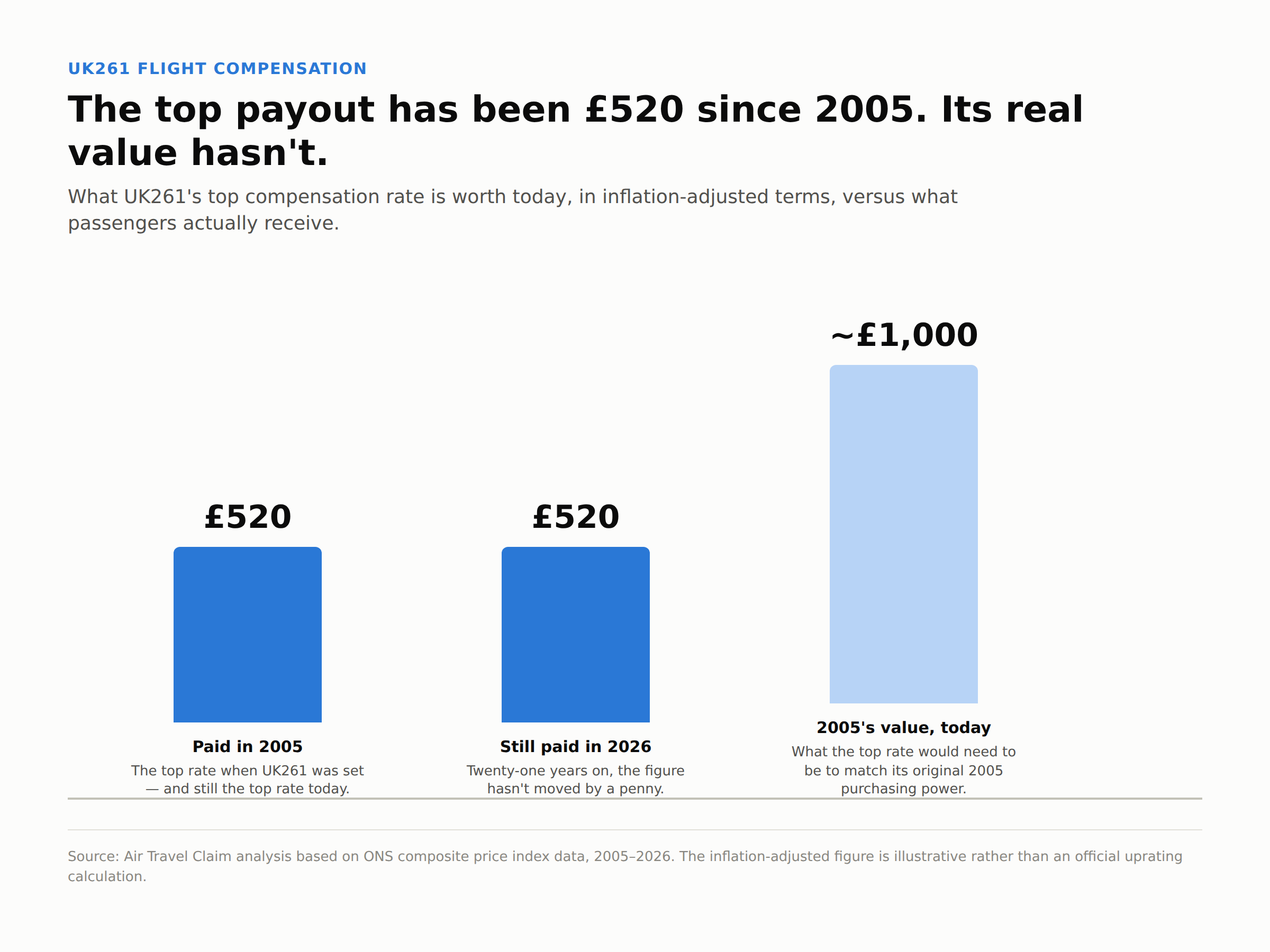
What UK 261's top compensation rate is worth today in inflation-adjusted terms versus what passengers actually receive
Flight disruption compensation - is it going to remain the same amount for another twenty years?
European lawmakers re-wrote the rule book for air passengers who have been affected by flight disruptions. But, they left the compensation amounts untouched.
UK flight compensation hasn’t risen by a penny in twenty years. Brussels has just passed the biggest overhaul of passenger rights in two decades without moving that figure, and Brexit means Britain won’t get even that — Air Travel Claim wants the Department for Transport to reopen the question.
A UK passenger delayed more than four hours on a long-haul flight has been entitled to exactly £520 since February 2005. It was £520 then, and it’s £520 now, despite losing roughly half its real value to inflation in the meantime.
Air Travel Claim, the flight delay and cancellation claims specialist, is calling on the Department for Transport to reopen UK261 and bring compensation back in line with what it was meant to be worth, with a mechanism built in so it can’t drift again.
The £520 that hasn’t moved since 2005
Under UK261 and its EU twin, compensation is fixed by distance: £220 under 1,500km, £350 for 1,500–3,500km, and £260 or £520 for longer flights depending on how late the aircraft lands. The EU figures — €250, €400 and €600 — are identical in substance, just paid in a different currency since Brexit. Neither has risen by a penny since the rules were written.
Matching £220’s original 2005 purchasing power today would mean paying out closer to £440; the top rate would need to be nearer £1,000 — airlines are compensating passengers at roughly half the real value intended. In practice, £520 doesn’t stretch far: a same-day replacement flight routinely costs several times that, before hotels or meals are counted.
Profits have moved. The compensation hasn’t.
The airlines paying it have not stood still. Ryanair’s profit after tax was €226.6 million in the year Regulation 261/2004 was adopted; by the year to March 2025 it was €1.61 billion, more than seven times as much. IAG, British Airways’ parent, posted record annual profits of €4.4 billion in 2024. Air Travel Claim isn’t arguing compensation should be tied to profit, only that an industry this much more profitable can hardly call inflation-linked compensation unaffordable.
Europe rewrote the rulebook. It left the number alone.
MEPs voted through the first real overhaul of EU261 since it was written on 7 July 2026, by 646 votes to 12: free cabin bags, a ban on no-show penalties, standardised claims forms. It’s the biggest shake-up passenger rights have had in two decades — yet the compensation itself, €250, €400 and €600, survives exactly as written in 2004. Brussels rewrote the rulebook and left the number alone.
Brexit means Britain won’t even get that much
UK261 was carried into domestic law after Brexit as a fixed snapshot of the old EU rules, not one that tracks whatever Brussels does next, so the 2027 reform stops at Dover. Unless Westminster acts separately, British passengers will keep flying under the 2004 rulebook once their European neighbours move on — not because Parliament decided the UK version was better, but because nobody decided anything at all.
One passenger, one trip, two rulebooks
It isn’t only different passengers who end up on different sides of this divide — increasingly, it’s the same one. Coverage is decided leg by leg, by where each flight departs from, and booking a trip as two separate one-way tickets, rather than one return fare, is now routine with budget carriers.
Take a passenger booking a long weekend in Amsterdam this way: one ticket out of Birmingham, one back from Amsterdam. The outbound leg falls under UK261, the return under EU261, regardless of airline. From mid-2027, if both flights were disrupted, that passenger would face two different rulebooks within one trip — the 2005-era process outbound, the reformed 2027 version, rebooking guarantee included, on the way back — and two entirely different claims processes to be compensated. Nothing about the passenger has changed, only the airport they happened to be departing from.
A number that reviews itself is not too much to ask
Air Travel Claim isn’t asking for the compensation model to be redesigned. A fixed, guaranteed sum paid without a fight is still right, and it’s why the system works for most claims. The ask is narrower: uprate the amounts to catch up two decades of inflation, and link them to the Consumer Prices Index going forward, the way the state pension and minimum wage already are.
“Nobody sat down in 2026 and decided £520 was still right for a long-haul cancellation — it’s just the number nobody’s revisited since 2005,” said Steve Reid, Passenger Advocate at Air Travel Claim. “Wages get reviewed. Pensions get reviewed. This is one of the only fixed payments in consumer law left to quietly go out of date on its own, and passengers are absorbing the difference. We’re not asking for anything exotic, just for the Department to do what it already does with every other statutory payment.”
What happens next
Air Travel Claim has written directly to Heidi Alexander MP, the Secretary of State for Transport, asking the Department to open a review of UK261, uprate compensation to reflect inflation since 2004, and introduce a mechanism to keep it current. The firm is inviting MPs, consumer groups and fellow claims specialists to back the call.
About Air Travel Claim
Air Travel Claim helps UK and EU passengers pursue compensation for flight delays, cancellations and denied boarding under UK261 and EU261. The company campaigns on passenger rights alongside its claims-handling work.
Note to editors: UK261/EU261 figures and the 2026 EU reform timeline are drawn from the Civil Aviation Authority and Regulation (EC) 261/2004. Airline profit figures are drawn from Ryanair’s and IAG’s published results. The inflation comparison is based on ONS composite price index data, 2005–2026, and is illustrative rather than an official uprating figure. A copy of the letter to the Secretary of State for Transport is available on request.
Steve Reid
Air Travel Claim
+44 7912 021160
email us here
Legal Disclaimer:
EIN Presswire provides this news content "as is" without warranty of any kind. We do not accept any responsibility or liability for the accuracy, content, images, videos, licenses, completeness, legality, or reliability of the information contained in this article. If you have any complaints or copyright issues related to this article, kindly contact the author above.
