
.jpeg)

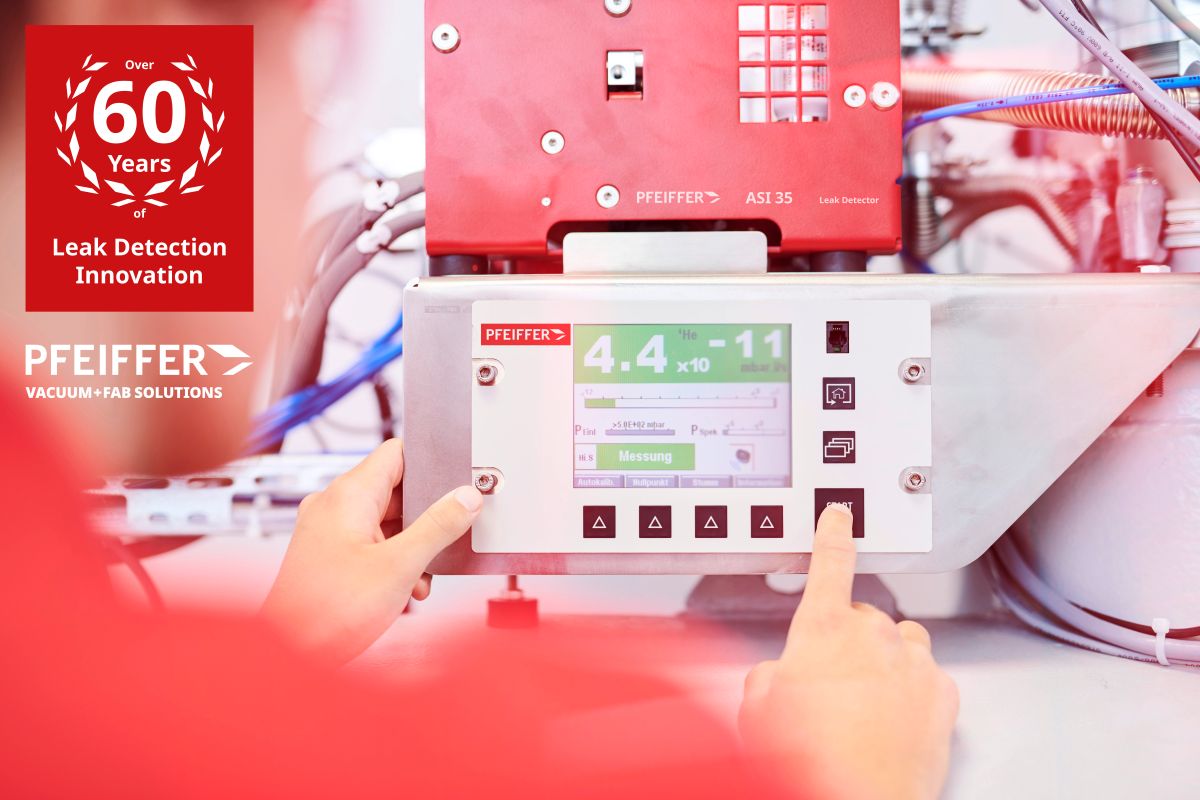
Leak rate is not a single, fixed number. It is shaped by various factors including pressure, temperature, leak location and gas type. Source: Pfeiffer Vacuum+Fab Solutions.
ASSLAR, GERMANY, September 22, 2026 /EINPresswire.com/ -- In standards terminology, for example EN ISO 20484, leakage rate is the quantity of a specific fluid that passes through a leak under specific conditions. Consequently, this leakage flow can change with operating conditions such as pressure, temperature, and other environmental conditions. This distinction matters in practice, as a leak that appears manageable under one set of conditions can become a significant source of inefficiency or process instability under another. Understanding what the term leakage rate actually means, how it is measured, what influences it, how it affects process consistency, and why it matters for your system's design margin, is essential for anyone responsible for operating or maintaining a vacuum process.
Unit of leak rate explained
The most commonly used unit for leakage rate is mbar·l/s (millibar liters per second). To understand leak rates, we first need to consider how gases behave. As gases are compressible, the amount of gas that could pass through a leak cannot be described by volume or pressure alone. If gas leaks from the surrounding environment into a vacuum system which is at a lower pressure, it will expand. For this reason, the amount of gas is expressed as the product of pressure times volume (p·V), in the unit mbar·l.
Leakage rate also needs a dimension of time to describe the amount of gas moving through a leak during a given period. This formula would therefore be p·V/t, expressed in mbar·l/s. A simple way to visualize p·V is a gas cylinder: a 50 liter cylinder at 200 bar contains 10,000 bar·l of gas quantity, or 10,000,000 mbar·l. This illustrates why pressure and volume must be considered together when comparing gas quantities, since neither volume or pressure alone are sufficient to describe an amount of gas.
In a pressure rise test, the system volume is therefore an essential part of the calculation. The same pressure increase over the same time represents a much larger amount of gas in a large chamber than in a small one. For this reason, the result must always be interpreted in relation to the tested volume: leakage rate = (ΔP × V) / t.
Breaking it down:
• mbar: the pressure component, reflecting how compressed the gas is
• liter: the volume component
• per second: the time interval over which the amount of gas leaking is measured
It is also worth noting that equivalent units are in common use depending on industry and geography. Pa·m³/s, Torr·l/s, and sccm (standard cubic centimeters per minute) may all be encountered. Care should be taken when comparing specifications expressed in different units. To support this, a unit converter can be used to quickly convert between common leakage rate units and avoid misinterpretation when comparing values.
Factors influencing leak rate
The rate at which gas passes through a leak is not a fixed value. It changes with operating conditions and is affected by several factors. Understanding these helps operators interpret measurements correctly and avoids drawing the wrong conclusions.
The effect of pressure
Pressure difference across a leak is the difference in pressure from inside the vacuum system compared to outside. Of course, this is also valid for pressurized systems against atmospheric or reduced pressure. In general, the higher the pressure difference, the greater the leakage rate, as pressure difference drives gas flow. However, the relationship is not quite this straightforward and does not increase indefinitely as vacuum deepens.
At a certain critical value, the pressure difference does not determine the leak flow any longer. After the transition to the so-called choked flow regime, a further pressure reduction does not increase the mass flow any longer. It is important to note however, that gas leaking in will expand to a greater volume as vacuum deepens, resulting in a greater volumetric flow rate for the vacuum pump to handle.
The effect of temperature
Temperature influences leak rate in two ways: through the gas itself and through the material of components within the system. Gas molecules move faster at higher temperatures, increasing flow through a given leak path. More significantly, sealing materials such as O-rings, gaskets, and polymer hoses expand and contract with temperature, hardening and contracting in the cold, softening and potentially deforming in the heat. In addition, temperature also has an influence on the permeability of materials used in vacuum systems. This is most important for elastomers which can show a significant increase in permeability with increasing temperature.
A system that shows no measurable leak at ambient temperature may develop one once it reaches normal operating temperature, or vice versa. Systems that cycle through wide temperature ranges should always be tested under representative operating conditions.
The effect of leak position
While the vacuum pump is actively pumping, a pressure gradient exists along the system, lowest at the pump inlet, progressively higher towards the process end. In compact systems with short pipework, the gradient is minimal, whereas longer or more restrictive pipework makes it more pronounced.
A leak near the pump inlet therefore experiences the greatest differential between internal and atmospheric pressure, producing the highest leak rate for a given defect size. A similar defect positioned closer to the process, where pressure is higher and the differential smaller, will admit less gas.
The effect of gas type
Gas type also plays a role, and the relevant mechanism depends on the pressure inside the system. At higher pressures, where gas molecules are closely packed and move together, the viscosity of the gas governs how readily it passes through a leak. At lower pressures, where molecules move more independently with greater distance between them, molecular weight becomes the dominant factor, with lighter molecules passing through more readily.
This is particularly relevant in processes that use gases other than air, such as nitrogen, argon, refrigerants, hydrogen or other inert gases, where the actual leak rate may differ from what an air-based test would suggest.
Leak rate’s effect on process consistency
Since pressure and temperature both influence leak rate, and in most applications, neither stays constant in practice, the effective leak rate is not a fixed value. As operating conditions shift, the leak rate shifts with them. This introduces variability into the process that can be difficult to trace back to its source.
The consequence of this variability differs from process to process. In heat treatment, if the leak rate differs between batches, the atmosphere inside the chamber varies, leading to inconsistent oxidation and unpredictable surface quality. In chemical processes, a varying leak rate means subtly different vacuum conditions across batches, which can shift reaction rates and affect product consistency.
Leak rate’s effect on system design margin
Not every leak causes an immediate process failure, which can create a false sense of security. Often, if the system still performs, the leak is deemed acceptable and left unaddressed.
What this overlooks is design margin. Vacuum processes are designed with a degree of spare pumping capacity to account for real-world operating conditions. A leak quietly consumes this margin. The system continues to function, but with less tolerance for anything else that makes additional demands such as a degrading seal elsewhere, a change in process conditions such as an increased vapor load, or simply the continued deterioration of other components over time.
By the time the leak causes a noticeable problem, the margin has already been eroded. What began as an acceptable leak rate has become the reason the system can no longer cope.
A leak does not always cause failure. It consumes the safety margin until failure becomes inevitable.
Summary
Leak rate is not a single, fixed number. It is shaped by various factors including pressure, temperature, leak location and gas type. A leak that appears insignificant under one set of conditions can prove to be significant under another. Understanding what drives leak rate is what allows you to manage it effectively.
Practical takeaway
• Test under operating conditions. Leak rate measurements taken at ambient temperature or rough vacuum may not reflect real-world performance.
Test under representative operating conditions.
• Account for system volume. A large system can mask a significant leak in testing. When using a pressure rise method, the result must be interpreted in
the context of the system volume: leak rate = (ΔP × V) / t.
• Define what is acceptable for your process. There is no universal acceptable leak rate. Set your threshold based on your process requirements and the
design safety margin available, not general rules of thumb.
• Track leak rate over time. A single measurement tells you little. A rising trend tells you that your margin is being consumed and action is needed before
performance is affected.
• Do not wait for failure. By the time a leak causes a visible problem, the design margin is already gone. Build leak rate checks into your regular
maintenance program and act on deterioration early, in a planned way.
Dr Sandra Thirtle-Höck
Pfeiffer Vacuum+Fab Solutions
+49 6441 8021460
email us here
Visit us on social media:
LinkedIn
YouTube
Legal Disclaimer:
EIN Presswire provides this news content "as is" without warranty of any kind. We do not accept any responsibility or liability for the accuracy, content, images, videos, licenses, completeness, legality, or reliability of the information contained in this article. If you have any complaints or copyright issues related to this article, kindly contact the author above.
