


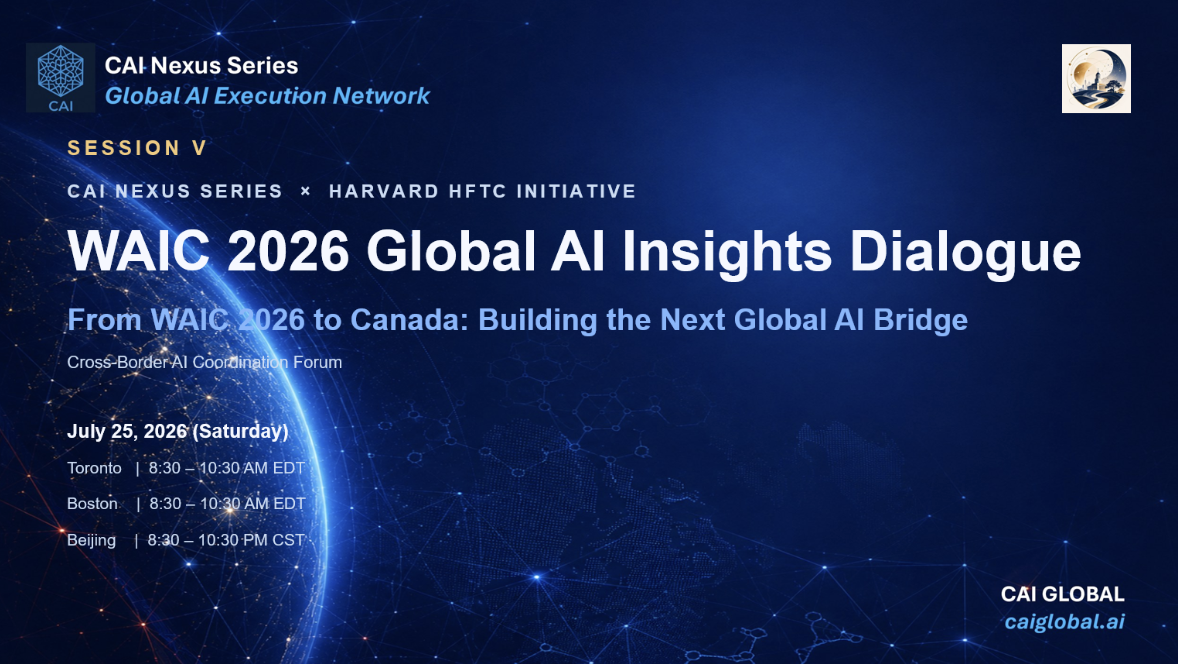
The WAIC 2026 Global AI Insights Dialogue, hosted online by CAI Global and the Harvard Frontier Techne Club Initiative (HFTC) on July 25, 2026.
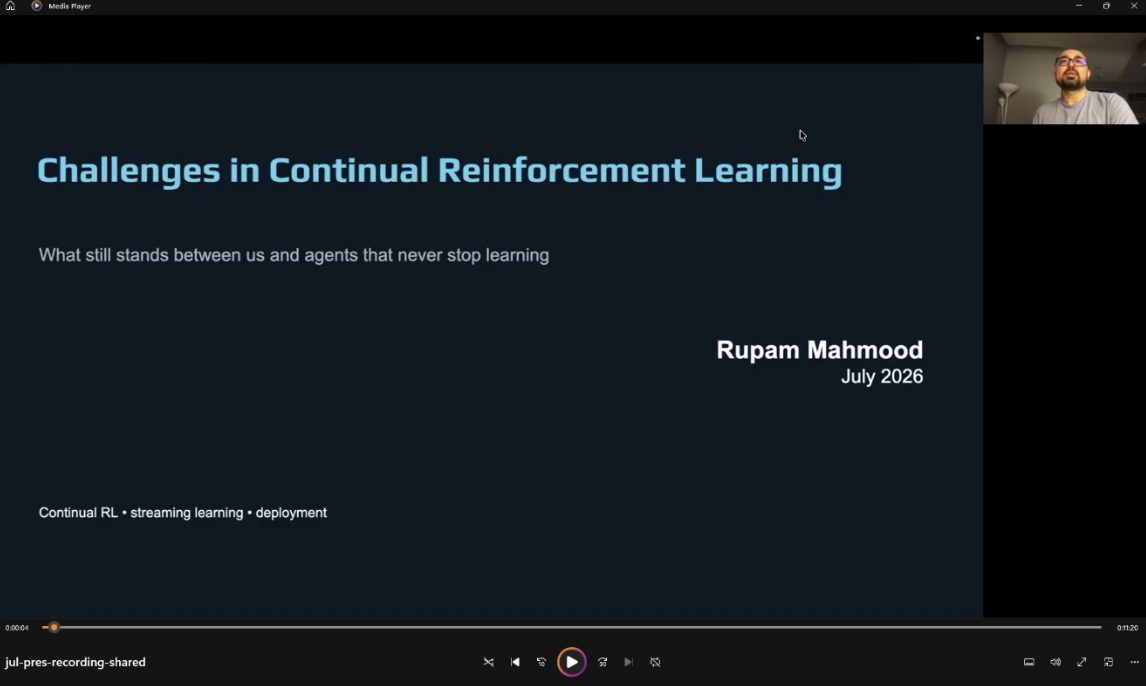
A. Rupam Mahmood of the University of Alberta delivers a recorded presentation on the challenges of continual reinforcement learning.
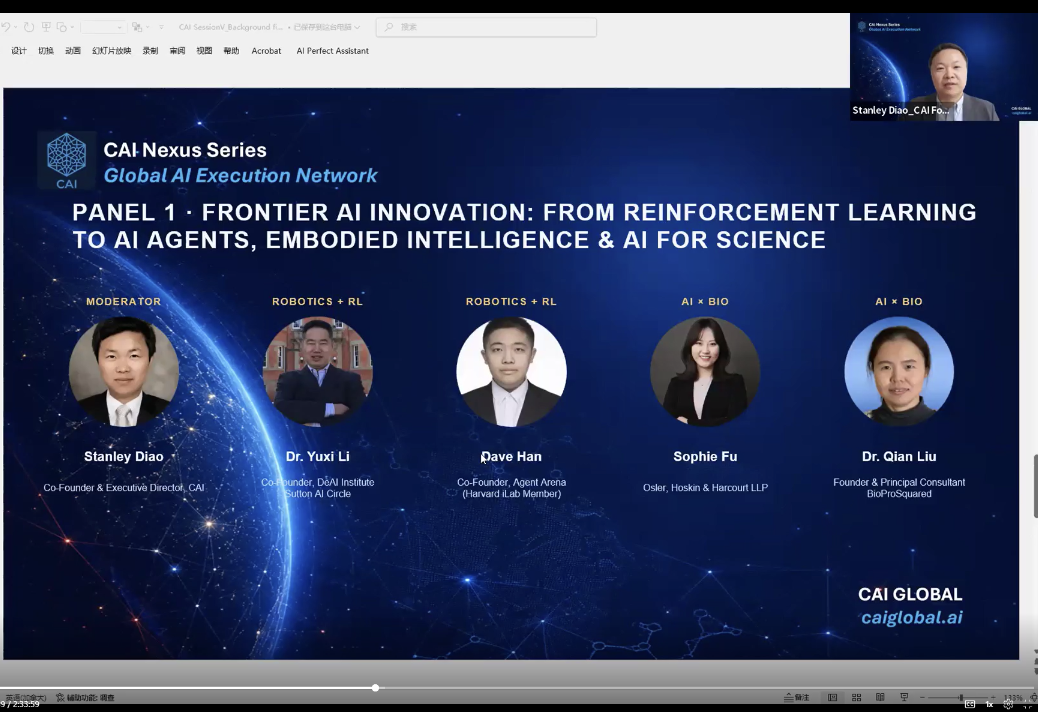
Panel 1 on frontier AI innovation, moderated by CAI Global founder Stanley Diao, covers reinforcement learning, AI agents, embodied intelligence and AI for Science.
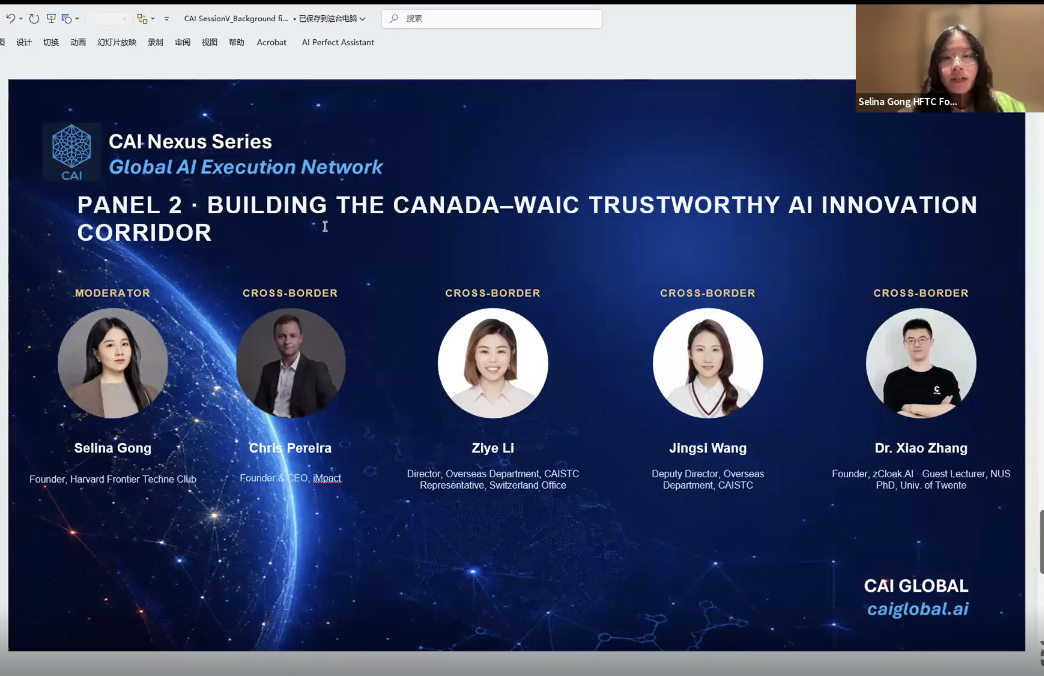
Panel 2 on building the Canada–WAIC trustworthy AI innovation corridor, moderated by HFTC founder Selina Gong.
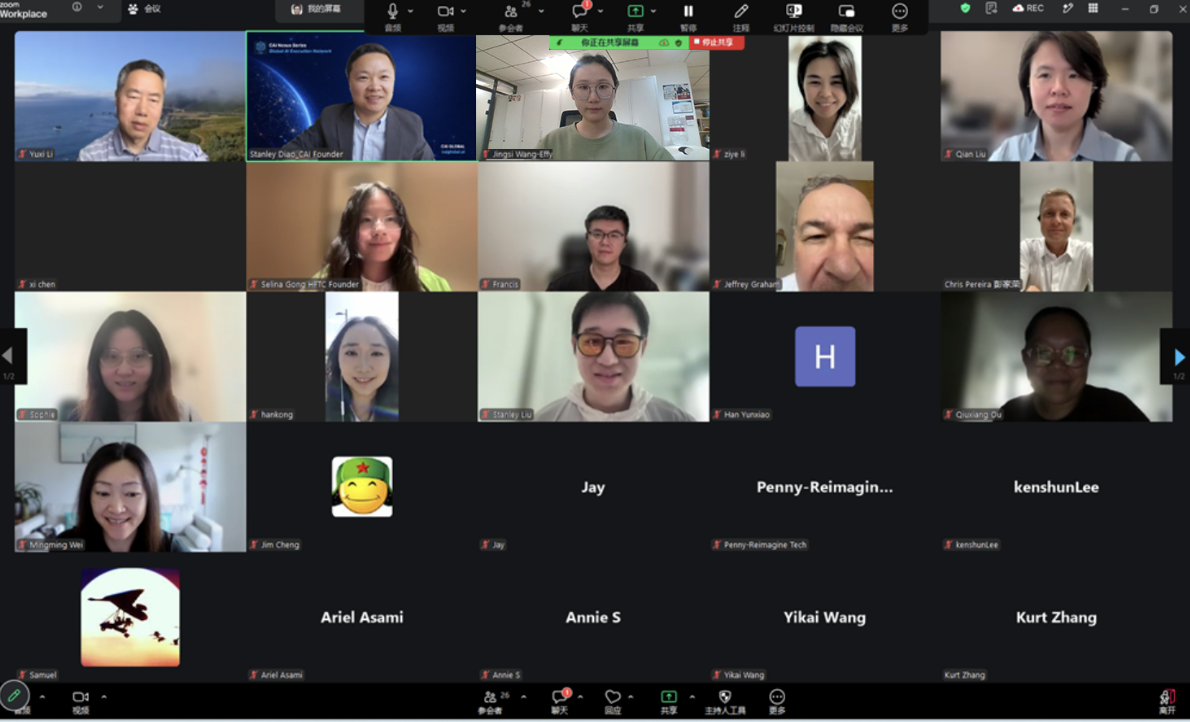
61 participants from more than 50 organizations across Canada, Asia and beyond joined the online dialogue.
CAI , together with the HFTC convened researchers, entrepreneurs and ecosystem leaders from Canada, Asia and beyond to advance trusted AI collaboration.
TORONTO, CANADA, August 5, 2026 /EINPresswire.com/ -- CAI (Canada–Asia Council for AI and Digital Innovation), together with the HFTC(Harvard Frontier Techne Club Initiative) and global innovation ecosystem partners,, hosted Canada’s first WAIC 2026 Global AI Insights Dialogue on July 25, 2026, connecting AI researchers, entrepreneurs and ecosystem leaders across Canada, Asia and beyond.Global AI Innovation Forum Brings Together Leading Experts and Organizations to Explore the Future of AI
The forum has confirmed participation from distinguished speakers and representatives from leading global institutions, including the Canadian Academy of Engineering, Alberta Machine Intelligence Institute (Amii), CIFAR,Harvard, Agent Arena, Cohere, Draper, and the National University of Singapore (NUS). The event will convene global experts and innovators to exchange insights on critical topics shaping the future of artificial intelligence, including AI Agents, Embodied Intelligence, AI for Science, and AI Governance.
The forum has attracted 61 global participants representing more than 50 organizations, spanning world-class universities, research institutes, technology companies, investment organizations, and innovation ecosystems. Participating organizations include the University of Toronto, Vector Institute, University of Pennsylvania, Tsinghua University, Fudan University, Harvard Kennedy School, Meta, ByteDance, Rogers, Bell Canada, Airwallex, BMO, and Osler, among others.
Through cross-sector dialogue and international collaboration, participants will explore emerging opportunities and challenges in AI Agents, AI for Science, Embodied Intelligence, AI Governance, and global innovation partnerships. The forum aims to strengthen connections between academia, industry, investors, and innovation communities, fostering collaboration across Canada, Asia, and the global AI ecosystem.
The dialogue built on insights from WAIC 2026, where Canada’s AI leadership was represented by contributions from leading Canadian AI researchers, including Turing Award recipients Richard S. Sutton, Yoshua Bengio and Gilles Brassard. Opening remarks came from Huijuan Mu, deputy secretary-general of CAISTC, and Hugh H.T. Liu, professor at the University of Toronto Institute for Aerospace Studies and Fellow of the Canadian Academy of Engineering. Mu emphasized trust and practical international cooperation;Prof Liu connected Canadian research strengths with Asia’s capabilities in manufacturing, engineering, and technology deployment. In a recorded presentation,Prof A. Rupam Mahmood, associate professor at the University of Alberta, Canada CIFAR AI Chair and Amii Fellow, explained that most models are frozen after training, whereas continual learning requires adaptation after deployment. He identified hyperparameter sensitivity and run-to-run variation as barriers to reliable continual learning; his related research on loss of plasticity appeared in Nature.
Panel 1, moderated by CAI Global’s Stanley Diao, featured DeAI Institute co-founder Yuxi Li on learning through real-world interaction; Agent Arena co-founder and Harvard iLab member Dave Han on multi-agent orchestration; BioProSquared founder and principal consultant Qian Liu on the gap between computational screening and real-world validation; and Sophie Fu, an associate at Osler, Hoskin & Harcourt LLP, on clarifying responsibility for AI outputs in contracts and separately conducting due diligence on training-data sources.
Panel 2, moderated by Harvard HFTC founder Selina Gong, featured iMpact founder and CEO Chris Pereira on trust and local relationships in market entry; Jingsi Wang from CAISTC’s international collaboration team on problem-led co-development and sustained follow-up; Ziye Li from CAISTC’s international collaboration team, representing its Switzerland-based network on partner matching and localization; and zCloak.AI founder and National University of Singapore guest lecturer Xiao Zhang on product-market fit and data protection.
The forum was supported by Quakers Venture Club at Penn, Cyberport x Draper Dragon Joint-Accelerator Program (CDDJAP), Agent Arena, AllScale and Siyuan AI Box. “AI’s future won’t be built by one country or one organization. It will be built through collaboration across research, industry, investment and entrepreneurship” said Stanley Diao, Founder of CAI Global.
Shunxin Pang
HashMatrix
+1 416-605-0175
email us here
Legal Disclaimer:
EIN Presswire provides this news content "as is" without warranty of any kind. We do not accept any responsibility or liability for the accuracy, content, images, videos, licenses, completeness, legality, or reliability of the information contained in this article. If you have any complaints or copyright issues related to this article, kindly contact the author above.
