



Corporate Logo ForTest 2026
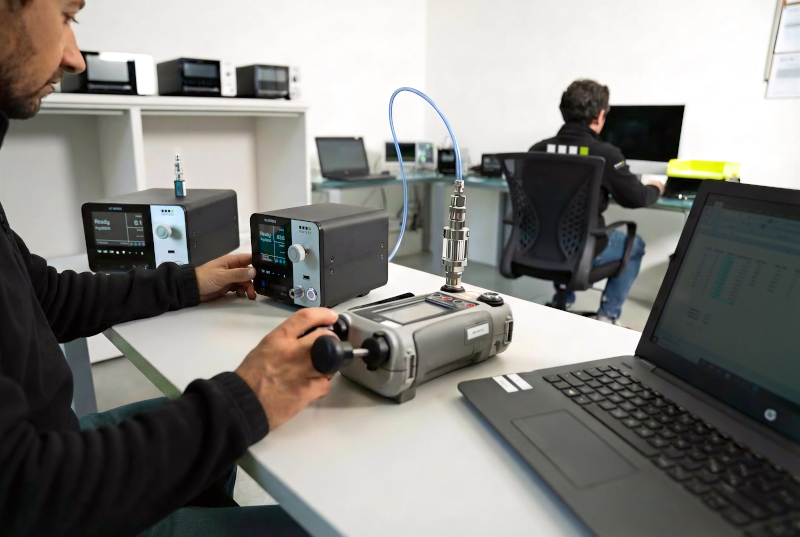
Use of ForTest leak tester in metrology laboratory
Die Casting Industry
ForTest explains the difference between calibration and adjustment, and why both keep compressed-air leak and flow testers reliable.
MODENA, ITALY, June 25, 2026 /EINPresswire.com/ -- In everyday technical language, the words "calibration" and "adjustment" are often used interchangeably. From a metrological standpoint, however, they describe two distinct operations with very different purposes. ForTest, a manufacturer of compressed-air leak and flow test instruments, is highlighting this distinction because, on a production line, it is exactly what separates a reliable quality control from a costly mistake.
In a leak or flow testing system, everything depends on the instrument's ability to read tiny pressure drops — sometimes fractions of a Pascal — or very small mass-flow rates, on the order of a few cubic centimetres per minute. An apparently negligible error on the pressure sensor or the mass-flow sensor can let a defective part pass, or wrongly reject a good one. Understanding the difference between verifying an instrument and correcting it is therefore not a formality, but a strategic part of the production process.
Calibration is the verification of an instrument's performance by comparison against a certified reference standard. During this operation, no modification is made: the instrument's reading is simply compared with the value supplied by the reference, traceable to national or international standards. In leak testing, that reference has a precise name — the certified calibrated leak, such as the ForTest T0710 and M0710. These are sintered stainless-steel elements that generate a known, stable micro-leak, supplied with an SIT-traceable calibration certificate. By connecting the calibrated leak to the test instrument, an operator can verify whether the leak tester actually reads the expected leak value within tolerance. The same principle applies to flow testing, where the mass-flow sensor readings are compared against a certified flow reference.
The purpose of calibration is to determine the measurement error, the linearity, and the repeatability of the instrument over time. It produces data and a certificate documenting the state of the instrument at the moment of the check. In practice, calibration corrects nothing: it provides a precise, traceable photograph of the health of the test system. This is indispensable in ISO-certified environments, where metrological traceability is an integral part of the quality control cycle.
Adjustment comes afterward and has a corrective function. If calibration reveals deviations beyond acceptable limits, the instrument is regulated to bring its measurements back within the required parameters. On a compressed-air test station, this can mean recalibrating the pressure and mass-flow sensors, applying software compensation for drift, or fine-tuning the closed-loop electronic pressure regulation, as in the Real Flow Output (RFO) technology of the ForTest T9740. After an adjustment, a new verification calibration is normally carried out to confirm that the residual error falls within the operating specifications.
The relationship between the two is best summed up simply: calibration tells you how your leak tester is behaving, while adjustment ensures that behaviour stays within what is required. The first is diagnosis; the second is the cure. They are complementary, sequential activities, not alternatives.
Both operations directly benefit the instruments themselves. Pressure and mass-flow sensors, stressed by thousands of cycles a day, can develop slight drift that periodic calibration catches before it becomes a problem. Leak testing is highly sensitive to temperature differences between the air and the part under test, and regular metrological checks ensure the instrument measures the real leak rather than a thermal artefact. When working at resolutions of 0.1 Pa or with leaks starting from 10 cc/h, even a minimal deviation matters, and verification with a certified calibrated leak confirms that the declared sensitivity is still effective. The result is fewer false-good and false-reject decisions, with a direct impact on perceived quality and production costs.
For manufacturers, the value extends across the whole process. Metrological management of test instruments is not an administrative procedure but a strategic lever. In sectors where tightness is a safety and functional requirement — automotive, aerospace, medical, gas, pneumatics and appliances — an unreliable check can lead to product recalls, energy waste from undetected micro-leaks that overwork the compressor, and defects that are hard to spot in early production stages. A structured programme of calibration and adjustment delivers traceability toward certified standards, repeatable and compliant end-of-line controls even on high-throughput benches, documented validation useful during audits, and the confidence of the final customer.
ForTest designs its instruments — from the K and T series test stations to the certified calibrated leaks — so that metrological rigour, ease of use and reliability coexist in the same product. For those who run tests every day, understanding the role of calibration and adjustment means improving operational reliability and quality control. As the company puts it: we know the leak.
About ForTest: ForTest designs and manufactures compressed-air leak and flow test instruments for industrial quality control, serving sectors including automotive, aerospace, medical, gas and pneumatics. The ForTest technical team is available to advise on selecting the most suitable test instrumentation and reference standards for each production need.
Fabrizio Benatti
ForTest Italia Srl
+39 059 557250
email us here
Legal Disclaimer:
EIN Presswire provides this news content "as is" without warranty of any kind. We do not accept any responsibility or liability for the accuracy, content, images, videos, licenses, completeness, legality, or reliability of the information contained in this article. If you have any complaints or copyright issues related to this article, kindly contact the author above.
