
.jpeg)
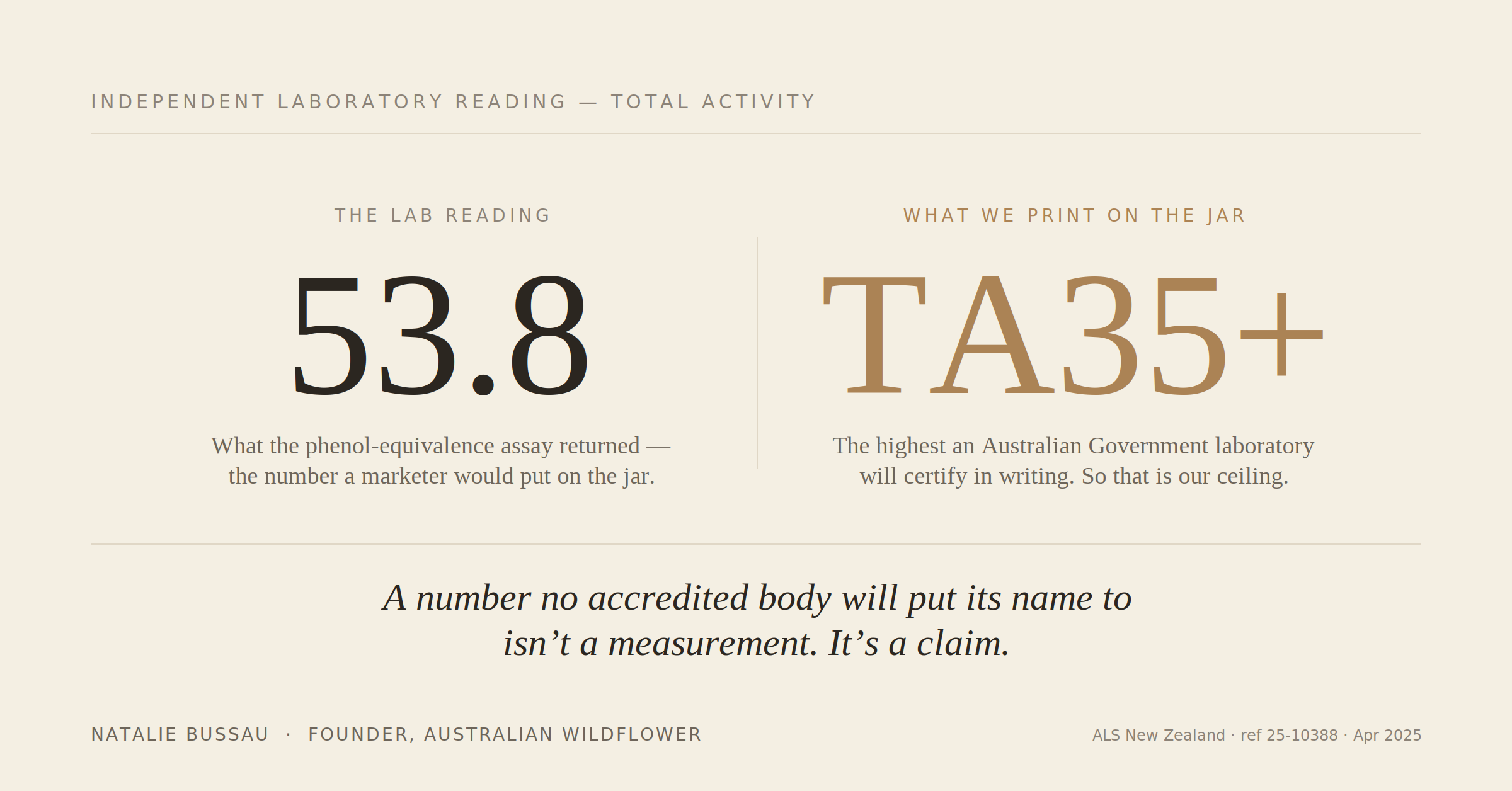
Australian Wildflower's flagship Jarrah honey returned a phenol-equivalence reading of 53.8 but is labelled TA35+ - the highest figure an Australian Government laboratory will certify in writing.
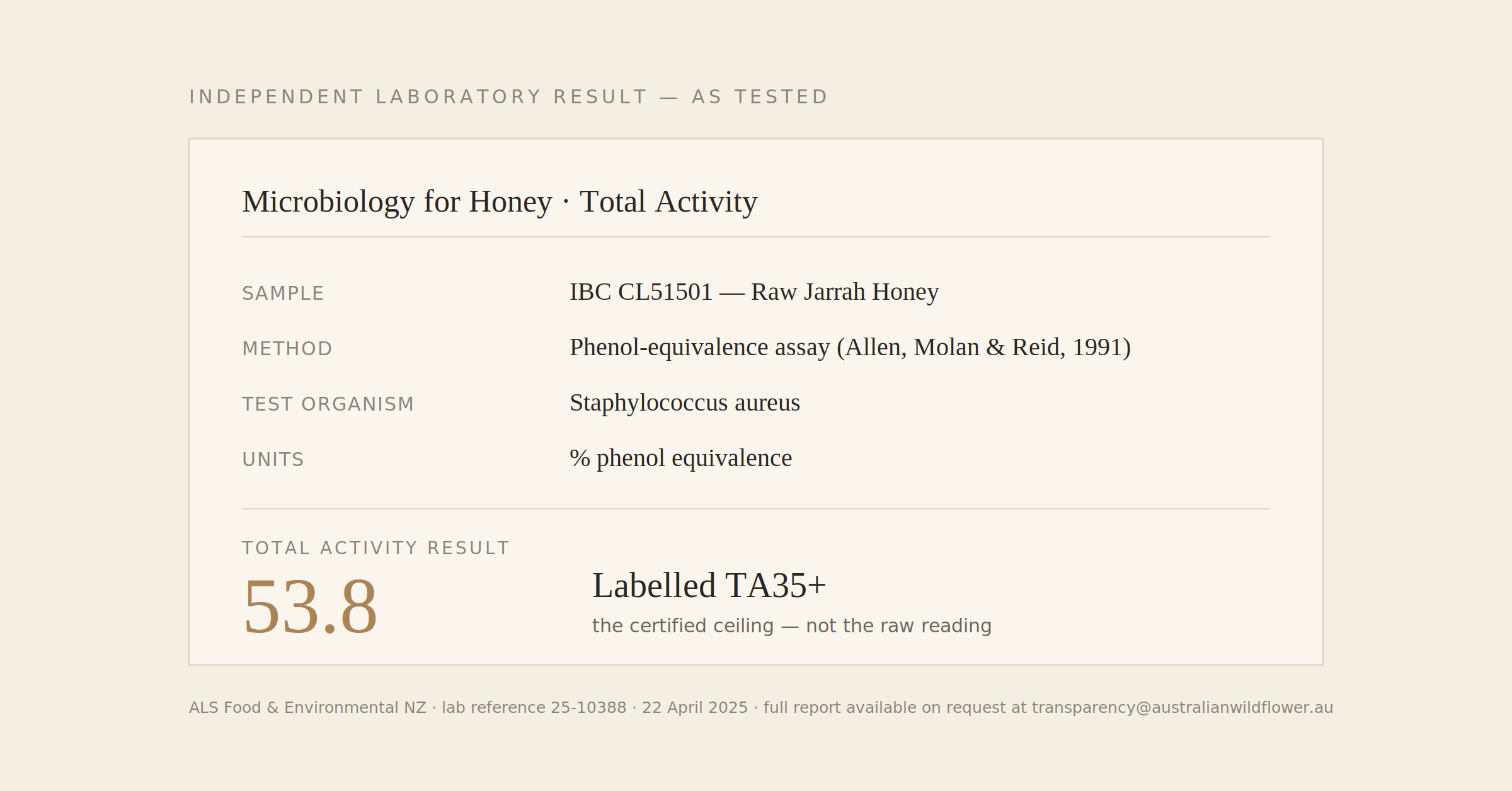
The independent laboratory result for Australian Wildflower's Jarrah honey - a Total Activity reading of 53.8, labelled TA35+.
The producer explains why it will not print the higher number its own independent testing returned: it is a figure no accredited laboratory will certify.
WEST PERTH, WESTERN AUSTRALIA, AUSTRALIA, August 13, 2026 /EINPresswire.com/ -- Australian Wildflower, a single-origin honey producer sourcing from the Southwest Australia Biodiversity Hotspot, has set out why its flagship Jarrah honey carries a TA35+ label even though an independent laboratory recorded a Total Activity reading of 53.8 for the batch.
The choice runs counter to a common pattern in the active-honey category, where a higher printed number is treated as a mark of quality. The company's position is that a figure no accredited body will certify is not a measurement but a claim.
"I paid an accredited laboratory to test my honey, and it came back at 53.8," said Natalie Bussau, Founder of Australian Wildflower. "I'm choosing not to sell you that number. A figure no accredited body will put its name to isn't a measurement - it's a claim."
What the number actually measures
The 53.8 reading comes from a phenol-equivalence assay - a long-established method that expresses a honey's total antibacterial activity as an equivalent percentage of phenol, measured against a single reference organism (Staphylococcus aureus) under laboratory conditions. A TA35 honey, for example, inhibits bacterial growth as effectively as a 35% phenol solution.
The method has a ceiling. Australia's National Measurement Institute reports a specific figure only up to TA35, designating any higher result as "greater than 35% Total Activity" - not because the honey is weak, but because above that point the assay cannot separate one high value from another with confidence. The largest peer-reviewed study of this activity recorded values only up to about TA26. A reading of 53.8 therefore sits beyond the range any accredited body will certify as a specific number. Australian Wildflower sets out the full explanation in a published article on why ratings above TA35+ cannot be scientifically certified.
Why the company points to the report, not just the result
The laboratory report behind the reading - issued by ALS New Zealand and available to customers on request since testing - runs to two pages, and the company draws attention to details a headline figure alone would obscure: the calculation relies on an assumed honey density averaged from prior experiments rather than measured for this batch; the assay itself was performed by a subcontracted laboratory; and the result reflects activity against one organism on one day.
"None of this makes the report inaccurate," said Bussau. "It makes it honest. It's a precise-looking number built on approximations underneath - and buyers deserve to see that, not just the figure."
The company also notes that a single reading is a snapshot rather than a fixed property. Jarrah's antibacterial activity is driven largely by hydrogen peroxide, which diminishes with exposure to heat, light and time. A value measured at harvest is therefore not necessarily the value in a jar opened months later - a further reason the company prefers a conservative, certifiable label to a precise-looking maximum.
The broader point
Australian Wildflower framed the position as part of a wider commitment to verifiable transparency: every batch carries a number traceable to a named laboratory, with the full Independent Testing Summary available to download and the original signed reports available on request through its Transparency Hub.
"A high number on a label isn't education," said Bussau. "It's a bet that you won't ask how the number was made - which lab, which batch, which method. We would rather answer the question before it's asked."
About Australian Wildflower
Every producer in this category makes excellent honey. While they pack the harvest, we taste and test the beekeeper's finest - and select the single best batch.
Jarrah trees only exist within the Southwest Australia Biodiversity Hotspot - one of only 36 recognised biodiversity hotspots on Earth. Jarrah flowers for two months, once every two years. Only 100–150 tonnes of Jarrah honey are produced a year - roughly twenty times rarer than Manuka.
Each year, Australian Wildflower works with our beekeepers and scientists to identify the single highest-performing batch of the entire harvest for each of our honeys - not the range, not a blend of good batches. One IBC.
We jar it, re-test it, and stop. Maximum 6,000 jars a year. It is not a volume constraint. It is the standard.
Every honey is single-origin and never blended, raw and cold-extracted, and tested pre-extraction and post-packing, with glyphosate and related chemicals not detected. Our independent testing partners include ALS New Zealand, which is IANZ ISO/IEC 17025 accredited. Full testing summaries are published at australianwildflower.au/transparency-hub.
Notes to editors / methodology
Batch: Jarrah, IBC CL51501. Independent laboratory report: ALS Food & Environmental NZ, reference 25-10388, April 2025. The report has been available to customers on request since testing; this release is an explanatory statement, not a first publication of the report.
Method: phenol-equivalence assay for total antibacterial activity (Allen K.L., Molan P.C. & Reid G.M., 1991, Journal of Pharmacy and Pharmacology, vol. 43, pp. 817–822); calibration against 2%–7% phenol reference standards; assumed honey density 1.35 g/mL; assay subcontracted to CAIQTEST (Pacific) Ltd.
Certification ceiling per the National Measurement Institute of Australia: results above range reported as "greater than 35% Total Activity."
Peer-reviewed basis for the ceiling: Cokcetin et al. (2016), PLOS ONE, DOI 10.1371/journal.pone.0167780 (highest recorded activity in the study equivalent to TA26+).
Full report and references: australianwildflower.au/transparency-hub
Natalie Bussau
Australian Wildflower Honey
email us here
Visit us on social media:
LinkedIn
Instagram
Facebook
YouTube
TikTok
Legal Disclaimer:
EIN Presswire provides this news content "as is" without warranty of any kind. We do not accept any responsibility or liability for the accuracy, content, images, videos, licenses, completeness, legality, or reliability of the information contained in this article. If you have any complaints or copyright issues related to this article, kindly contact the author above.
