


How Charlotte-area property managers make the call, and why waiting too long turns a drying job into mold remediation.
What maintenance often can't see is what's happening behind the wall, underneath flooring, or inside adjoining spaces.”
CHARLOTTE, NC, UNITED STATES, July 31, 2026 /EINPresswire.com/ -- Every water damage report begins as a judgment call. Maintenance walks the unit, then a property manager decides whether the problem is addressed by on-site maintenance or gets escalated to a third-party restoration vendor. Getting that call wrong in either direction can be expensive. In addition, the window for making this call is typically only a matter of days before further losses occur. RestorePro Reconstruction shares guidance from Charlotte-area property managers, especially during the summer season when HVAC failures are driving the highest volume of interior water damage.— Scott Sauerbier
HVAC Systems Drive Summer Water Losses
At multifamily and mixed-use properties in the Charlotte metro, one of the most common sources of interior water damage in the summer is not a burst pipe. It’s the HVAC unit in the attic.
"Our HVAC units are installed in the attics. When they overflow, the water leaks out into the resident’s home. It typically happens in the summer, when the A/C gets cranked after being off for the last year," said Erica Palmer, a property manager overseeing four communities in the Charlotte metro.
Unlike a burst pipe, these leaks often do not exhibit any immediate warning signs. They start slowly, run continuously, and may not be noticed immediately. By the time a resident calls about a stain on the ceiling, it’s possible the water has already been flowing for quite some time. Hidden moisture often extends well beyond what is visible, and moisture mapping is what determines the true extent of the loss.
Four Conditions That Escalate a Loss to a Vendor
RestorePro identifies four conditions that indicate a water loss has typically exceeded the on-site maintenance capability:
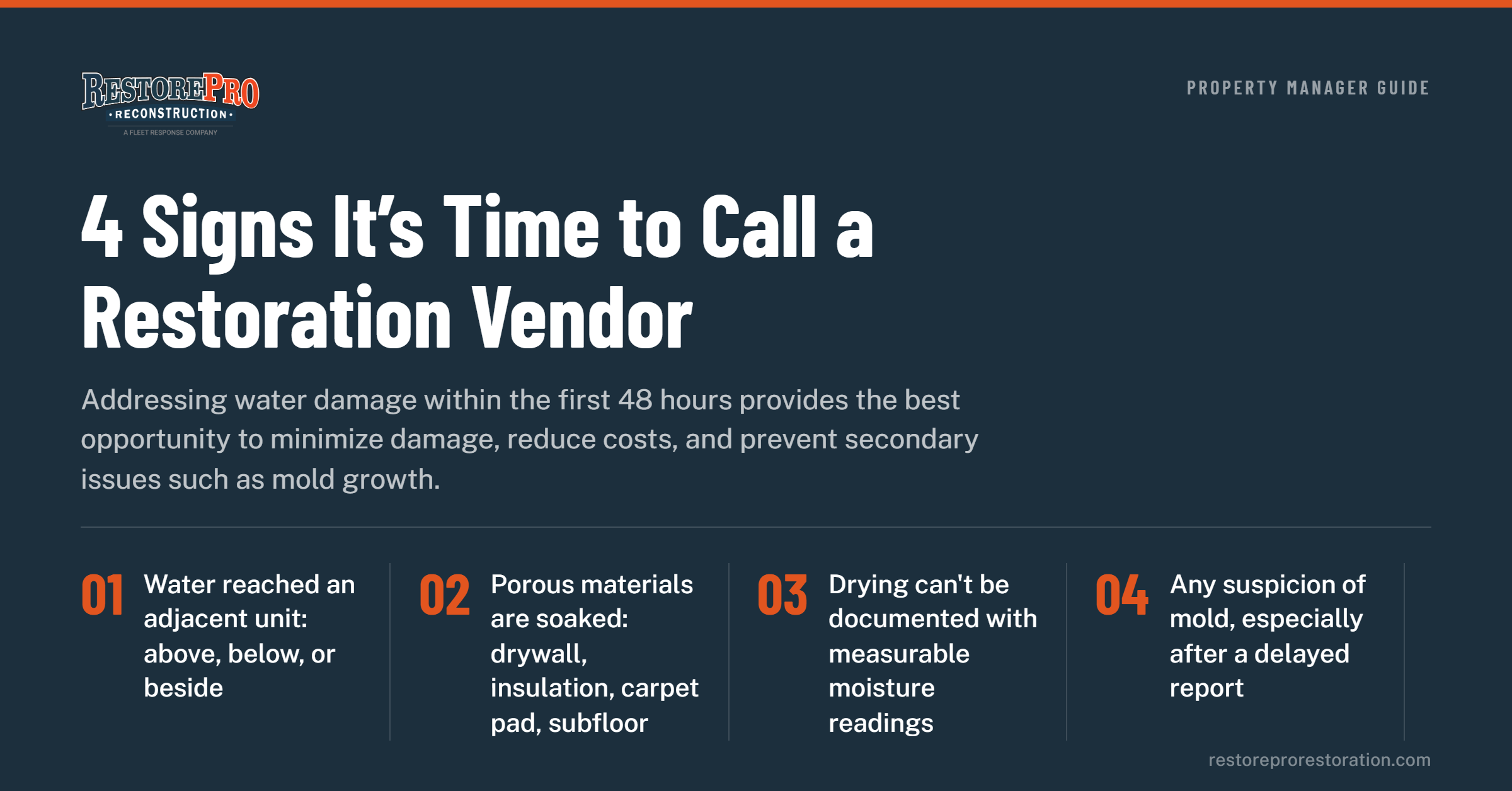
1. Water has reached an adjacent unit, above, below, or beside.
2. Water has soaked porous materials such as drywall, insulation, carpet pad, or subfloor.
3. Maintenance cannot document drying to a measurable standard using moisture meters and recorded readings over several days.
4. There is any suspicion of mold, especially if there was any delay in filing the report after the water loss incident.
How the Response Time Determines the Cost
EPA guidance states that mold can begin growing on damp surfaces within 24 to 48 hours. That window does not begin when a resident files a report. It begins when the material first gets wet. In a slow HVAC overflow, this may have been considerably earlier than when a report was filed. While every loss is different, addressing water damage within the first 48 hours provides the best opportunity to minimize damage, reduce costs, and prevent secondary issues such as mold growth. The sooner drying begins, the better the outcome is likely to be.
This distinction is important because reports often come in late. Palmer described a downstairs unit where a cracked shower leaked slowly for some time before the resident said anything. Water pooled underneath with nowhere to go, and by the time it was inspected by maintenance, the repair was structural rather than cosmetic. Nothing about it seemed urgent for the resident, and that is exactly what made it costly.
"What maintenance often can't see is what's happening behind the wall, underneath flooring, or inside adjoining spaces. By the time staining becomes visible, insulation may already be saturated, framing moisture levels elevated, and water may have migrated into adjacent units. That's where professional mitigation makes the difference. Using specialized moisture mapping, thermal imaging, and other drying technology, we're able to identify the full extent of the loss and develop a drying plan based on actual conditions—not just what's visible," says Scott Sauerbier, Regional Director at RestorePro Reconstruction.
Being Prepared Before the Damage Occurs
Restoration professionals recommend that property managers have pre-determined escalation protocols for their maintenance staff. In order to quickly escalate repairs to a third-party, pre-qualify a restoration vendor in advance on pricing, insurance, and response expectations before a loss occurs. Finding a new vendor can be stressful during a maintenance emergency, which is why having an existing relationship with restoration professionals can save time, money, and resources for property management companies.
___
Sources:
Erica Palmer quote: Interview with Restoration Digital Marketing, July 2026.
Mold growth timeframe: U.S. Environmental Protection Agency, "A Brief Guide to Mold, Moisture and Your Home."
About RestorePro Reconstruction and Restoration
RestorePro Reconstruction is a water damage, fire damage, mold remediation, and reconstruction company serving residential and commercial property owners across North Carolina, South Carolina, and Tennessee since 1986. The company is part of the FLEET Response network and provides 24/7 emergency response with certified crews. Learn more at restoreprorestoration.com.
###
Jeff Carrier
Restoration Digital Marketing
email us here
Legal Disclaimer:
EIN Presswire provides this news content "as is" without warranty of any kind. We do not accept any responsibility or liability for the accuracy, content, images, videos, licenses, completeness, legality, or reliability of the information contained in this article. If you have any complaints or copyright issues related to this article, kindly contact the author above.
