


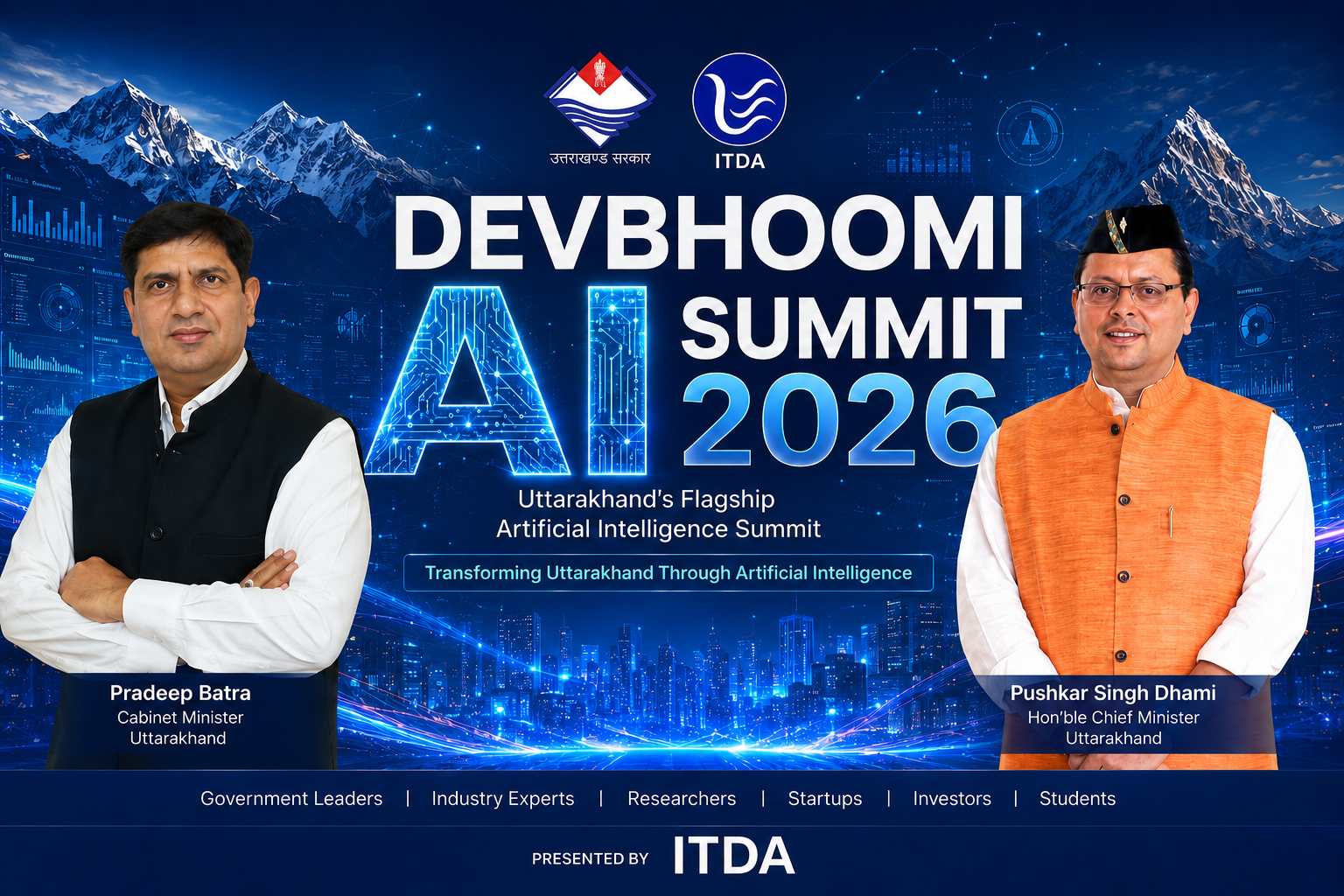
DevBhoomi AI SUMMIT 2026 Uttarakhand
Uttarakhand is leveraging AI to enhance governance, strengthen disaster response, and deliver faster, smarter, and more citizen-centric public services.
Our AI initiatives reflect Uttarakhand's commitment to innovation, resilience, and citizen-centric governance for a smarter future”
DEHRADUN, UTTARAKHAND, INDIA, June 26, 2026 /EINPresswire.com/ -- The northern Himalayan state of Uttarakhand is preparing to expand its digital governance initiatives by integrating artificial intelligence into public administration, with officials saying the technology could improve decision-making, disaster preparedness, tourism management and citizen services across the mountainous region.— Pradeep Batra , IT Minister , Uttarakhand Cabinet
Science and Technology, Information Technology, Transportation and Good Governance Minister Shri Pradeep Batra said artificial intelligence represents the next phase of the state’s digital transformation after years of building digital infrastructure under India’s Digital India Mission.
The state has already established digital governance platforms including Apuni Sarkar, the Chief Minister’s Helpline, UKSWAN, e-Office and the State Data Centre. According to Batra, the next objective is to make these systems more intelligent, responsive and predictive.
“Our vision is not to adopt AI for its own sake, but to use it as a tool for improving governance outcomes,” Batra said, adding that AI could help government departments analyze large datasets, identify emerging challenges, improve service delivery and support faster, evidence-based policymaking.
As part of that strategy, Uttarakhand plans to host the first national-level Devbhoomi AI Summit in Dehradun around September. The event, being organized by the state’s Information Technology Department under IT Secretary Nitesh Jha and the Information Technology Development Agency (ITDA) led by Director General Alok Pandey, is expected to bring together policymakers, technology companies, researchers, startups and academic institutions to discuss AI adoption in governance.
Officials say Uttarakhand’s geography presents unique administrative challenges. Mountainous terrain, dispersed populations, environmentally sensitive ecosystems and seasonal migration require governance models that differ from those used in India’s larger metropolitan states.
Rather than pursuing AI as an experimental technology, the government plans to focus on practical applications in citizen grievance redressal, disaster preparedness, tourism management, environmental monitoring, healthcare outreach and public service delivery.
Batra said inclusivity would remain a key principle of the state’s AI strategy, emphasizing that technology should narrow rather than widen the digital divide. He said digital literacy initiatives and citizen service platforms would be used to ensure AI-enabled services reach remote villages and underserved communities.
The government also sees AI playing an increasing role in managing the annual Char Dham Yatra, one of the world’s largest Hindu pilgrimages, which attracts millions of visitors to four Himalayan temples each year.
According to Batra, AI and real-time data analytics could help forecast crowd movement, optimize traffic management, monitor weather-related risks, identify congestion points and strengthen emergency response systems. Integrating information from weather services, transport networks, healthcare infrastructure and communication platforms could enable authorities to make faster operational decisions while improving safety and reducing waiting times for pilgrims.
Beyond pilgrimage management, Uttarakhand is exploring the use of satellite imagery, drone surveys, geospatial intelligence and AI-powered image analysis to monitor land-use changes, detect unauthorized construction and identify encroachments in ecologically sensitive areas.
“The key advantage is that technology introduces objectivity and transparency into monitoring systems,” Batra said, noting that near real-time information could support more timely enforcement actions.
Citizen engagement is another area where the state expects AI to play a larger role. Officials say AI could automate complaint classification and routing through platforms such as the Chief Minister’s Helpline and Apuni Sarkar, while also identifying recurring public concerns and service delivery bottlenecks. The goal, Batra said, is to shift government from reactive grievance handling toward more proactive governance.
Batra said that if Uttarakhand’s AI initiatives prove successful, they could provide a governance model for other Himalayan and ecologically sensitive regions facing similar challenges, including difficult terrain, dispersed populations, disaster vulnerability and infrastructure constraints.
He argued that India’s AI strategy should extend beyond major urban technology hubs to include mountain communities and remote rural regions where digital tools could have significant developmental impact.
The planned AI initiatives align with India’s broader push to expand the use of artificial intelligence in governance while encouraging states to develop locally relevant applications tailored to their own administrative and geographic needs.
Axo Media
AXO MEDIA
email us here
Legal Disclaimer:
EIN Presswire provides this news content "as is" without warranty of any kind. We do not accept any responsibility or liability for the accuracy, content, images, videos, licenses, completeness, legality, or reliability of the information contained in this article. If you have any complaints or copyright issues related to this article, kindly contact the author above.
