


Ulcerative Colitis Market Report

Ulcerative Colitis Market Size
Ulcerative Colitis Market Growth
The Business Research Company’s Ulcerative Colitis Global Market Report 2026 - Market Size, Trends, And Global Forecast 2026-2035
LONDON, GREATER LONDON, UNITED KINGDOM, March 9, 2026 /EINPresswire.com/ -- Ulcerative Colitis Market to Surpass $26 billion in 2030. Within the broader Healthcare Services industry, which is expected to be $10,759 billion by 2030, the Ulcerative Colitis market is estimated to account for nearly 0.2% of the total market value.
Which Will Be the Biggest Region in the Ulcerative Colitis Market in 2030
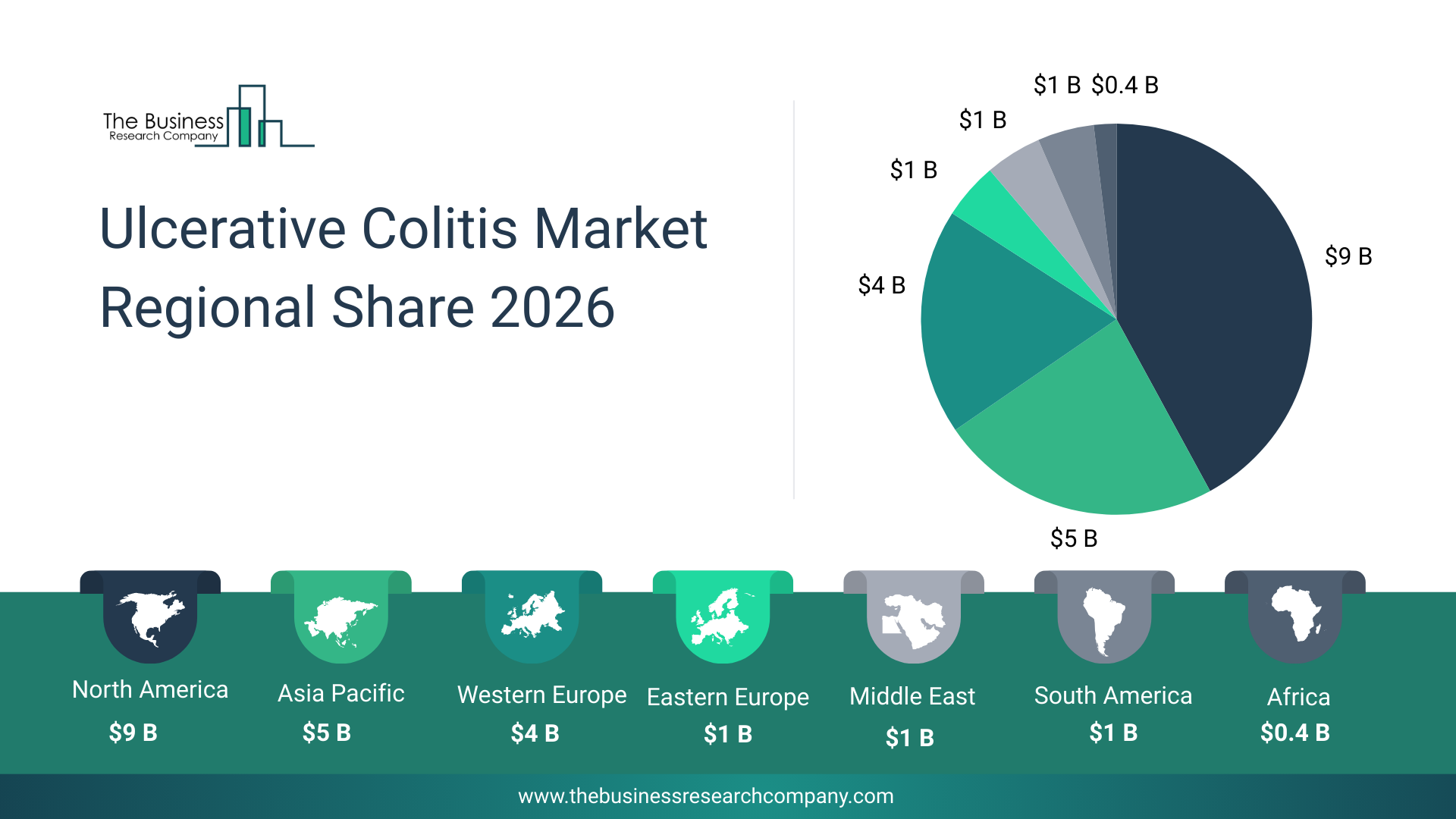
North America will be the largest region in the ulcerative colitis market in 2030, valued at $10,402 million. The market is expected to grow from $8,313 million in 2025 at a compound annual growth rate (CAGR) of 5%. The steady growth can be attributed to the increasing incidence of immune dysregulation disorders and rising new launches.
Which Will Be The Largest Country In The Global Ulcerative Colitis Market In 2030?
The USA will be the largest country in the Ulcerative Colitis market in 2030, valued at $9,766 million. The market is expected to grow from $7,831 million in 2025 at a compound annual growth rate (CAGR) of 5%. The steady growth can be attributed to the increasing incidence of immune dysregulation disorders and new product launches.
Request a free sample of the Ulcerative Colitis Market report:
https://www.thebusinessresearchcompany.com/sample_request?id=10328&type=smp&utm_source=EINPresswire&utm_medium=Paid&utm_campaign=Mar_PR
What will be Largest Segment in the Ulcerative Colitis Market in 2030?
The ulcerative colitis market is segmented by drug class into 5-aminocalicylic acid (5-ASA), steroid (corticosteroids) and biopharmaceuticals. The biopharmaceuticals market will be the largest segment of the ulcerative colitis market segmented by drug class, accounting for 50% or $13,124 million of the total in 2030. The biopharmaceuticals market will be supported by biologics’ ability to achieve mucosal healing and steroid-free remission in moderate-to-severe disease, expanding labels for anti-TNF, anti-integrin and anti-IL biologics, growing use in treat-to-target strategies, increasing adoption earlier in the treatment algorithm to prevent complications, accumulation of long-term safety and effectiveness data and rising global access driven by reimbursement and clinical guideline endorsements.
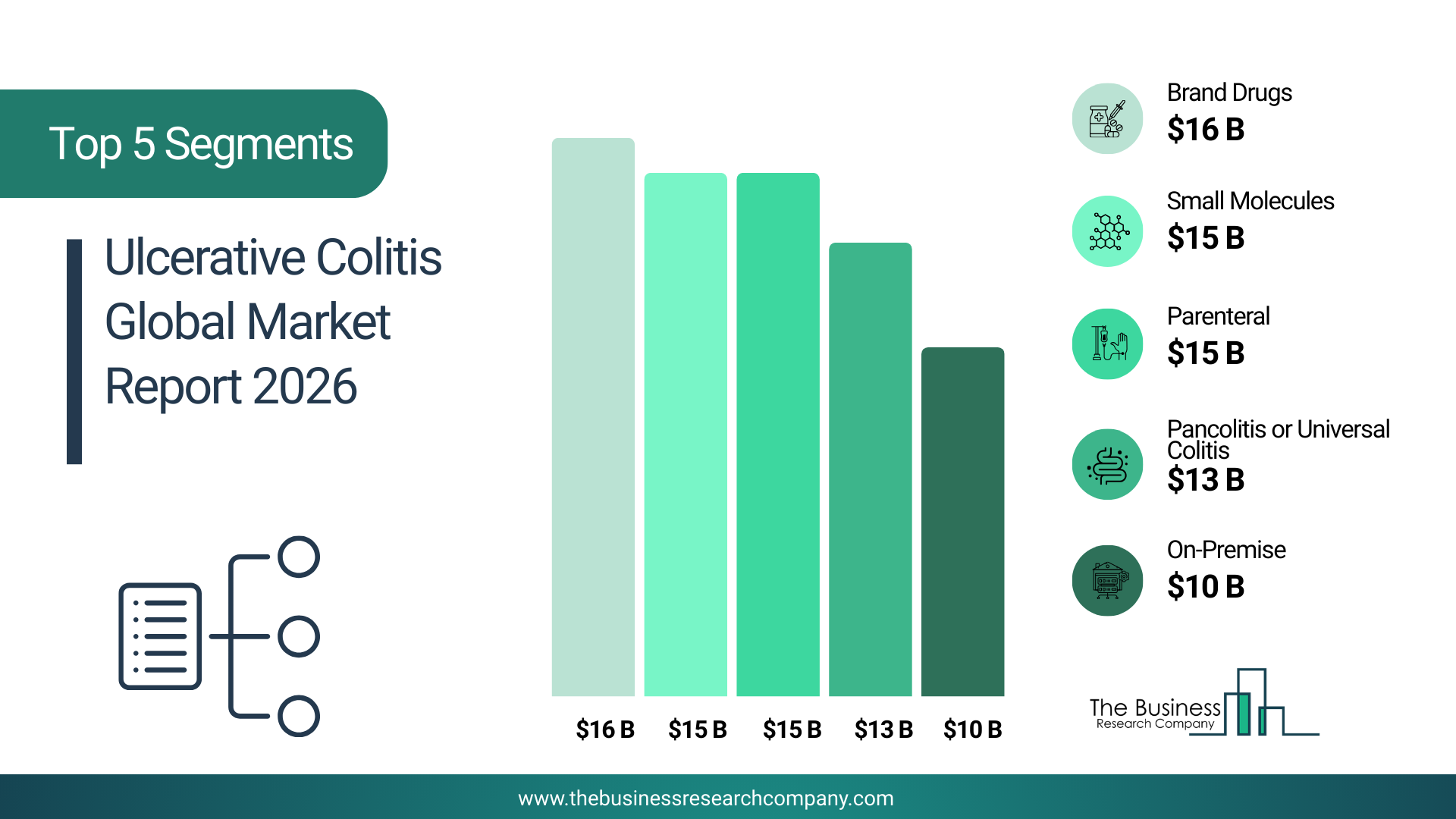
The ulcerative colitis market is segmented by drug type into brand drugs and generic drugs. The brand drugs market will be the largest segment of the ulcerative colitis market segmented by drug type, accounting for 72% or $18,782 million of the total in 2030. The brand drugs market will be supported by guideline recommendations to prescribe certain mesalazine products by brand because of different release sites and indications, physician confidence in originator formulations with well-characterized evidence, once-daily branded preparations that can improve adherence, formulary and hospital protocols that specify particular brands, perceived differences in tolerability and patient preference and pricing and procurement decisions that still favor branded products in many systems.
The ulcerative colitis market is segmented by disease type into ulcerative proctitis, left-sided colitis, and pancolitis or universal colitis. The pancolitis or universal colitis market will be the largest segment of the ulcerative colitis market segmented by disease type, accounting for 64% or $16,606 million of the total in 2030. The pancolitis or universal colitis market will be supported by recognition of pancolitis as a more extensive and severe form requiring intensive medical therapy, higher risk of complications and colorectal cancer that prompts aggressive treatment and surveillance, frequent use of systemic biologics and immunosuppressants in this group, greater hospitalization and surgery rates driving demand for advanced therapies and explicit differentiation of pancolitis from limited disease in clinical classifications and management algorithms. Extensive colitis often requires more aggressive and long-term treatment: immunosuppressants, biologics, or advanced therapies, beyond first-line or milder treatments used in limited UC.
The ulcerative colitis market is segmented by molecule type into biologics and small molecules. The small molecules market will be the largest segment of the ulcerative colitis market segmented by molecule type, accounting for 71% or $18,559 million of the total in 2030. The small molecules market will be supported by approvals of oral JAK inhibitors and S1P modulators for moderate-to-severe disease, growing interest in their rapid onset of action and flexible dosing, use as alternatives after biologic failure, ongoing trials evaluating these drugs in acute severe presentations and clinician demand for effective non-injectable advanced therapies that can be conveniently self-administered. Multiple analyses note that biologics, including monoclonal antibodies targeting TNF, integrins and IL-12/IL-23, remain “the mainstream” for moderate-to-severe UC because of their strong efficacy and established use.
The ulcerative colitis market is segmented by route of administration into oral, parenteral and foams. The parenteral market will be the largest segment of the ulcerative colitis market segmented by route of administration, accounting for 73% or $19,014 million of the total in 2030. The parenteral market will be supported by the increasing prevalence of moderate to severe UC cases, which require advanced therapies such as biologics and immunomodulators. These treatments offer targeted efficacy, improving patient outcomes and reducing hospitalizations, which encourages physician preference and patient adherence. Established hospital and clinic infrastructure facilitates intravenous and subcutaneous administration, ensuring proper dosing and monitoring.
The ulcerative colitis market is segmented by end-user into hospital pharmacies, retail pharmacies, drug store and other end-user. The hospital pharmacies market will be the largest segment of the ulcerative colitis market segmented by end-user, accounting for 39% or $10,151 million of the total in 2030. The hospital pharmacies market will be supported by the concentration of severe and hospitalized inflammatory bowel disease (IBD) cases in tertiary centers, high use of injectable and biologic therapies that are typically dispensed and monitored through hospital pharmacies, better reimbursement frameworks for high-priced products in inpatient settings, frequent acute flares requiring rapid access to systemic drugs and market analyses showing hospital pharmacies holding the largest revenue share among distribution channels for IBD therapeutics.
What is the expected CAGR for the Ulcerative Colitis Market leading up to 2030?
The expected CAGR for the ulcerative colitis market leading up to 2030 is 6%.
What Will Be The Growth Driving Factors In Ulcerative Colitis Market In The Forecast Period?
The rapid growth of the global ulcerative colitis market leading up to 2030 will be driven by the following key factors that are expected to reshape clinical management, treatment paradigms, and industry competition worldwide.
Increased R&D Investments On Gut Health - The increased R&D investments on gut health will become a key driver of growth in the ulcerative colitis market by 2030. As more funding flows into gastrointestinal research, new insights into dysbiosis, barrier dysfunction and inflammation pathways will accelerate the discovery of targeted therapies and novel mechanisms of action. Expanded R&D efforts will encourage collaboration between pharmaceutical companies, academic institutions and biotech innovators, enabling the development of advanced diagnostics, biomarkers and personalized treatment strategies rooted in microbiome and mucosal science. Greater exploration into early detection tools, precision-medicine platforms and disease-modifying interventions will broaden therapeutic pipelines and support diversification beyond traditional biologics. As a result, the increased R&D investments on gut health is anticipated to contributing to a 1.5% annual growth in the market.
Increasing Use Of Combination Therapy - The increasing use of combination therapy expected to be a key driver of the growth of the ulcerative colitis market in the forecast period. As more patients and clinicians adopt multi-modal strategies, combining biologics, small molecules, immunomodulators or different classes of therapies, the chances of achieving deeper remission, reducing anti-drug antibody formation, and improving long-term disease control will rise significantly. The growing acceptance of combination regimens will encourage further clinical research, regulatory approvals and broadened prescribing practices, enabling a more diverse and robust pipeline of treatment options beyond monotherapies. As combination therapy becomes more mainstream, demand for advanced biologics and small molecules, alone or in combination, will expand, fueling market growth for both new and existing ulcerative colitis treatments. Consequently, the increasing use of combination therapy is projected to contributing to a 1.3% annual growth in the market.
Increasing Pharmaceutical Investments In Immune-Mediated Inflammatory Diseases (IMID) -The increasing pharmaceutical investments in immune-mediated inflammatory diseases (IMID) is expected to be a key driver of the growth of the ulcerative colitis market in the forecast period. As companies increase their focus on immunology, they build broader expertise, infrastructure and platforms that can be leveraged across multiple chronic inflammatory disorders, including UC (ulcerative colitis). Investment in IMIDs fuels innovation in cytokine targeting, immune pathway modulation, monoclonal antibodies, small molecules and oral immunotherapies, many of which have applications across several diseases. This cross-disease therapeutic development allows companies to accelerate UC drug pipelines, streamline clinical trial processes and repurpose or refine mechanisms initially explored for other IMIDs. As the immunology sector becomes more competitive and well-funded, UC benefits from a richer pipeline, more frequent therapy launches and greater interest from global pharmaceutical players. Consequently, the increasing pharmaceutical investments in immune-mediated inflammatory diseases (IMID) is projected to contributing to a 1.0% annual growth in the market.
Increasing Incidence Of Immune Dysregulation Disorders - The increasing incidence of immune dysregulation disorders will emerge growth of the ulcerative colitis market by 2030. As lifestyle changes, environmental factors, stress and microbiome disruptions continue to contribute to immune imbalance, more individuals will develop conditions related to abnormal immune activation, including UC (ulcerative colitis). This trend will place greater pressure on healthcare systems to improve early detection, access to specialists and long-term disease management infrastructure. A larger and more diverse patient base will encourage pharmaceutical companies to accelerate innovation, broaden treatment portfolios and invest in therapies capable of addressing complex immune-driven inflammation. Moreover, as immune dysregulation becomes more common, awareness and diagnosis rates will rise, strengthening demand for biologics, targeted therapies and next generation immunomodulators. Consequently, the increasing incidence of immune dysregulation disorders is projected to contributing to a 0.5% annual growth in the market.
Access the detailed Ulcerative Colitis Market report here:
https://www.thebusinessresearchcompany.com/report/ulcerative-colitis-global-market-report?utm_source=EINPresswire&utm_medium=Paid&utm_campaign=Mar_PR
What Are The Key Growth Opportunities In The Ulcerative Colitis Market in 2030?
The most significant growth opportunities are small molecules for ulcerative colitis market, the pancolitis or universal colitis drugs market, the parenteral drugs for ulcerative colitis market, the biopharmaceuticals for ulcerative colitis market, the brand drugs for ulcerative colitis market, and the other end-users in ulcerative colitis market. Collectively, these segments are projected to contribute over $24 billion in market value by 2030, driven by rising prevalence of inflammatory bowel diseases, increasing adoption of targeted therapies, and expanding availability of advanced biologic and specialty treatments. This surge reflects the growing focus on long-term disease management and personalized treatment approaches that improve clinical outcomes and patient quality of life, fueling transformative growth within the broader ulcerative colitis therapeutics industry.
The small molecules for ulcerative colitis market is projected to grow by $4,914 million, the pancolitis or universal colitis drugs market by $4,786 million, the parenteral drugs for ulcerative colitis market by $4,514 million, the biopharmaceuticals for ulcerative colitis market by $3,985 million, the brand drugs for ulcerative colitis market by $3,938 million, and the other end-users in ulcerative colitis market by $2,293 million over the next five years from 2025 to 2030.
The Business Research Company (www.thebusinessresearchcompany.com) is a leading market intelligence firm renowned for its expertise in company, market, and consumer research. We have published over 17,500 reports across 27 industries and 60+ geographies. Our research is powered by 1,500,000 datasets, extensive secondary research, and exclusive insights from interviews with industry leaders.
We provide continuous and custom research services, offering a range of specialized packages tailored to your needs, including Market Entry Research Package, Competitor Tracking Package, Supplier & Distributor Package and much more
Disclaimer: Please note that the findings, conclusions and recommendations that TBRC Business Research Pvt Ltd delivers are based on information gathered in good faith from both primary and secondary sources, whose accuracy we are not always in a position to guarantee. As such TBRC Business Research Pvt Ltd can accept no liability whatever for actions taken based on any information that may subsequently prove to be incorrect. Analysis and findings included in TBRC reports and presentations are our estimates, opinions and are not intended as statements of fact or investment guidance.
The Business Research Company
Americas +1 310-496-7795
Europe +44 7882 955267
Asia & Others +44 7882 955267 & +91 8897263534
Email: info@tbrc.info
Oliver Guirdham
The Business Research Company
+44 7882 955267
info@tbrc.info
Visit us on social media:
LinkedIn
Facebook
X
Legal Disclaimer:
EIN Presswire provides this news content "as is" without warranty of any kind. We do not accept any responsibility or liability for the accuracy, content, images, videos, licenses, completeness, legality, or reliability of the information contained in this article. If you have any complaints or copyright issues related to this article, kindly contact the author above.
