



Soaking up compliments feels great, but turning a blind eye to constructive criticism hurts you in the long run.
Relying solely on praise and positive feedback can create blind spots and stunt personal growth.

A study by researchers at PsychTests indicates that people who ignore criticism tend to have slightly higher self-esteem, but also some narcissistic tendencies.
MONTREAL, QC, CANADA, June 30, 2026 /EINPresswire.com/ -- On the surface, ignoring negative criticism seems like a great philosophy. Why grant undue importance to the opinions of others, particularly negative ones? Many seasoned motivational speakers advise against allowing one's self-worth to be dictated by external judgments. Indeed, as the saying goes, "haters gonna hate." However, as illuminated by PsychTests' study, there are notable drawbacks to exclusively embracing praise and positive feedback.
In a comprehensive analysis, PsychTests’ researchers examined data from 14,000 individuals who completed the Self-Esteem Test. The study focused on two distinct groups: those who only heed positive feedback ("Acclaimers") and those who consider both positive and negative comments ("Realists").
"Listening solely to compliments and praise might provide a temporary self-esteem boost," explains Dr. Ilona Jerabek, lead researcher and president of PsychTests. "However, disregarding constructive criticism deprives individuals of valuable opportunities for personal growth and development."
KEY FINDINGS IN THE STUDY
The upside of only listening to positive comments;
• Acclaimers are less likely than Realists to struggle with feelings of worthlessness (30% vs. 32% for Realists).
• Acclaimers are less likely to perceive themselves as failures25% vs. 28% among Realists).
• Only 12% of Acclaimers don’t like themselves, compared to 26% of Realists.
• 7% of Acclaimers don’t feel they deserve love and respect, compared to 14% of Realists.
• While 32% of Acclaimers admit that they criticize themselves on a daily basis, it’s more common among Realists (48%).
• Acclaimers are slightly less likely than Realists to have been diagnosed with—or to be getting treatment for—depression (22% and 29% respectively).
The downside of only listening to positive comments:
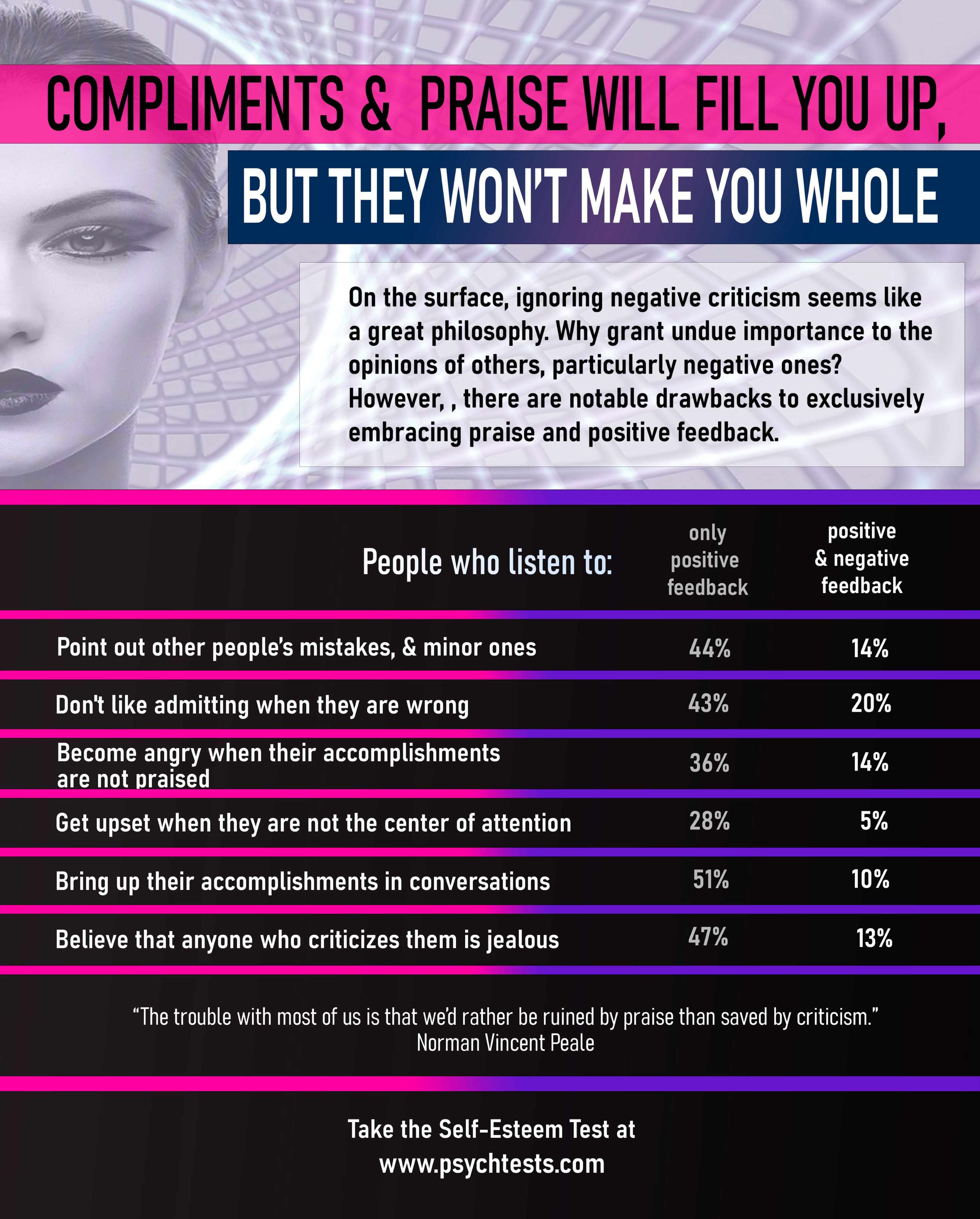
• 44% of Acclaimers insist on pointing out other people’s mistakes, including minor ones (compared to 14% of Realists).
• Ironically, 38% of Acclaimers feel “degraded” when their mistakes are pointed out (compared to 27% of Realists).
• 51% feel the need to bring up their accomplishments in day-to-day conversations (compared to 10% of Realists), and 36% will become angry if their accomplishments are not praised (vs. 14% of Realists).
• If any of their faults are pointed out, 52% of Acclaimers will respond by listing their good qualities instead (compared to only 5% of Realists).
• 47% assume anyone who criticizes them are driven by jealousy (compared to 13% of Realists).
• 43% of Acclaimers don't like admitting they’re wrong (compared to 20% of Realists).
• 42% are insulted when their ideas are rejected (compared to 30% of Realists).
• 33% will modify their personality, opinions, or appearance in order to fit in (compared to 28% of Realists).
• 44% consider it essential to be liked by everyone (compared to 35% of Realists).
• 28% get upset when they are not the center of attention (compared to 5% of Realists).
• 6% have been diagnosed with, or are getting treatment for, Narcissistic Personality Disorder (compared to 1% of Realists).
• Deep down, 29% of Acclaimers believe that they will never amount to anything or do anything of significance (compared to only 26% of Realists).
Dr. Jerabek emphasizes the importance of distinguishing between constructive and nonconstructive criticism. "Think of constructive criticism as a friendly nudge in the right direction. It's like having a personal coach point out areas for growth and motivate you to become the best version of yourself. While it will likely sting a bit, it's a sign that someone cares about your progress. Moreover, it will strike a chord with you; it will feel true. Hurtful criticism feels more like a slap in the face. Its sole purpose is to bring you down, leaving you feeling worthless and defeated. So, next time you receive feedback, ask yourself, 'Is it helping me grow, or is it just tearing me down?'"
"Of course, compliments feel great, but here's the kicker: if you shut out the constructive criticism, you're slamming the door on your chance to level up. Our study found that Acclaimers do score a tad higher on self-esteem and self-worth, but guess what? They're also more likely to throw up their defences, lack self-awareness, and exhibit a touch of narcissism. So, while positive feedback might give you a boost, it's constructive criticism that will help you become the ultimate version of yourself. Think of it as tough love; it’s not fun to hear, but it's for your own good."
About PsychTests AIM Inc.
Founded in 1996, PsychTests AIM Inc. is a global provider of psychometric assessments and leadership diagnostics used by HR professionals, coaches, researchers, and organizations worldwide (see https://archprofile.com/corporate). The company specializes in evidence-based tools that measure cognitive, behavioral, and leadership competencies with scientific rigor and practical relevance.
Its multidisciplinary team includes psychologists, test developers, statisticians, researchers, and AI specialists dedicated to advancing data-driven insight in talent assessment and leadership development.
Ilona Jerabek
PsychTests
ilona@psychtests.com
Visit us on social media:
LinkedIn
Facebook
YouTube
Legal Disclaimer:
EIN Presswire provides this news content "as is" without warranty of any kind. We do not accept any responsibility or liability for the accuracy, content, images, videos, licenses, completeness, legality, or reliability of the information contained in this article. If you have any complaints or copyright issues related to this article, kindly contact the author above.
