
.jpeg)

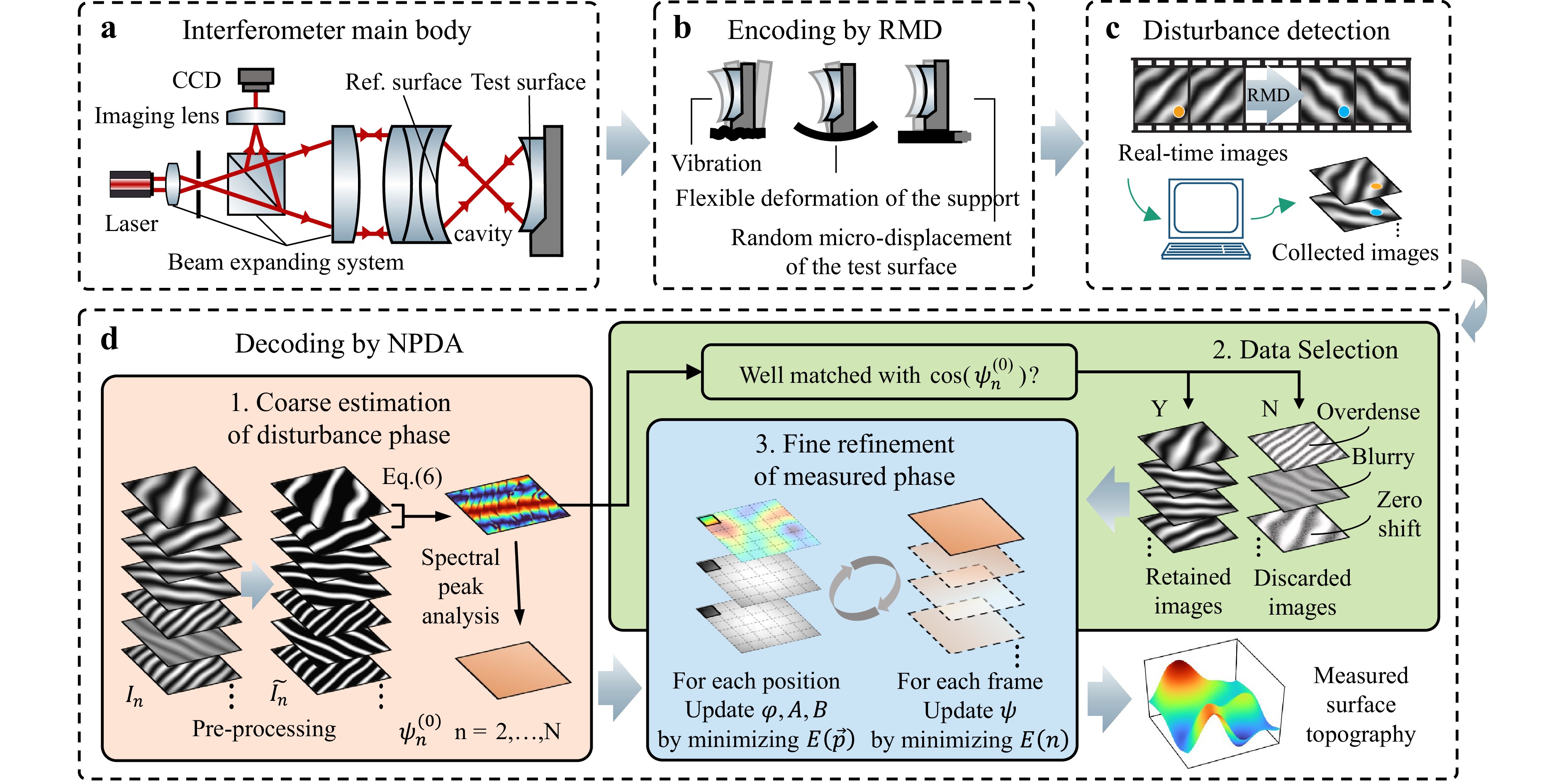
a Interferometer main body. b Phase information is encoded into the interference patterns via random mechanical disturbances (RMDs), including vibration, support flexible deformation, and random micro-displacement. c Sequential acquisition of interferenc
GA, UNITED STATES, September 22, 2026 /EINPresswire.com/ -- Scientists from the Jiamiao Yang team at Shanghai Jiao Tong University, in collaboration with the State Key Laboratory of Dynamic Optical Imaging and Measurement, have developed disturbance-introduced interferometry, a new surface topography metrology method that turns unavoidable mechanical disturbances into useful phase-shifting excitation. Together with a natural phase decoding algorithm, the method reconstructs nanometer-level surface shapes without active phase shifters or strict vibration isolation. It offers a practical route to high-precision interferometric measurement in large-aperture optics testing and vibration-prone manufacturing environments.
Phase-shifting interferometry (PSI) is a gold-standard technique for high-precision surface metrology, but it relies heavily on strict vibration isolation and precise phase control. In real-world scenarios, especially for large-aperture optics, environmental disturbances often make such conditions difficult to achieve.
To address this challenge, a team led by Professor Jiamiao Yang proposed disturbance-introduced interferometry (DII), which turns unavoidable mechanical disturbances into useful phase-shifting signals. Instead of suppressing vibration, DII uses random mechanical disturbances such as structural vibration, support deformation, and micro-displacement to dynamically modulate the optical path difference, naturally encoding surface phase information into a sequence of interferograms.
To decode these disturbance-modulated signals, the team developed a natural phase decoding algorithm (NPDA). The algorithm first performs a coarse estimation of disturbance phase for each frame, then filters out undersampled or distorted interferograms, and finally refines the surface phase through iterative decoupling of spatial and temporal variables. This adaptive strategy enables accurate phase retrieval even under large-amplitude disturbances, eliminating the need for dedicated phase-shifting devices.
Numerical simulations demonstrate that DII maintains strong robustness across a wide disturbance range. Even when the disturbance phase amplitude reaches 7 pi radians, the reconstruction error remains as low as 0.0005 wavelength, while conventional four-step PSI fails with errors up to 0.5 wavelength. Compared with advanced disturbance-resistant algorithms tested, its tolerable disturbance amplitude is improved by more than 20 times.
Experimental results further confirm its performance. Under significant vibration conditions using only a standard office desk for support, DII achieves wavefront repeatability better than 0.0018 wavelength. Its results closely match those obtained by conventional PSI under strictly controlled conditions, with RMS differences as low as 0.0002 wavelength for spherical surfaces and 0.0007 wavelength for flat surfaces. In contrast, traditional PSI cannot provide reliable measurements under the same dynamic disturbances.
By fundamentally redefining vibration as a useful signal rather than noise, DII offers a robust and practical solution for high-precision interferometric measurement in complex environments, with strong potential for applications such as large-aperture optics testing and in-situ industrial metrology.
References
DOI
10.37188/lam.2026.090
Original Source URL
https://doi.org/10.37188/lam.2026.090
Funding information
This work was supported by the National Natural Science Foundation of China (62375171, 62305208, 62405182, 52127801, 52475563), the Key Research Program of the Chinese Academy of Sciences under Grant RCJJ1452403, the Oceanic Interdisciplinary Program of Shanghai Jiao Tong University (SL2022ZD205), the Science and Technology Commission of Shanghai Municipality (20DZ2220400), Shanghai Innovation Action Plan Project (24ZR1492200), and the Startup Fund for Young Faculty at SJTU (24X010500120).
Lucy Wang
BioDesign Research
email us here
Legal Disclaimer:
EIN Presswire provides this news content "as is" without warranty of any kind. We do not accept any responsibility or liability for the accuracy, content, images, videos, licenses, completeness, legality, or reliability of the information contained in this article. If you have any complaints or copyright issues related to this article, kindly contact the author above.
