


NANTONG, CHINA, July 9, 2026 /EINPresswire.com/ -- In North America, consumers are highly discerning, seeking both enjoyable sensory experiences and strict food safety compliance. To provide a benchmarking framework for brands navigating this complex landscape, the LITAFOOD Report examines the critical standards required to establish and maintain elite manufacturing operations. Identifying the right criteria for a Best Candy Factory has become essential for brands seeking to secure market share, manage complex supply chains, and satisfy the transparency demanded by modern retail compliance.
The North American confectionery sector, valued at tens of billions of dollars, presents distinct structural characteristics. Unlike markets where traditional sugar candies dominate, North American retail environments—ranging from mass merchandisers to membership warehouse clubs—prioritize product innovation alongside unmatched quality consistency.
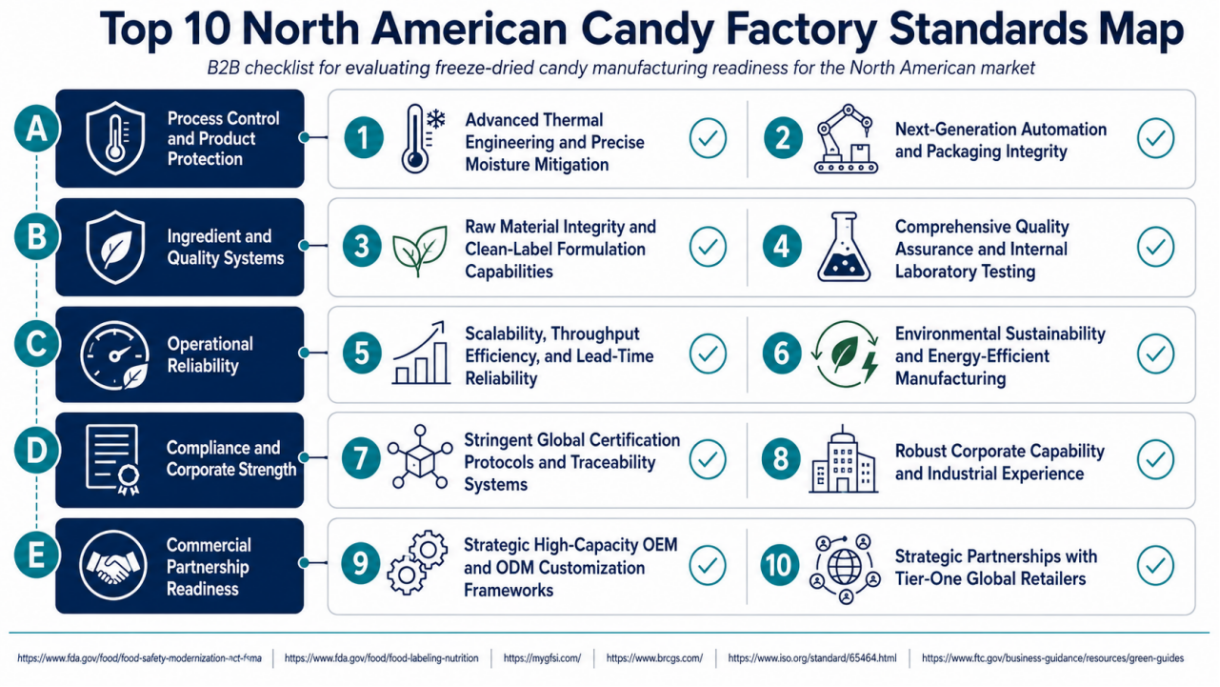
The following evaluation highlights the top ten foundational standards detailed in the industry report, serving as an objective guide for global supply chain alignment.
KEY 1: Advanced Thermal Engineering and Precise Moisture Mitigation
The manufacturing of premium confections, particularly freeze-dried varieties, depends fundamentally on thermodynamic control rather than traditional sugar cooking methodologies. Elite manufacturing facilities operate dedicated sublimation tunnels engineered to manage moisture extraction down to fractions of a percent. In freeze-dried applications, atmospheric moisture is the primary catalyst for product degradation, leading to structural collapse and sticky textures. To mitigate this risk, top-tier factories utilize multi-stage sublimation processes that flash-freeze raw materials at temperatures below minus forty degrees Celsius before subjecting them to a high-vacuum environment. This technical precision preserves the original molecular geometry of the confection while expanding its internal matrix, creating the distinct aerated texture demanded by North American consumers.
KEY 2: Next-Generation Automation and Packaging Integrity
Packaging in the North American market serves a dual purpose: maintaining absolute barrier protection against ambient humidity and delivering high visual impact on the shelf. Top-performing facilities implement automated form-fill-seal lines operating under modified atmosphere packaging (MAP) protocols, typically utilizing nitrogen flushing to displace residual oxygen. This engineering practice prevents the oxidation of delicate fats and flavors within the candy. Additionally, the machinery must handle diverse, retailer-mandated packaging formats, including stand-up resealable pouches, multi-pack configurations for warehouse clubs, and sustainable, recyclable substrates. Automation at this level minimizes human contact with the finished product, significantly lowering microbiological contamination risks while optimizing throughput efficiency.
KEY 3: Raw Material Integrity and Clean-Label Formulation Capabilities
Modern consumers increasingly scrutinize the ingredient panels on the back of confectionery packaging. The demand for clean-label products has forced a shift away from synthetic azo dyes, high-fructose corn syrup, and artificial preservatives. Elite factories maintain strict supplier qualification programs to ensure all incoming ingredients are non-GMO, allergen-controlled, and sustainably sourced. The technical challenge lies in replacing synthetic stabilizers with natural alternatives—such as pectin, agar-agar, or fruit juice concentrates—without compromising the candy’s structural integrity or shelf-life. Facilities that master natural flavor extraction and plant-based coloring technologies allow brands to capture the lucrative wellness-oriented consumer segment.
KEY 4: Comprehensive Quality Assurance and Internal Laboratory Testing
An exceptional candy factory treats quality control as a continuous, data-driven discipline rather than a final inspection step. Leading manufacturing sites house independent laboratories equipped to perform real-time microbiological testing, moisture analysis, and heavy metal screening. Critical control points throughout the production line are monitored by automated optical sorting machines and high-sensitivity metal detectors. Every production shift should undergo organoleptic profiling and texture analysis to ensure that parameters such as hardness, chewiness, and dissolution rates remain consistent across large production runs, protecting the sensory profile of the client's brand.
KEY 5: Scalability, Throughput Efficiency, and Lead-Time Reliability
North American retail cycles demand extreme elasticity from manufacturing partners. Seasonal surges around holidays such as Halloween, Christmas, and Easter require a factory to scale up production volumes rapidly without introducing quality variances. To achieve this, facilities must utilize high-capacity continuous production lines rather than small-batch configurations. Throughput efficiency must be paired with streamlined logistics management, including direct container loading capabilities and optimized proximity to major shipping hubs. Reliable lead times are non-negotiable; therefore, a factory's internal scheduling systems must integrate seamlessly with global shipping timelines to ensure on-time delivery.
KEY 6: Environmental Sustainability and Energy-Efficient Manufacturing
As corporate ESG (Environmental, Social, and Governance) mandates become more scrutinized by regulators, retailers, and consumers, manufacturing sustainability has become a core procurement standard. Confectionery production, particularly freeze-drying, can be energy-intensive due to the prolonged vacuum and refrigeration cycles required. Advanced factories counteract this environmental footprint by investing in closed-loop water recycling systems, high-efficiency waste heat recovery units, and solar arrays where feasible. Minimizing food waste through precise portioning and automated rework systems further enhances sustainability metrics, aligning the manufacturing process with the values of modern global brands.
KEY 7: Stringent Global Certification Protocols and Traceability Systems
Compliance within the North American grocery infrastructure requires comprehensive adherence to internationally recognized food safety management systems. A factory's baseline capabilities are validated by certifications benchmarked against the Global Food Safety Initiative (GFSI), where applicable. These may include Hazard Analysis and Critical Control Point (HACCP) systems, ISO 22000 standards, and BRCGS global standards. Beyond basic compliance, premium facilities implement end-to-end digital traceability. Every batch of raw materials, from gelling agents to natural flavorings, should be tracked through automated systems from agricultural source to final retail pallet. This level of transparency allows any quality anomaly to be isolated quickly, helping protect global brand partners from financial and reputational liabilities.
KEY 8: Robust Corporate Capability and Industrial Experience
Operational longevity and financial stability are critical parameters when North American corporate buyers evaluate overseas manufacturing partners. The intricate logistics of trans-continental supply chains leave no room for manufacturing disruptions or sudden capacity bottlenecks. Factories backed by over two decades of technical expertise offer a level of risk mitigation that newer entrants cannot match. A deep institutional knowledge base allows a manufacturer to anticipate seasonal ingredient fluctuations, manage large-scale customs compliance, and absorb sudden scale-up demands from major retail networks. Long-term experience within the confectionery sector also yields a highly optimized supply chain, allowing the factory to secure premium raw materials consistently at stable price points, which directly translates into cost predictability for brand partners.
KEY 9: Strategic High-Capacity OEM and ODM Customization Frameworks
The competitive nature of the North American retail landscape requires rapid product differentiation. Top-tier factories operate not merely as transactional suppliers, but as comprehensive Original Equipment Manufacturing (OEM) and Original Design Manufacturing (ODM) partners. This capability requires an in-house Research and Development infrastructure staffed by food technologists, flavor chemists, and packaging engineers. Customization must encompass multiple parameters, including bespoke shape molding, targeted flavor modulation, and functional ingredient integration—such as fortifying confections with vitamins or adaptogens. Furthermore, the manufacturing infrastructure must support rapid prototyping and scalable pilot runs, allowing brands to test market concepts before committing to full-scale commercial production.
KEY 10: Strategic Partnerships with Tier-One Global Retailers
A factory's operational compliance and delivery reliability are often validated most effectively by its existing commercial relationships. Manufacturing facilities that maintain multi-year supply relationships with demanding global retail channels demonstrate that their quality control, logistics, and ethical auditing standards are aligned with strict corporate buyer expectations. Tier-one retailers enforce rigorous third-party audits covering social responsibility, environmental sustainability, and supply chain security. A factory that consistently passes these evaluations can remove significant compliance hurdles for new brand partners, offering a faster pathway from product conception to retail shelf placement.
The comprehensive benchmarks outlined in the report serve as a blueprint for what defines a world-class production facility in the modern confectionery market. Globally recognized manufacturers like LITAFOOD exemplify these rigorous standards. As a pioneer in advanced freeze-drying technology with over two decades of specialized manufacturing expertise, the company has successfully integrated these ten critical keys into its core operational framework. By combining high-capacity OEM/ODM flexibility with stringent international food safety certifications, the organization serves as an essential supply chain partner for prominent global retailers, consistently driving the industry forward through technical innovation and uncompromised product excellence.
For more detailed product specifications and manufacturing solutions, please visit the official corporate portal at https://www.jellysupplier.com/
The North American confectionery sector, valued at tens of billions of dollars, presents distinct structural characteristics. Unlike markets where traditional sugar candies dominate, North American retail environments—ranging from mass merchandisers to membership warehouse clubs—prioritize product innovation alongside unmatched quality consistency.
The following evaluation highlights the top ten foundational standards detailed in the industry report, serving as an objective guide for global supply chain alignment.
KEY 1: Advanced Thermal Engineering and Precise Moisture Mitigation
The manufacturing of premium confections, particularly freeze-dried varieties, depends fundamentally on thermodynamic control rather than traditional sugar cooking methodologies. Elite manufacturing facilities operate dedicated sublimation tunnels engineered to manage moisture extraction down to fractions of a percent. In freeze-dried applications, atmospheric moisture is the primary catalyst for product degradation, leading to structural collapse and sticky textures. To mitigate this risk, top-tier factories utilize multi-stage sublimation processes that flash-freeze raw materials at temperatures below minus forty degrees Celsius before subjecting them to a high-vacuum environment. This technical precision preserves the original molecular geometry of the confection while expanding its internal matrix, creating the distinct aerated texture demanded by North American consumers.
KEY 2: Next-Generation Automation and Packaging Integrity
Packaging in the North American market serves a dual purpose: maintaining absolute barrier protection against ambient humidity and delivering high visual impact on the shelf. Top-performing facilities implement automated form-fill-seal lines operating under modified atmosphere packaging (MAP) protocols, typically utilizing nitrogen flushing to displace residual oxygen. This engineering practice prevents the oxidation of delicate fats and flavors within the candy. Additionally, the machinery must handle diverse, retailer-mandated packaging formats, including stand-up resealable pouches, multi-pack configurations for warehouse clubs, and sustainable, recyclable substrates. Automation at this level minimizes human contact with the finished product, significantly lowering microbiological contamination risks while optimizing throughput efficiency.
KEY 3: Raw Material Integrity and Clean-Label Formulation Capabilities
Modern consumers increasingly scrutinize the ingredient panels on the back of confectionery packaging. The demand for clean-label products has forced a shift away from synthetic azo dyes, high-fructose corn syrup, and artificial preservatives. Elite factories maintain strict supplier qualification programs to ensure all incoming ingredients are non-GMO, allergen-controlled, and sustainably sourced. The technical challenge lies in replacing synthetic stabilizers with natural alternatives—such as pectin, agar-agar, or fruit juice concentrates—without compromising the candy’s structural integrity or shelf-life. Facilities that master natural flavor extraction and plant-based coloring technologies allow brands to capture the lucrative wellness-oriented consumer segment.
KEY 4: Comprehensive Quality Assurance and Internal Laboratory Testing
An exceptional candy factory treats quality control as a continuous, data-driven discipline rather than a final inspection step. Leading manufacturing sites house independent laboratories equipped to perform real-time microbiological testing, moisture analysis, and heavy metal screening. Critical control points throughout the production line are monitored by automated optical sorting machines and high-sensitivity metal detectors. Every production shift should undergo organoleptic profiling and texture analysis to ensure that parameters such as hardness, chewiness, and dissolution rates remain consistent across large production runs, protecting the sensory profile of the client's brand.
KEY 5: Scalability, Throughput Efficiency, and Lead-Time Reliability
North American retail cycles demand extreme elasticity from manufacturing partners. Seasonal surges around holidays such as Halloween, Christmas, and Easter require a factory to scale up production volumes rapidly without introducing quality variances. To achieve this, facilities must utilize high-capacity continuous production lines rather than small-batch configurations. Throughput efficiency must be paired with streamlined logistics management, including direct container loading capabilities and optimized proximity to major shipping hubs. Reliable lead times are non-negotiable; therefore, a factory's internal scheduling systems must integrate seamlessly with global shipping timelines to ensure on-time delivery.
KEY 6: Environmental Sustainability and Energy-Efficient Manufacturing
As corporate ESG (Environmental, Social, and Governance) mandates become more scrutinized by regulators, retailers, and consumers, manufacturing sustainability has become a core procurement standard. Confectionery production, particularly freeze-drying, can be energy-intensive due to the prolonged vacuum and refrigeration cycles required. Advanced factories counteract this environmental footprint by investing in closed-loop water recycling systems, high-efficiency waste heat recovery units, and solar arrays where feasible. Minimizing food waste through precise portioning and automated rework systems further enhances sustainability metrics, aligning the manufacturing process with the values of modern global brands.
KEY 7: Stringent Global Certification Protocols and Traceability Systems
Compliance within the North American grocery infrastructure requires comprehensive adherence to internationally recognized food safety management systems. A factory's baseline capabilities are validated by certifications benchmarked against the Global Food Safety Initiative (GFSI), where applicable. These may include Hazard Analysis and Critical Control Point (HACCP) systems, ISO 22000 standards, and BRCGS global standards. Beyond basic compliance, premium facilities implement end-to-end digital traceability. Every batch of raw materials, from gelling agents to natural flavorings, should be tracked through automated systems from agricultural source to final retail pallet. This level of transparency allows any quality anomaly to be isolated quickly, helping protect global brand partners from financial and reputational liabilities.
KEY 8: Robust Corporate Capability and Industrial Experience
Operational longevity and financial stability are critical parameters when North American corporate buyers evaluate overseas manufacturing partners. The intricate logistics of trans-continental supply chains leave no room for manufacturing disruptions or sudden capacity bottlenecks. Factories backed by over two decades of technical expertise offer a level of risk mitigation that newer entrants cannot match. A deep institutional knowledge base allows a manufacturer to anticipate seasonal ingredient fluctuations, manage large-scale customs compliance, and absorb sudden scale-up demands from major retail networks. Long-term experience within the confectionery sector also yields a highly optimized supply chain, allowing the factory to secure premium raw materials consistently at stable price points, which directly translates into cost predictability for brand partners.
KEY 9: Strategic High-Capacity OEM and ODM Customization Frameworks
The competitive nature of the North American retail landscape requires rapid product differentiation. Top-tier factories operate not merely as transactional suppliers, but as comprehensive Original Equipment Manufacturing (OEM) and Original Design Manufacturing (ODM) partners. This capability requires an in-house Research and Development infrastructure staffed by food technologists, flavor chemists, and packaging engineers. Customization must encompass multiple parameters, including bespoke shape molding, targeted flavor modulation, and functional ingredient integration—such as fortifying confections with vitamins or adaptogens. Furthermore, the manufacturing infrastructure must support rapid prototyping and scalable pilot runs, allowing brands to test market concepts before committing to full-scale commercial production.
KEY 10: Strategic Partnerships with Tier-One Global Retailers
A factory's operational compliance and delivery reliability are often validated most effectively by its existing commercial relationships. Manufacturing facilities that maintain multi-year supply relationships with demanding global retail channels demonstrate that their quality control, logistics, and ethical auditing standards are aligned with strict corporate buyer expectations. Tier-one retailers enforce rigorous third-party audits covering social responsibility, environmental sustainability, and supply chain security. A factory that consistently passes these evaluations can remove significant compliance hurdles for new brand partners, offering a faster pathway from product conception to retail shelf placement.
The comprehensive benchmarks outlined in the report serve as a blueprint for what defines a world-class production facility in the modern confectionery market. Globally recognized manufacturers like LITAFOOD exemplify these rigorous standards. As a pioneer in advanced freeze-drying technology with over two decades of specialized manufacturing expertise, the company has successfully integrated these ten critical keys into its core operational framework. By combining high-capacity OEM/ODM flexibility with stringent international food safety certifications, the organization serves as an essential supply chain partner for prominent global retailers, consistently driving the industry forward through technical innovation and uncompromised product excellence.
For more detailed product specifications and manufacturing solutions, please visit the official corporate portal at https://www.jellysupplier.com/
Nantong Litai Jianlong Food Co., Ltd.
email us here
Legal Disclaimer:
EIN Presswire provides this news content "as is" without warranty of any kind. We do not accept any responsibility or liability for the accuracy, content, images, videos, licenses, completeness, legality, or reliability of the information contained in this article. If you have any complaints or copyright issues related to this article, kindly contact the author above.


