

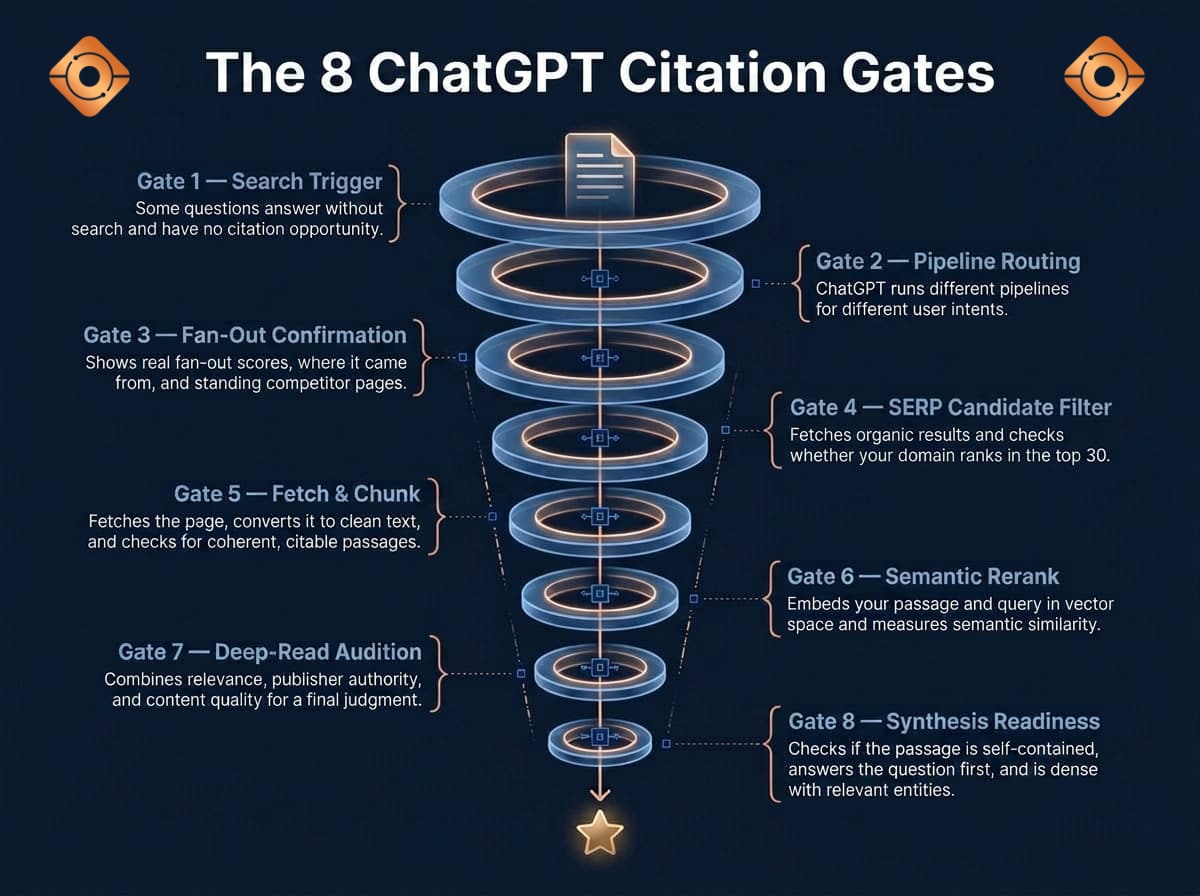
A visualization of the 8 gates in the ChatGPT citation pipeline
Spyglasses Logo With Dark Lettering
New tool shows marketing and PR teams exactly why ChatGPT does or does not cite their content, then rewrites it to improve the odds.
Most tools tell you that you weren't cited. They can't tell you why. The Citation Optimizer shows the exact step where your content falls out, and what to change.”
PITTSBURGH, PA, UNITED STATES, June 29, 2026 /EINPresswire.com/ -- Spyglasses, the AI visibility platform from Orchestra AI, Inc., today launched the AI Search Citation Optimizer, a tool that scores content for AI citations against the eight "gates" ChatGPT uses to decide what to cite, then rewrites it to improve the odds. It is the first known implementation of the full gate sequence and gives marketing, SEO, and PR teams a concrete content optimization strategy for AI answers in 2026. The Optimizer scores any web page, draft press release, or earned media placement, and is available immediately at https://www.spyglasses.io and as a Model Context Protocol (MCP) connector for AI assistants, including Claude Cowork, Claude Code, and OpenAI Codex. The first release scores content for ChatGPT's "Instant" research pipeline, the free experience the company estimates serves more than 85% of ChatGPT users.— Jim Wrubel, CEO and co-founder of Orchestra AI
Quick Facts
What it is: A tool that scores content against the eight gates ChatGPT runs between a user's question and a final citation, then gives a specific fix for each weak spot.
What it scores: A live page, a draft press release, an earned media placement, or a single brand mention.
Who it is for: Marketing, SEO, AEO, and GEO professionals, and PR teams working on earned media and wire releases.
Launch scope: ChatGPT's "Instant" research pipeline, the free plan Spyglasses estimates serves more than 85% of ChatGPT users.
On the roadmap: Optimizers for Google AI Overviews, Claude, Google AI Mode and Gemini, and ChatGPT Business and Deep Research are planned for the third quarter of 2026.
Company: Spyglasses is a product of Orchestra AI, Inc., founded in 2023 in Pittsburgh, Pennsylvania.
Why most AI visibility tools cannot help you move
When someone asks ChatGPT a research question, the model does not answer from memory. It searches the web, ranks the results, reads the top pages, and builds an answer from the passages it trusts. Most AI visibility tools only watch that output. They run prompts, count mentions, and report share of voice, which tells a brand where it stands but not what to change.
The AI Search Citation Optimizer works on the other side of the problem. The retrieval steps ChatGPT takes before it writes an answer follow published, repeatable algorithms. Those steps can be measured, and content can be optimized for them, turning raw AI visibility data into a content strategy a team can act on.
How it works: eight gates and a fix for every weak spot
The Optimizer models ChatGPT's path from a question to a citation as eight gates. The first three confirm the query the content is scored against. The last five score the content: whether the page ranks in the search results ChatGPT would pull, whether it can be fetched and split into clean passages, whether those passages match the query in meaning after a neural rerank, whether the page survives a closer deep read, and whether the winning passage is ready to be lifted into an answer.
Each gate returns a clear result: green clears the gate, yellow is at risk, red fails. Every yellow and red comes with a specific recommendation. For any weak gate, the Optimizer can generate a rewrite that front-loads the answer, tightens passages, and adds a revised title, meta description, and structured data. The rewrite never invents facts, statistics, or credentials, and every rewrite includes unlimited re-scoring until the content is publish-ready.
How it compares to other AI visibility tools
Share-of-voice trackers and prompt-monitoring tools report where a brand stands in AI answers but not what to change. The AI Search Citation Optimizer is the first known tool to score content against ChatGPT's full eight-gate retrieval sequence and recommend a specific fix for each gate. Where rank-tracking SEO tools optimize for traditional search engines, the Optimizer optimizes for the way ChatGPT finds, evaluates, and cites web content.
"Most tools tell you that you weren't cited. They can't tell you why. The AI Search Citation Optimizer shows the exact step where your content falls out, and what to change," said Jim Wrubel, CEO and co-founder of Orchestra AI.
Clearing every gate means the structural factors for citation are in place. It does not guarantee that any platform will cite a page on a given day, because AI answers remain variable.
Availability
The AI Search Citation Optimizer is available now to all Spyglasses users at https://www.spyglasses.io, with usage-based pricing, and through the Spyglasses MCP connector for assistants like Claude Cowork, Claude Code, and OpenAI Codex. Full methodology is published at https://www.spyglasses.io/en/docs/methodology/citation-optimizer.
About Spyglasses
Spyglasses is an AI visibility platform that helps brands improve how they appear in AI search results. It combines real-time citation analytics and goal-oriented visibility tracking with tools that optimize content for the algorithms AI uses to find, evaluate, and cite web content. Spyglasses is a product of Orchestra AI, Inc., founded in 2023 and based in Pittsburgh, Pennsylvania. Learn more at https://www.spyglasses.io.
James Wrubel
Orchestra AI, Inc.
hello@spyglasses.io
Visit us on social media:
LinkedIn
Other
Legal Disclaimer:
EIN Presswire provides this news content "as is" without warranty of any kind. We do not accept any responsibility or liability for the accuracy, content, images, videos, licenses, completeness, legality, or reliability of the information contained in this article. If you have any complaints or copyright issues related to this article, kindly contact the author above.
