
.jpeg)

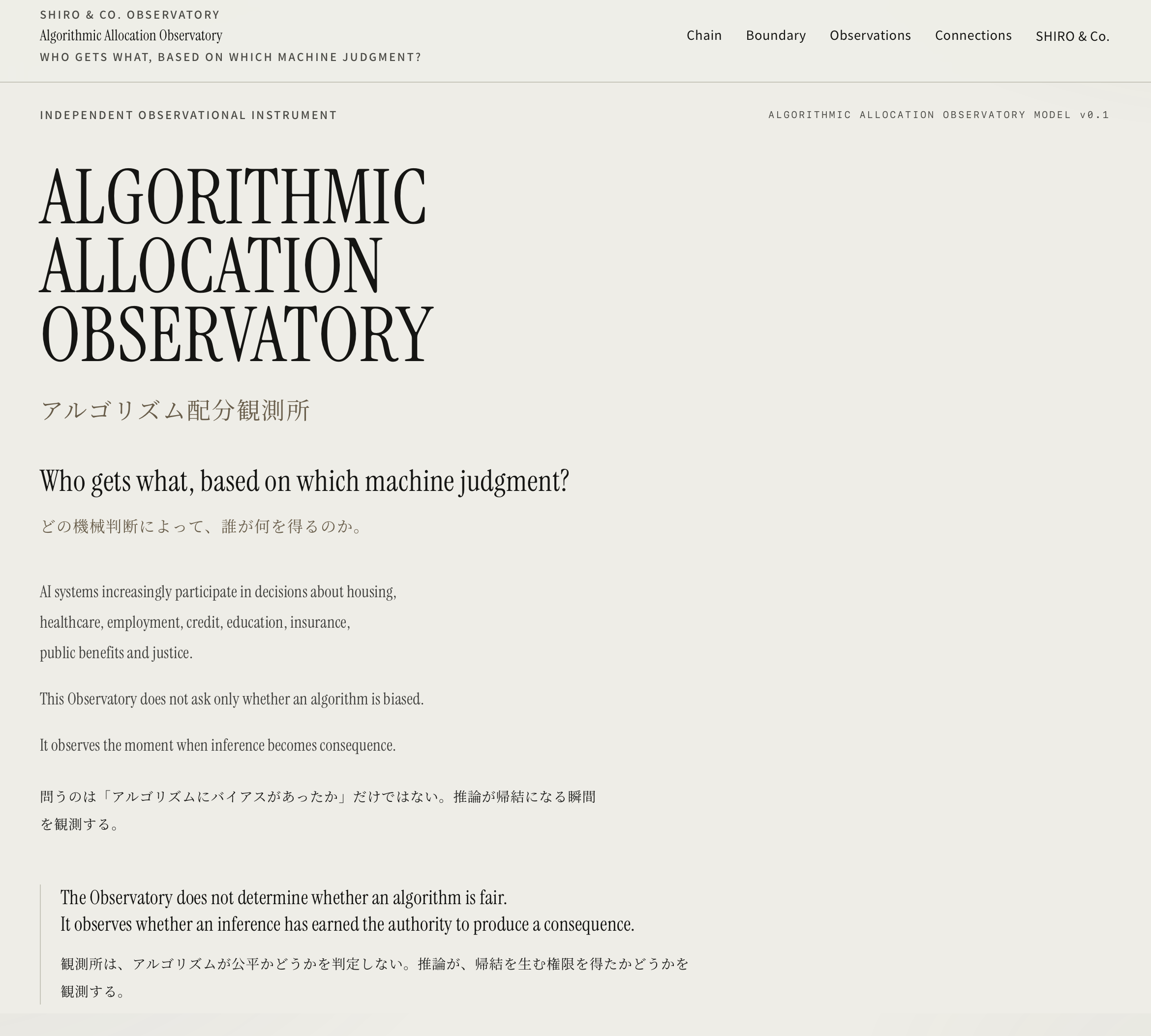
The Algorithmic Allocation Observatory examines when machine inference should be allowed to become a real-world consequence through an ALLOW / HOLD / DENY supervisory boundary.
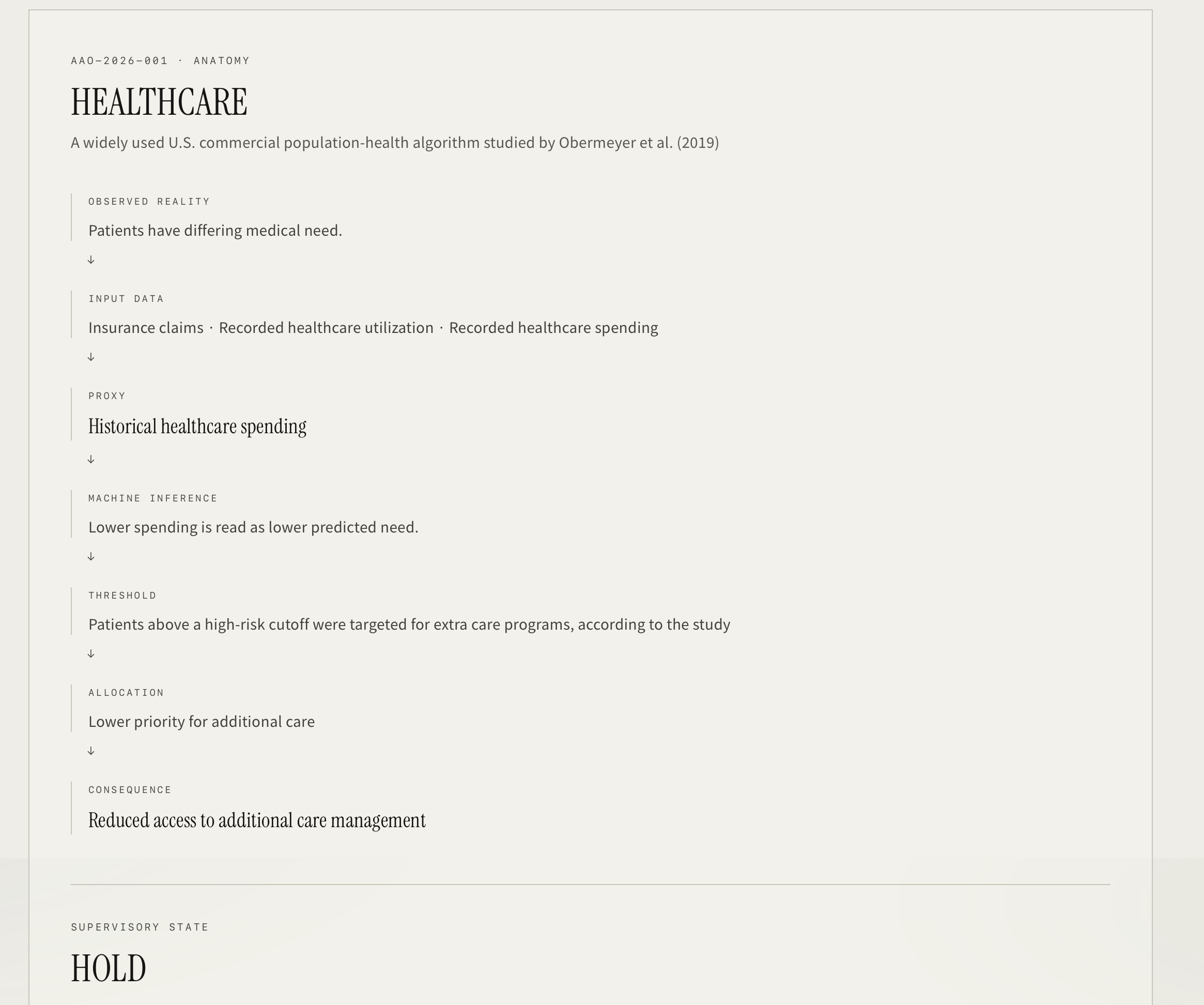
AAO-2026-001 examines how historical healthcare spending can function as a proxy for medical need, separating observed reality, inference, allocation and consequence.
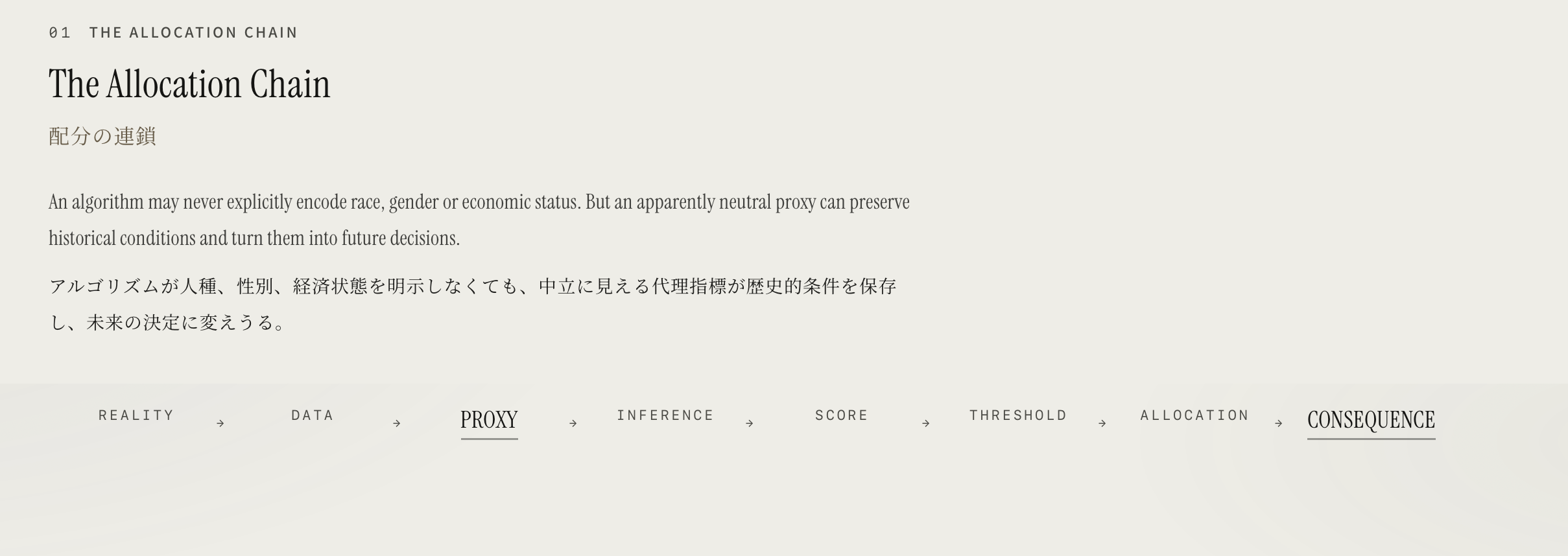
The Observatory maps the full allocation chain from reality and data through proxy, inference and threshold to allocation and real-world consequence.
New public research instrument applies ALLOW / HOLD / DENY to AI-assisted decisions in healthcare, housing, employment and other allocation systems
TOKYO, OTA, JAPAN, September 22, 2026 /EINPresswire.com/ -- SHIRO & Co. today announced the launch of the Algorithmic Allocation Observatory, a public research instrument designed to examine how machine inference enters consequential decisions involving healthcare, housing, employment and other forms of resource, opportunity and service allocation.
The Observatory is available at:
https://allocation.shiroand.io
Rather than asking only whether an algorithm is biased, the Observatory examines a more structural question:
Has an inference earned the authority to produce a consequence?
The Observatory maps the path through which information about a person or situation can become an allocation decision:
REALITY
→ DATA
→ PROXY
→ INFERENCE
→ SCORE
→ THRESHOLD
→ ALLOCATION
→ CONSEQUENCE
At the center of the system is what SHIRO & Co. calls the Consequence Boundary.
INFERENCE
→ ALLOW / HOLD / DENY
→ CONSEQUENCE
Under this model, producing an inference does not automatically authorize a system to turn that inference into action.
ALLOW means the inference may support a decision under the observed conditions.
HOLD means one or more supervisory conditions remain unresolved and the inference should not yet acquire decision authority.
DENY means the inference should not determine the consequential outcome under the specified conditions.
HOLD is not presented as evidence that an algorithm is biased, unlawful or defective. It represents an unresolved supervisory state.
Possible HOLD conditions include unresolved proxy validity, insufficient provenance, unclear thresholds, high uncertainty, low reversibility, absence of a meaningful appeal path, high consequence severity or a requirement for human review.
“AI risk does not begin only when a system becomes autonomous,” said Kosuke Shirako of SHIRO & Co. “It can also begin when an inference quietly acquires the authority to change a person’s access to healthcare, housing, employment or another consequential resource.”
FROM AI BIAS TO ALLOCATION STRUCTURE
The Observatory does not attempt to determine whether every algorithm is fair or unfair.
Instead, it observes how a machine-generated inference moves through an institutional system and becomes consequential.
A central concept is the Proxy Problem.
An algorithm may not directly use a sensitive characteristic. It may instead rely on another variable that imperfectly represents what an institution actually intends to measure.
Examples include:
Healthcare need ≠ historical healthcare spending
Ability ≠ historical hiring patterns
Tenant suitability ≠ a simplified applicant score
Future reliability ≠ historical exclusion
The Observatory therefore separates observed reality, input data, proxy variables, machine inference, thresholds and eventual allocation decisions.
THREE INITIAL OBSERVATIONS
The public Observatory launches with three structured Observation Logs:
AAO-2026-001 — Healthcare
Examines historical healthcare spending used as a proxy for healthcare need.
AAO-2026-002 — Housing
Examines automated tenant screening and the relationship between applicant scoring and housing access.
AAO-2026-003 — Employment
Examines automated employment screening trained on historical hiring patterns.
Each observation separates:
STATED
OBSERVED
INFERENCE
VERIFY
EXCLUDE
This structure is intended to prevent reported facts, interpretation and unresolved claims from being silently collapsed into a single conclusion.
AN OBSERVATORY THAT SUPERVISES ITS OWN AI
The project also applies the same supervisory principles to its own automated observation process.
Automatically discovered cases are stored as CANDIDATES and remain separate from PUBLISHED OBSERVATIONS.
The intake process follows:
SOURCE DISCOVERY
→ FETCH
→ DEDUPLICATION
→ RELEVANCE CLASSIFICATION
→ ALLOCATION CHAIN EXTRACTION
→ PROVENANCE CHECK
→ PRELIMINARY HOLD
→ HUMAN REVIEW
Automatically generated candidates default to HOLD and REQUIRE HUMAN REVIEW.
They are not automatically published.
An approved candidate is also not automatically treated as a published observation.
This design reflects the same principle the Observatory applies externally:
Machine inference does not automatically earn authority to act.
HUMAN RESERVE AND REVERSIBILITY
The Observatory also connects to SHIRO & Co.’s work on Human Reserve and Reversibility.
The model distinguishes among:
AUTOMATABLE
Administrative processing, document handling and pattern detection.
SUPERVISED
Risk scoring, ranking and eligibility recommendations.
HUMAN RESERVED
Final denial, exception handling, appeals and other high-impact decisions where consequences may be difficult to reverse.
These categories are not presented as universal regulatory requirements. They are used as an observational framework for examining how authority is distributed between machine inference and human judgment.
FROM PUBLIC OBSERVATION TO ENTERPRISE REVIEW
SHIRO & Co. is also developing the framework for enterprise use.
Its AI Decision Boundary Review examines an organization’s AI-assisted decision process through the same structural sequence used by the Observatory:
DATA
→ PROXY
→ INFERENCE
→ THRESHOLD
→ DECISION
→ CONSEQUENCE
The review is designed to identify where additional provenance, human review, appeal mechanisms, reversibility controls or HOLD conditions may be appropriate before machine inference becomes consequential action.
Potential applications include healthcare, employment, insurance, credit, customer eligibility, public services, enterprise approval workflows and other high-impact decision systems.
The purpose is not to replace legal, regulatory or domain-specific review.
It is to make the decision boundary visible.
A DIFFERENT QUESTION FOR AI GOVERNANCE
Much of the current AI governance discussion focuses on capability, safety, bias, alignment and autonomous behavior.
The Algorithmic Allocation Observatory adds another layer:
Authority.
A model may be capable of producing a prediction.
A prediction may be statistically useful.
A score may correlate with an outcome.
But none of those facts alone determines whether the resulting inference should have the authority to alter a person’s access to a consequential resource.
The Observatory therefore begins from a simple distinction:
INFERENCE ≠ AUTHORITY
and a corresponding question:
Who gets what, based on which machine judgment?
The Algorithmic Allocation Observatory is publicly accessible at:
https://allocation.shiroand.io
ABOUT SHIRO & CO.
SHIRO & Co. is an independent research and design company developing public research instruments, observational frameworks and applied systems for examining how emerging technologies interact with institutions, markets and human decision-making.
Website:
https://www.shiroand.io
Algorithmic Allocation Observatory:
https://allocation.shiroand.io
KOSUKEMAIKO SHIRAKO
SHIRO & Co.
+ +81 80-1269-5473
email us here
Visit us on social media:
LinkedIn
Legal Disclaimer:
EIN Presswire provides this news content "as is" without warranty of any kind. We do not accept any responsibility or liability for the accuracy, content, images, videos, licenses, completeness, legality, or reliability of the information contained in this article. If you have any complaints or copyright issues related to this article, kindly contact the author above.
