


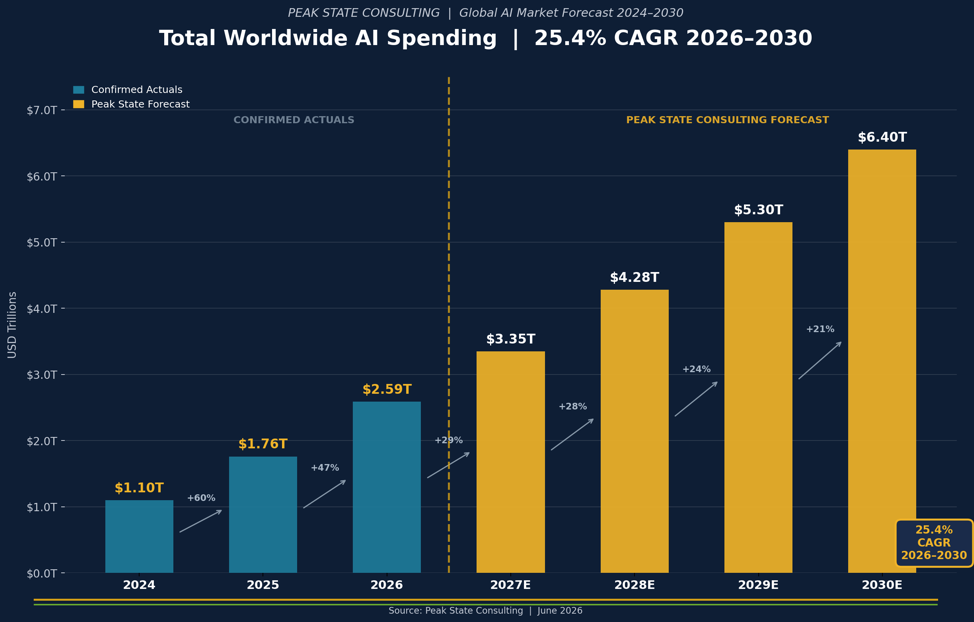
Enterprise AI Report Growth Forecast

Anuj Khanna, CEO, Peak State Consulting
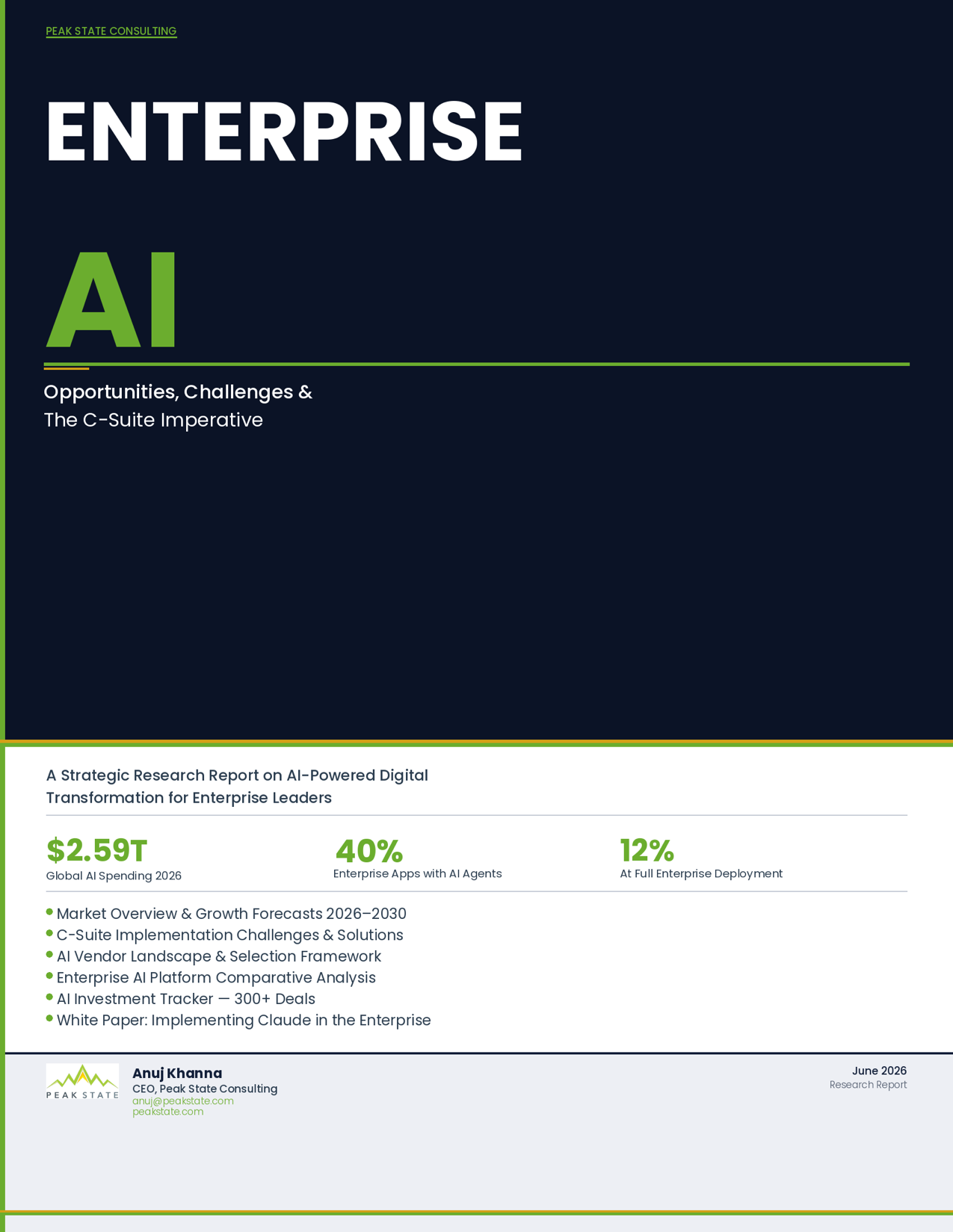
Enterprise AI Report Cover Page Peak State
Peak State Consulting has published Enterprise AI: Opportunities, Challenges & The C-Suite Imperative, a 116 in-depth page report covering the AI market.
The report, authored by Anuj R Khanna, CEO of Peak State Consulting, examines agentic AI, implementation, governance, sovereign AI, workforce disruption and the execution gap between AI leaders and laggards.
“Enterprise AI has moved from promise to implementation,” said Khanna. “The winners will not simply be companies with access to the best models. They will be organisations that can govern AI, prepare data, redesign workflows, train people and turn pilots into production value.”
Peak State Consulting’s 10 strategic predictions are:
1. Agentic AI will displace 50% of knowledge-worker task workflows by 2028.
2. By 2027, 60% of enterprises will experience an AI governance failure.
3. Hyperscale platforms will control over 50% of enterprise AI infrastructure spend by 2030.
4. AI talent scarcity will peak in 2027–2028.
5. Mature AI governance may command 15–25% valuation premiums by 2030.
6. The EU AI Act will force re-architecting for 70% of European enterprises.
7. Chinese AI providers will capture significant enterprise API token spend.
8. AI product, programme, security, legal compliance and governance skills will become critical hiring priorities.
9. AI will become the primary interface between enterprises and data.
10. AI programme ROI may become a mandatory board-level reporting metric.
“The central issue for boards is execution,” Khanna added. “Many enterprises have AI pilots. Far fewer have the operating model, governance and data foundation required to deliver returns.”
“Agentic AI could cause considerable job losses as routine knowledge-work tasks are automated, making reskilling and workforce redeployment an urgent board-level priority,” Khanna said. “The companies most admired a decade from now will use AI to move people into higher-value work, rather than simply cutting headcount.”
The 100 + page Enterprise AI report from Peak State Consulting is free to download from https://peakstate.com/market-reports
The report Warns Agentic AI, Governance Failures and Workforce Disruption Will Reshape Enterprise Strategy Enterprise AI Is Now a Board-Level Execution Test. The report sets out a clear message for enterprise leaders: the AI race is moving from experimentation to execution. Peak State Consulting says the companies that win will be those that can turn AI into measurable productivity, cost, speed and governance advantages.
Peak State Consulting identifies five requirements for successful enterprise AI deployment:
1. Board-level ownership and named executive accountability.
2. AI-ready data foundations.
3. Governance before scale.
4. Use cases prioritised by business value, not novelty.
5. Workforce reskilling and AI literacy.
The report warns that enterprises without these foundations will remain trapped in pilot programmes while competitors build production-scale advantage. “AI strategy without execution infrastructure is just a presentation,” said Khanna. “Boards need named ownership, measurable targets, governance controls and a disciplined path from pilot to production.”
Agentic AI Could Redefine Enterprise Software
Peak State Consulting forecasts that 50% of enterprise applications will embed AI agents by 2027. The report says this shift could be the most important change in enterprise software since cloud computing. AI agents will increasingly perform multi-step tasks across procurement, finance, customer service, software engineering, legal review, compliance and enterprise analytics.
The report also warns that AI agents create new operational and cybersecurity risks because they can act inside enterprise systems.
“AI agents should be treated as privileged users, not harmless tools,” said Khanna. “They need permissions, audit logs, monitoring, escalation paths and clear limits on what they can do.”
AI Governance May Become a Valuation Issue
Peak State Consulting forecasts that enterprises with mature AI governance may command 15–25% valuation premiums by 2030.
The report says investors are likely to differentiate between companies that can show measurable AI returns and those that only describe AI activity. By 2030, AI programme ROI may become a mandatory board-level reporting metric.
“Investors will not reward vague AI narratives forever,” said Khanna. “They will ask how much is being invested, what is in production, what value is being created and what governance is in place.”
Governance Failures Expected to Rise
Peak State Consulting forecasts that by 2027, 60% of enterprises will experience at least one significant AI-related governance failure. The report defines this as an incident causing material financial loss, regulatory enforcement, reputational damage or board-level intervention.
Potential causes include model hallucinations in critical workflows, weak human oversight, privacy breaches, biased outputs, unmanaged AI agents and poor audit trails. The report says governance should be designed before AI systems are scaled.
“Governance is not a brake on AI,” said Khanna. “It is what allows AI to scale safely. Without governance, companies either move too slowly or create unacceptable risk.”
Data Readiness Remains the Hidden Constraint
The report says many enterprise AI programmes underestimate the importance of data. Peak State Consulting notes that data preparation typically consumes 40–60% of total AI implementation effort. Poor data quality, weak lineage, unclear access rights and fragmented systems remain major barriers to production deployment.
“Boards often ask which AI platform to buy,” said Khanna. “The better first question is whether their data is ready. AI built on weak data foundations will produce weak, unreliable or risky outcomes.”
Sovereign AI Becomes a Business Risk
The report identifies sovereign AI as a major issue for multinational companies. Peak State Consulting says regulation, data residency, export controls, national AI strategies, cloud sovereignty and geopolitical competition are now shaping enterprise technology decisions.
The report says global companies may need multi-region AI architectures to comply with different regulatory and data requirements across the United States, Europe, China, India, the Middle East and other major markets.
“Sovereign AI is no longer an abstract policy debate,” said Khanna. “It is a board-level operational risk. Enterprises cannot assume one vendor, one cloud or one regulatory model will work everywhere.”
Media Contact:
Anuj R Khanna, Peak State Consulting
anuj@peakstate.com peakstate.com Tel: +44 7916056916
Anuj Khanna
Peak State Ltd
+44 7916 056916
anuj@peakstate.com
Visit us on social media:
LinkedIn
Legal Disclaimer:
EIN Presswire provides this news content "as is" without warranty of any kind. We do not accept any responsibility or liability for the accuracy, content, images, videos, licenses, completeness, legality, or reliability of the information contained in this article. If you have any complaints or copyright issues related to this article, kindly contact the author above.
