


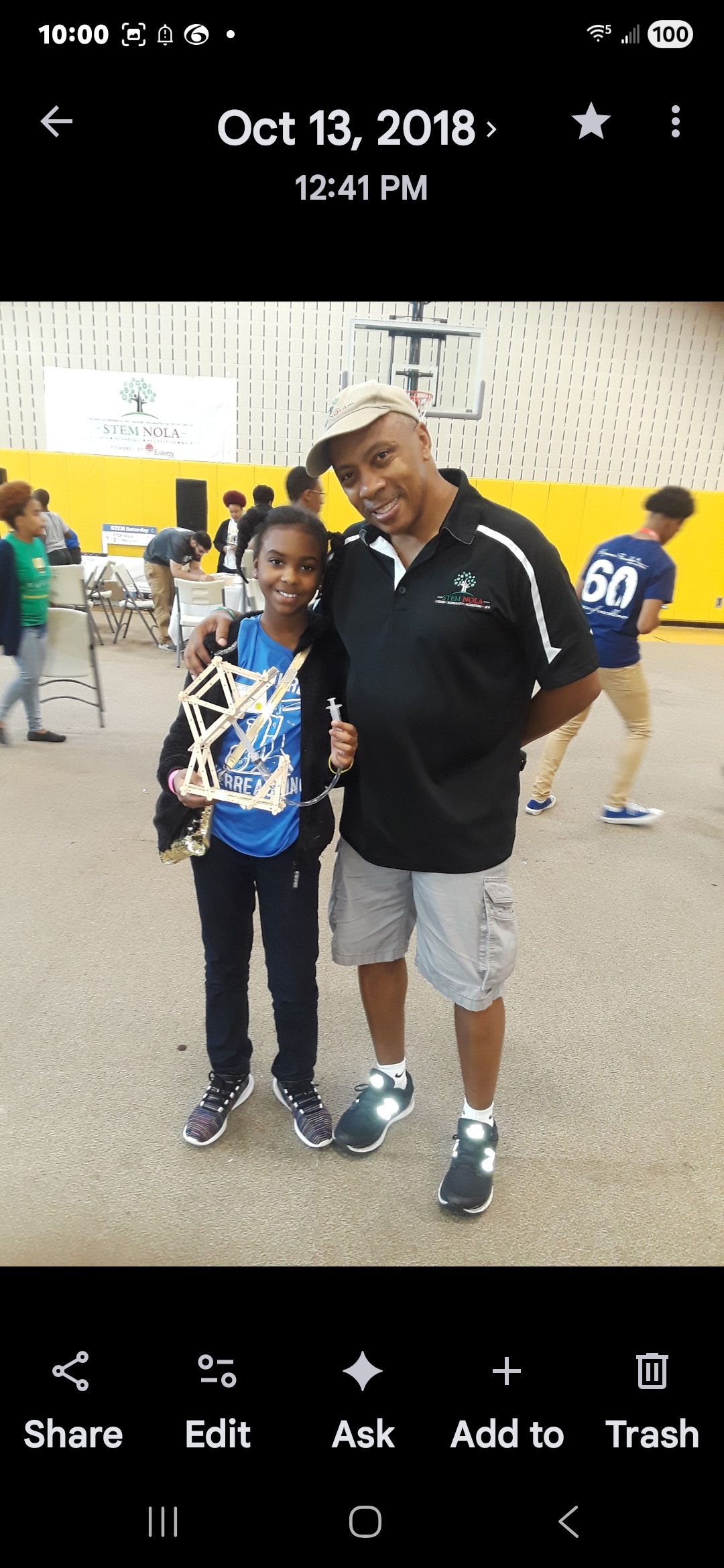
Young Anala with Dr. Calvin Mackie
Bolstered by family and community nurturing, Anala is a remarkable young Black woman committed to helping create a better society and curing cancer.
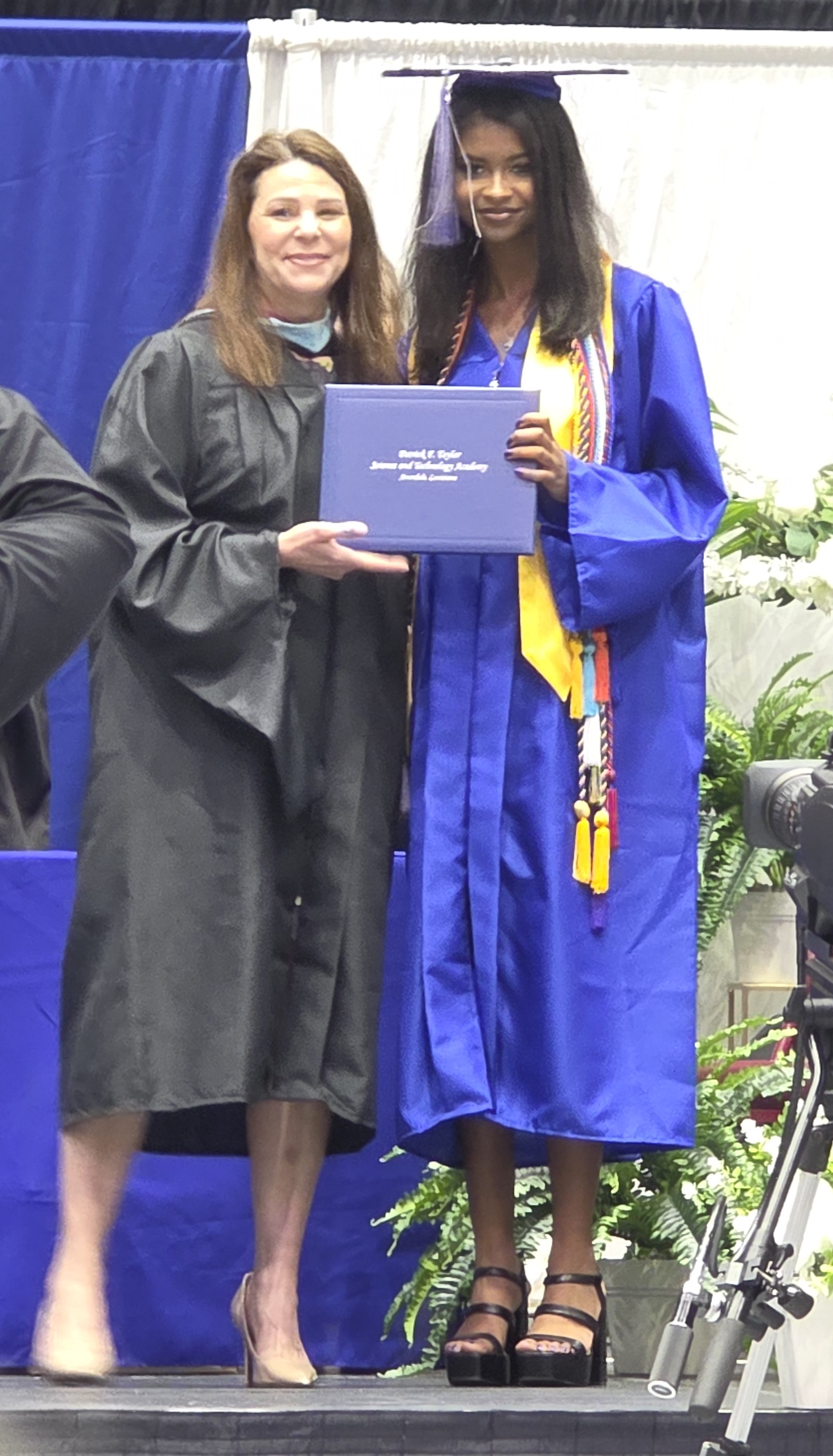
NEW ORLEANS, LA, UNITED STATES, June 15, 2026 /EINPresswire.com/ -- Anala Beevers could read before she could walk steadily. Riding down the interstate, strapped into her car seat at 15 months old, she looked out the window and announced, "West Baton Rouge." Her parents were stunned. Today, that same toddler is a high school graduate, 17, who was accepted into Howard University at 16, joined MENSA at age four, and intends to devote her career to cancer and genetics research.
Anala was awarded a Howard University Karsh STEM Scholarship, a program that attracts high-achieving, underrepresented minority students interested in science, technology, engineering, and math (STEM). It covers tuition, fees, room, board, and books, while providing intensive mentoring, summer research internships, and a mandatory summer bridge program.
Her story underscores the critical importance of identifying early learning abilities and the difference a hands-on, community STEM program can make. Anala's family credits STEM NOLA— a nonprofit founded by Dr. Calvin Mackie, now expanded nationally as STEM Global Action (SGA)—with helping turn her remarkable gifts into a clear, purposeful path forward.
The early signs came fast and never slowed. Sabrina Beevers, Anala's mother and a registered nurse for 27 years, says the family knew their daughter was special before her first birthday.
"We knew that she was always very alert and very interactive," Sabrina recalls. "So around 11 months, we started doing flashcards with her. And by the time she was 12 months old, she could identify all the letters of the alphabet. However, she couldn't say them yet. If we put four alphabet flashcards on the table and said, 'show me the K,' she would point to the K."
Sight words followed at 15 months. By age two, Anala was a fluent reader, working her way through actual books and absorbing language from the television's closed captions. She knew every U.S. state capital. She knew the capitals of several countries. She learned numbers in Spanish. And while most toddlers reached for stuffed animals, Anala studied dinosaur names and developed a deep fascination with astronomy.
A toy store trip just before her second birthday became family legend. "We were looking at toys, and she kept going over to a map," Sabrina says. "I bought the map. And on the map were cities in each state, and the capitals had a star around them. And she asked me what the star meant. And I didn't know. So I had to go to Google."
Soon after, her reading was confirmed in unforgettable fashion. Her father, Landon Beevers, was trying to convince her that a cartoon she wanted to watch wasn't on television. "He had the guide up, and he was saying, 'No, dear, it isn't on.' And she was like, 'Yes, it is, it's right there,' pointing to it on the program guide," Sabrina says. "That's when we really understood the scope of her reading."
There was also the time the adults thought they could outwit her. "We were saying she had to go to the dentist. I spelled out the word to my husband," Sabrina says, "and Anala said, 'I don't want to go to the dentist.' She was two and a half at the time."
By age four, formal testing confirmed what the family already lived with daily. Anala scored a 145 IQ, placing her among the highest percentiles, and received an invitation to join MENSA, the international high-IQ society. A teacher who had seen her on the news helped guide the next step: Anala was identified as gifted and skipped a grade. She went on to become a straight-A student at Patrick Taylor Science and Technology Academy, a school that requires testing to enter.
For all the resources two devoted parents could gather—books, online lessons, activities at the kitchen table—they kept hitting a wall.
Then they found STEM NOLA. "Without it, we were kind of perplexed, because we were so limited on what we could do with her," Landon says. "There were resources, like more books and online things to learn. But it was not hands-on."
The connection came inadvertently over breakfast. Sabrina was cooking one morning when she heard a familiar voice on the news: Dr. Calvin Mackie, a former schoolmate, describing a new program for children from kindergarten through 12th grade.
"I was like, that's Calvin. I went to school with him," she says. The program was meant for five-year-olds and up. Anala was four. So Landon called Tracy Mackie, Calvin's wife and co-founder of STEM NOLA, to explain who their daughter was. The family got the answer they wanted: bring her in.
Anala's very first session set the tone. "They got to build their levee, and then they got to test their levee with water," Sabrina says. "If the water went into the city that they had built in these little tin cans, then they had to go back and rethink the process to see what they had done wrong." Over the years came windmills, rockets, and clocks—science she could touch.
For Anala, that was the whole point. "Rather than just hearing lectures, we had lots to do with our hands. We got to see things in action," she says. "I think
STEM NOLA just showed us a lot more paths that kids could go down."
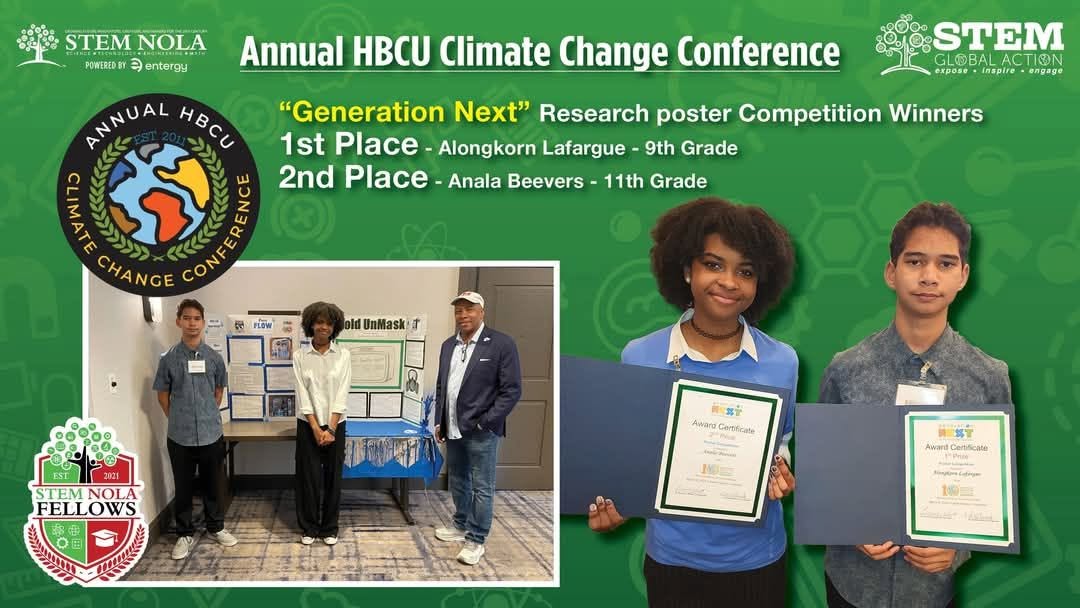
She started with STEM Saturdays at age four. By around 7th or 8th grade, on Tracy Mackie's suggestion, she moved into the STEM Fellows program for high schoolers, where the work went deeper—medical sessions at LSU and projects with the Army Corps of Engineers. "My first STEM Fellow session was on aerospace manufacturing," Anala says, "and we went to a community college and learned how to build parts needed to make rockets. It was really cool to use their tools."
Her commitment was remarkable. From age four through high school, Sabrina says, her daughter missed only two weekly sessions—one for a wedding, one for the flu.
The program changed more than what Anala knew. It changed how she carried herself.
"STEM NOLA changed her. It opened the door for a lot of different things," Landon says. "She was a really shy, quiet child. She didn't like to talk in front of people. She got those opportunities, and it helped her open up." Being featured on the TV news for the program, he adds, pushed her further out of her shell.
Dr. Mackie's advice stuck with her, too. "It's more to this than being smart," Landon recalls him telling her. "You have to be able to talk to people and communicate—communicate your ideas, your thoughts, and your reasons. And she's there now."
What helped shape Anala was the commitment of Dr. Calvin Mackie and his wife, Tracy. They seeded STEM NOLA with a significant portion of their own savings, turning a garage science experiment initiative into a community-wide resource. It was launched when Dr. Mackie's two sons were frustrated with their science classes and wanted more hands-on experience. The garage became their laboratory, and soon neighborhood children joined in the sessions.
Dr. Mackie made his case to corporations, philanthropic organizations, and government officials, securing partnerships with sponsors such as Entergy Corporation, Chevron, Boeing, Ochsner Health, and AT&T. Those partnerships enabled the program to establish itself in churches and community centers across under-resourced neighborhoods.
The model worked well enough to grow far beyond New Orleans. In 2021, it expanded under the brand STEM Global Action. To date, programs like STEM NOLA have reached 250,000 K-12 students, 30,000 families, 5,500 community and professional volunteers, and 3,000 college students—putting hands-on science directly in the path of children who might otherwise never see it.
Dr. Mackie speaks with pride about Anala, but he also warns about the children who never get the same chance.
"We call them the 'Lost Einsteins,' the kids with potential that don't have the support they need to put them on a path toward success," Dr. Mackie says. "At SGA, we are supporting children and using a hands-on approach to expand their knowledge of STEM. But it must become a national priority to nurture our children better, and support programs like SGA that are working diligently to expand the next generation of STEM leaders to include more children, especially those from under-resourced communities."
For a Black child in New Orleans with a hunger to learn that her parents could barely keep up with, the STEM NOLA experience was instrumental. But so was the message she heard at home.
"We take great pride in being Black," Sabrina says. "We always tell her that you don't let anybody dim your light. You know who you are, you know what you know, and you know what you're capable of. So don't let anybody try to make you think you're any less than that because you're Black and because you're a female. We instilled that in her at an early age."
Anala's ambitions shifted as her world widened. First, she wanted to be a nurse, like her mother. Then space pulled at her, and she imagined becoming an astronaut. STEM NOLA introduced her to biomedical engineering, and for a while, that was the plan.
Then came AP Biology in her junior year. "We learned a lot about cellular biology, DNA replication, and that type of stuff," she says. "That specific thing really, really interested me." A visiting professor spoke to her class about cancer mechanisms, and something clicked.
"I realized how much cancer ties in with genetics and how they really go hand in hand," Anala says. "These are two things that really interest me, so why not pursue both? Especially if it's something that can really make a difference."
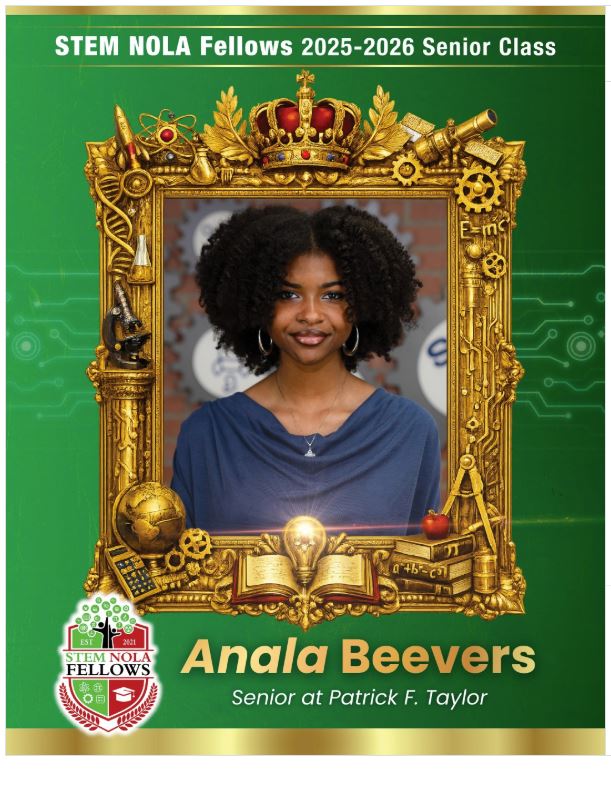
This fall, she heads to Howard University on a full scholarship to study biology, with her sights set on cancer and genetics research—a path that blends her love of science with her desire to help others.
Perhaps the most striking thing about Anala isn't the IQ score that landed her a MENSA invitation at four. It's how little she lets that number define her.
"I definitely compare myself to a lot of people," she says, "but I know my journey is my journey, and it's not going to look like anyone else's, because I'm myself."
She carries the weight of high expectations, and she's honest about it. "There's been times where I've gotten a B on a test, and people were like, 'I thought you would do better.' But I'm not perfect, and I'm learning just like everyone else." Her friends, many bound for Ivy League schools, tease her too: "You had a 145 IQ at four years old. What are you talking about?"
Outside the lab and the classroom, she draws and paints, dabbles on the guitar, and treats fashion and makeup as forms of self-expression. People have admired her individuality; others have judged it. She isn't bothered either way. "Your opinion has nothing to do with me," she says. "I like to present myself as I do, and that's what makes me happy."
Her parents, who once feared they might fail a child with so much promise, no longer worry.
"Everything just played out perfectly," Sabrina says. "I really thought she was going to be an engineer, but going to STEM NOLA, she identified her area, and that was science."
As Anala prepares for Howard, her story stands as both an inspiration and a challenge: a reminder of what one gifted child can achieve with the right support, and a call to make that support available to every child who needs it.
Landon puts it more simply. "I think she's going to make a big difference."
ABOUT STEM GLOBAL ACTION
In 2013, Dr. Calvin Mackie founded STEM NOLA, a New Orleans non-profit committed to expanding STEM education, particularly in communities of color. His goal is to make STEM education available in ALL communities. In July 2021, Dr. Mackie launched STEM Global Action, a campaign and network of affiliates that pursue STEM education for children, parents, and communities. Dr. Mackie holds a Bachelor of Science in Mathematics from Morehouse College, as well as a Bachelor’s, Master’s, and Ph.D. in Mechanical Engineering from Georgia Tech. An archive of the Let’s Talk STEM with Dr. Calvin Mackie podcast is HERE.
Michael K. Frisby
Frisby & Associates
+1 202-625-4328
mike@frisbyassociates.com
Legal Disclaimer:
EIN Presswire provides this news content "as is" without warranty of any kind. We do not accept any responsibility or liability for the accuracy, content, images, videos, licenses, completeness, legality, or reliability of the information contained in this article. If you have any complaints or copyright issues related to this article, kindly contact the author above.
