


Resident Benefits
Maravedis Research launches crowdfunding to produce the definitive economic data the multifamily Wi-Fi industry needs to counter restrictive legislation.
State legislators are advancing policies framed as 'consumer choice' while ignoring the substantial economic harm these laws inflict. This study will give the industry the data it needs to fight back.”
MIAMI, FL, UNITED STATES, March 10, 2026 /EINPresswire.com/ -- Maravedis Research, the leading independent analyst firm specializing in multifamily connectivity markets, today announced the launch of a crowdfunding campaign to finance the Bulk Managed Wi-Fi Economic Impact Study — a comprehensive, 12-week independent economic analysis designed to quantify the full economic and social value of bulk-billed managed Wi-Fi in U.S. multifamily residential properties.— Adlane Fellah
The study is a direct response to an accelerating wave of state legislation that threatens to dismantle bulk-managed Wi-Fi arrangements. California's AB 1414 took effect in January 2026, mandating tenant opt-out rights for bulk-billed internet. Colorado has enacted an open access mandate (HB 24-1334). Similar bills are advancing in multiple other states — yet no authoritative economic study exists to demonstrate what these "pro-consumer" policies actually cost the residents they claim to protect.
"State legislators are advancing policies framed as 'consumer choice' while ignoring the substantial economic harm these laws inflict on the very populations they claim to protect — particularly residents of affordable, student, and senior housing. This study will give the industry the data it needs to fight back." — Adlane Fellah, Chief Analyst, Maravedis Research
About the Study
The Bulk Managed Wi-Fi Economic Impact Study will apply a rigorous partial-equilibrium economic framework to quantify managed Wi-Fi's total contribution across six critical dimensions:
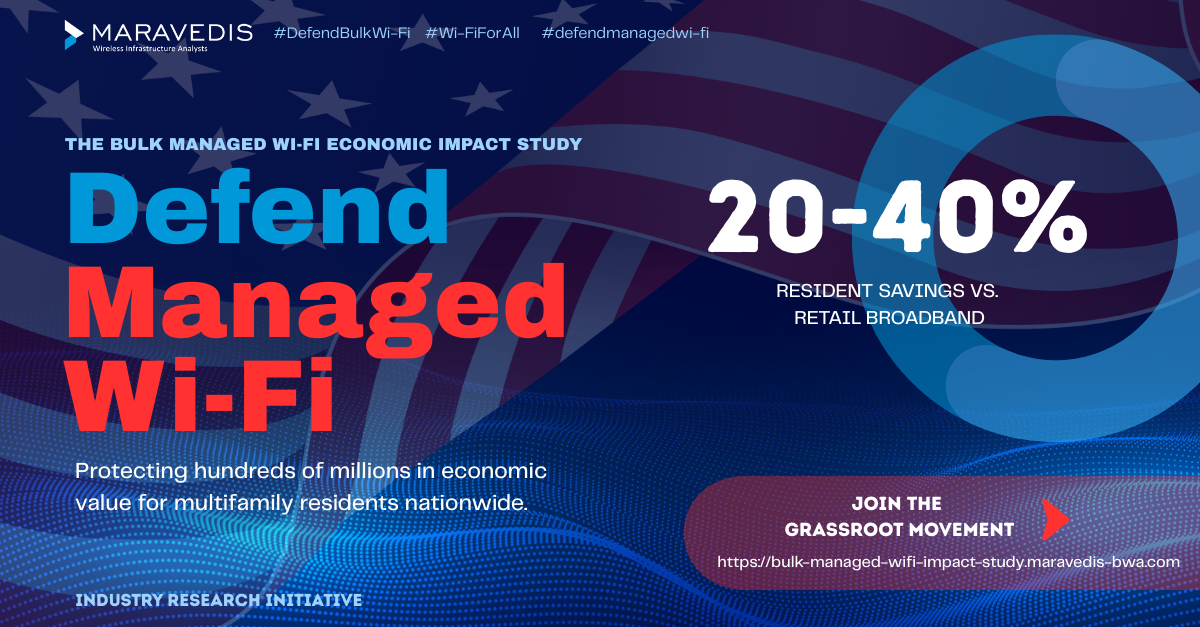
1. Resident Cost Savings & Digital Equity — Documenting the 20–40% cost reductions residents capture through bulk pricing, and the barrier-free access that benefits low-income, student, and senior populations most.
2. Infrastructure Efficiency — Calculating the avoided costs of redundant wiring, duplicate truck rolls, and building disruption when multiple ISPs install parallel systems.
3. Professional Network Performance — Quantifying the productivity and quality-of-life gains from enterprise-grade, always-on connectivity versus fragmented retail alternatives.
4. Environmental Sustainability — Valuing energy savings, water conservation, and e-waste reduction enabled by IoT-connected smart buildings.
5. PropTech Enablement — Assessing the economic value of smart access controls, security systems, and building management technologies that depend on community-wide connectivity.
6. Regulatory Scenario Modeling — Projecting economic outcomes under five distinct policy frameworks, including opt-out mandates, open access requirements, markup restrictions, and combined regulatory packages.
The research will produce six deliverables purpose-built for advocacy use: a 50–70 page comprehensive research report, a 4–6 page executive summary for legislative testimony, a digital equity impact analysis, a regulatory scenario analysis applicable to any state jurisdiction, a technical data appendix, and a 20–25 slide stakeholder presentation deck.
Janus Norman, President & CEO, California Broadband & Video Association, said, "If we had had the economic data, our ability to challenge AB 1414 would have been greatly enhanced. The threat is real. Being prepared — so that ISPs and property owners can come together — is critical to warding off the spread of legislation like this to other states."
Taylor P. Jones, President and CTO, Elauwit Connection Inc., said, “Managed Wi-Fi is no longer just a perk; it is the central nervous system of the modern apartment community. While we know that high-speed, managed bulk broadband elevates the resident experience and creates a clear competitive advantage, the market needs independent, empirical research to quantify this value. We strongly support funding this study to provide operators and owners with the definitive data required to navigate the future of multifamily technology.”
Dan Myers, Founder/CEO - Dojo Networks, said, "Bulk managed Wi-Fi is the most affordable way to deliver reliable broadband at scale in dense housing—especially for affordable, student, conventional/luxury, and senior communities where cost and simplicity matter. When connectivity is treated as shared infrastructure, residents get better performance, faster support, and more predictable costs, while properties avoid the inefficiency and disruption of multiple overlapping installs. We need a data-driven policy that recognizes what managed Wi-Fi truly enables in modern multifamily living."
Scott McGee, Founder & President, Connext Strategies, said, “Bulk managed Wi-Fi is more than a tech decision; it’s an economic one. It affects resident costs, property performance, infrastructure strategy, and how well a building can support modern PropTech. If states are going to consider restricting these models, the conversation needs real data, not assumptions. Independent research gives owners and operators something solid to stand on.”
World-Class Research Team
The study will be led by Adlane Fellah (CWTS, CWNA), Chief Analyst at Maravedis Research, in partnership with Dr. Raul Katz, Ph.D., and M.S. from MIT, President of Telecom Advisory Services, LLC, and Director of Business Strategy Research at the Columbia Institute for Tele-Information, Columbia Business School. The research team also includes three senior economists and a telecom engineer with deep experience in broadband economic analysis across the U.S. and internationally.
Industry-Backed Crowdfunding Model
The campaign is open to all stakeholders with a material interest in the multifamily managed Wi-Fi ecosystem: managed service providers (MSPs), internet service providers, PropTech companies, property owners and REITs, equipment manufacturers, and industry associations.
"No single company should bear the full cost of producing the industry-wide evidence needed to counter this legislation," said Fellah. "A crowdfunding model distributes the investment across the stakeholders who benefit most and produces findings with greater credibility than any single-sponsor study could achieve."
The Urgency Is Now
The regulatory threat is both immediate and escalating. California AB 1414 is now law. Colorado's restrictions are already in force. Legislators advancing these bills face no credible economic counterargument — because the industry has not yet produced one. The Bulk Managed Wi-Fi Economic Impact Study is designed to close that gap, providing defensible, peer-level analysis that withstands regulatory and media scrutiny in any state jurisdiction.
How to Contribute
Organizations interested in funding this research can learn more and register their contribution at https://bulk-managed-wifi-impact-study.maravedis-bwa.com, or contact Adlane Fellah directly at info@maravedis-bwa.com or +1 (305) 865-1006.
About Maravedis Research
Maravedis Research is a leading independent wireless and connectivity analyst firm founded in 2002. The firm specializes in managed Wi-Fi, MDU connectivity, and
Adlane Fellah
Maravedis LLC
+1 305-865-1006
afellah@Maravedis-bwa.com
Visit us on social media:
LinkedIn
YouTube
X
Legal Disclaimer:
EIN Presswire provides this news content "as is" without warranty of any kind. We do not accept any responsibility or liability for the accuracy, content, images, videos, licenses, completeness, legality, or reliability of the information contained in this article. If you have any complaints or copyright issues related to this article, kindly contact the author above.
