
.jpeg)


The Business Research Company
Light Vehicle Fuel Injection Market Overview
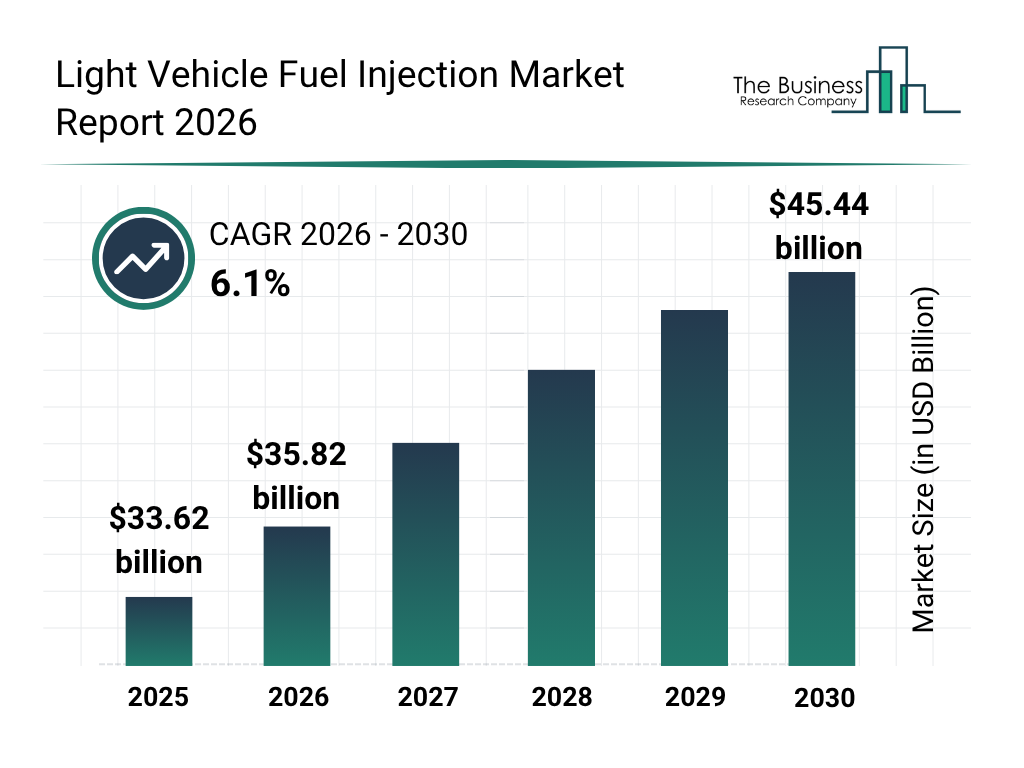
The Business Research Company's Light Vehicle Fuel Injection Market Growth Rate Expected To Reach 6.1% CAGR By 2030
LONDON, GREATER LONDON, UNITED KINGDOM, November 27, 2026 /EINPresswire.com/ -- "The light vehicle fuel injection market has experienced substantial growth over recent years, driven by evolving automotive technologies and stricter regulations. As manufacturers focus on improving fuel efficiency and reducing emissions, this sector continues to expand with promising prospects on the horizon. Let’s delve into the market’s development, the key factors fueling its growth, prominent segments, emerging trends, regional dynamics, and leading companies shaping its future.
Light Vehicle Fuel Injection Market Size and Growth Outlook
Recent years have seen a robust increase in the light vehicle fuel injection market size. Projections indicate that the market will grow from $33.62 billion in 2025 to $35.82 billion in 2026, achieving a compound annual growth rate (CAGR) of 6.6%. This growth during the historical period has been mainly driven by rising passenger vehicle production, expanding light commercial vehicle fleets, wider adoption of electronic fuel injection systems, tightening emissions standards, and escalating demand for better fuel economy. Looking ahead, the market is expected to continue its upward trajectory, reaching $45.44 billion by 2030 at a CAGR of 6.1%. Factors contributing to this future expansion include increasing demand for low-emission internal combustion engines, greater use of gasoline direct injection systems, growing interest in advanced fuel injectors, heightened integration of electronically controlled fuel systems, and the rise of alternative-fuel light vehicles. Key trends shaping the forecast period involve the greater adoption of high-pressure fuel injection systems, development of sophisticated multi-hole injectors, expanded use of gasoline direct injection, enhanced variable fuel pressure control, and creation of more compact, lightweight fuel injection components.
Download a free sample of the light vehicle fuel injection market report:
https://www.thebusinessresearchcompany.com/sample_request?id=96102020&type=smp&name=Light%20Vehicle%20Fuel%20Injection%20Market%20Report%202026&utm_source=EINPresswire&utm_medium=Paid&utm_campaign=Nov_PR
Fuel-Efficient Vehicle Demand as a Growth Catalyst in the Light Vehicle Fuel Injection Market
One of the principal drivers behind the light vehicle fuel injection market’s growth is the surging demand for fuel-efficient light vehicles. These vehicles, which include passenger cars and light-duty vehicles, are engineered to maximize fuel economy by reducing fuel consumption without sacrificing driving performance or emission compliance. The rising cost of fuel has pushed consumers to favor vehicles that offer lower operating expenses, thus creating a stronger market for technologies that enhance fuel efficiency. This demand directly boosts the adoption of advanced fuel injection systems, which precisely manage fuel delivery, enhance combustion efficiency, lower emissions, and improve overall engine performance. For example, in February 2026, the U.S. Environmental Protection Agency reported that the average real-world fuel economy of new 2024 vehicle models reached a record 27.2 miles per gallon, reflecting ongoing progress in vehicle efficiency. This trend clearly supports expansion within the light vehicle fuel injection market.
Additional Factors Reinforcing Growth in the Light Vehicle Fuel Injection Market
Beyond fuel efficiency, regulatory pressures to limit vehicular emissions also play a significant role in propelling the market. Governments worldwide are imposing stricter emission standards, encouraging manufacturers to adopt advanced fuel injection technologies that help meet these requirements. Furthermore, technological advancements in fuel injector design and the push for alternative fuel compatibility add momentum to market growth. The convergence of these factors ensures sustained interest and investment in fuel injection systems within light vehicles.
View the full light vehicle fuel injection market report:
https://www.thebusinessresearchcompany.com/report/light-vehicle-fuel-injection-market-report?utm_source=EINPresswire&utm_medium=Paid&utm_campaign=Nov_PR
Key Segments Leading the Light Vehicle Fuel Injection Market Expansion
The light vehicle fuel injection market is organized into several critical segments based on type, components, fuel type, and sales channels.
By Type, the market includes:
- Gasoline Port Fuel Injection (PFI) with subtypes such as Single Point Port Injection, Multi Point Port Injection, and Sequential Port Injection
- Gasoline Direct Injection (GDI), further segmented into Wall Guided Direct Injection, Spray Guided Direct Injection, and Air Guided Direct Injection
- Common Rail Direct Injection (CRDI), which includes Solenoid Injector Systems and Piezoelectric Injector Systems
- Throttle Body Injection (TBI) divided into Single Injector and Dual Injector Throttle Body Injection
By Component, the market covers Fuel Injectors, Fuel Pumps, Fuel Rails, Fuel Pressure Regulators, Electronic Control Units (ECU), Fuel Filters, and Fuel Injection Sensors.
Fuel types span Diesel, Compressed Natural Gas, Liquefied Petroleum Gas, Ethanol or Flex-Fuel, and Hydrogen.
In terms of sales channels, the segments include Original Equipment Manufacturer (OEM) and Aftermarket sales. These divisions offer a detailed view of the market's structure and growth drivers.
How Current Trends Are Reshaping the Light Vehicle Fuel Injection Market’s Future
Leading companies in this market are heavily investing in the development of advanced, high-pressure gasoline direct injection (GDI) systems. These systems aim to improve fuel efficiency, reduce particulate emissions, and comply with future emission standards. High-pressure GDI technology injects fuel directly into the combustion chamber under elevated pressure, allowing finer fuel atomization, better combustion, and lower emissions. For instance, in April 2026, PHINIA Inc., a US-based fuel systems manufacturer, introduced its 500bar+ gasoline direct injection system at Auto China 2026. This system features optimized software and fuel injection technology designed to enhance atomization, increase fuel economy, and reduce particulate emissions while supporting multi-fuel vehicle applications through methanol and ethanol injection capabilities.
Geographical Markets Driving the Light Vehicle Fuel Injection Industry’s Growth
Geographically, Asia-Pacific led the light vehicle fuel injection market in 2025 and is forecast to remain the fastest-growing region throughout the coming years. The report also provides insights into other key regions including South East Asia, Western Europe, Eastern Europe, North America, South America, the Middle East, and Africa, outlining their roles in the global market’s trajectory.
Prominent Players Leading Competition in the Light Vehicle Fuel Injection Market
Competition in this market is shaped by a range of major global companies, including Robert Bosch GmbH, DENSO Corporation, BorgWarner Inc., Marelli Holdings Co. Ltd., Hitachi Astemo Ltd., Rheinmetall AG, Sensata Technologies Inc., PHINIA Inc., Aisan Industry Co. Ltd., Standard Motor Products Inc., Shindengen Electric Manufacturing Co. Ltd., Stanadyne LLC, UCAL Limited, Dell'Orto S.p.A., and GB Remanufacturing Inc. These players continue to innovate and expand their product portfolios to meet the evolving demands of the sector.
New additions to our 2026 reports:
• Market attractiveness scoring and analysis
• Total addressable market (TAM) analysis
• Company scoring matrix graphics and tables
• Excel-based forecasting dashboards
• Market hotspots infographics
• Key technologies and future trend analysis
• Updated graphics and tables
Speak With Our Expert:
Saumya Sahay
Americas +1 310-496-7795
Asia +44 7882 955267 & +91 8897263534
Europe +44 7882 955267
Email: marketing@tbrc.info
The Business Research Company - www.thebusinessresearchcompany.com
Follow Us On:
• LinkedIn: https://in.linkedin.com/company/the-business-research-company"
Oliver Guirdham
The Business Research Company
+44 7882 955267
info@tbrc.info
Visit us on social media:
LinkedIn
Facebook
X
Legal Disclaimer:
EIN Presswire provides this news content "as is" without warranty of any kind. We do not accept any responsibility or liability for the accuracy, content, images, videos, licenses, completeness, legality, or reliability of the information contained in this article. If you have any complaints or copyright issues related to this article, kindly contact the author above.
