


Preventive cardiology doesn't need more CCTA, it needs AI-CVD
AI-CAC and AI-CVD

HeartLung Logo
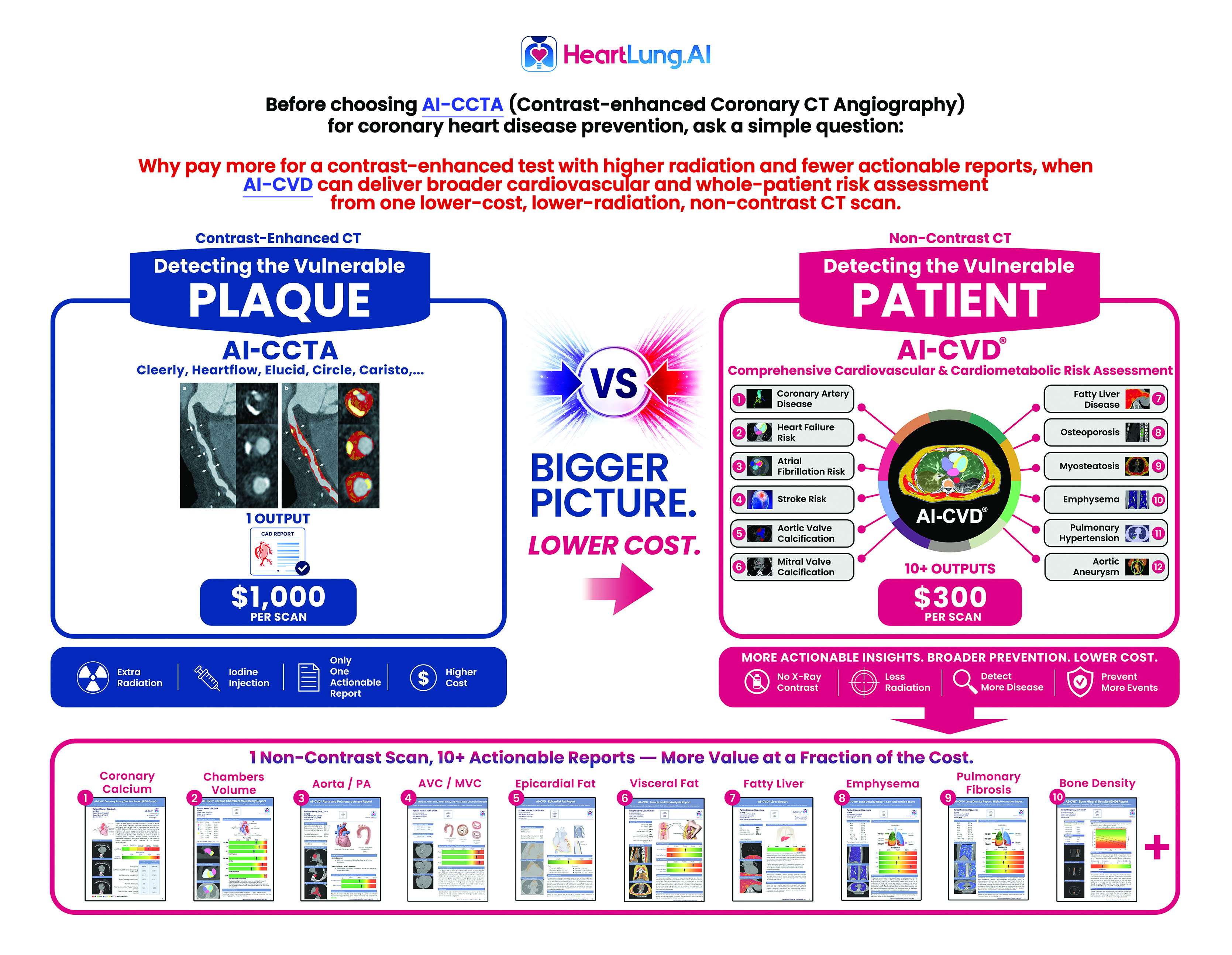
AI-CVD challenges plaque-centric AI-CCTA with CAC-based primary prevention: one non-contrast CT, lower cost and radiation, 10+ reports.
If CCTA prevents more heart attacks than CAC, prove it.”
SAN DIEGO, CA, UNITED STATES, July 6, 2026 /EINPresswire.com/ -- HeartLung Corporation (HeartLung.AI), a medical AI company transforming CT imaging into preventive care intelligence, today announced the launch of its "Why Pay More and Get Less?" Campaign at SCCT 2026, the 21st Annual Scientific Meeting of the Society of Cardiovascular Computed Tomography, taking place July 9-12, 2026 at the Gaylord Pacific Resort & Convention Center in the San Diego area.— Morteza Naghavi, M.D.
The campaign asks physicians, imaging centers, payers and patients or consumers to question the expanding commercial push by AI-CCTA companies - including Cleerly, HeartFlow, Elucid, Caristo and others - to promote contrast-enhanced coronary CT angiography plaque analysis as a routine heart-attack prevention strategy for asymptomatic adults.
The campaign challenges a different and increasingly common implication: that people without chest pain or symptoms should undergo a higher-cost, contrast-enhanced CCTA plus AI plaque analysis to prevent heart attacks, even when a lower-cost, non-contrast CAC scan powered by AI can provide broader whole-patient information.
The campaign's central question is simple: why pay more for a contrast-enhanced, plaque-focused test with fewer actionable report domains, when AI-CVD can deliver CAC, AI-CAC and 10+ cardiovascular and cardiometabolic reports from one eligible lower-cost, non-contrast CT scan?
"AI-CCTA companies are entitled to compete, but marketing implication is not evidence," said Morteza Naghavi, MD, Founder of HeartLung.AI. "If companies want to tell asymptomatic people that contrast-enhanced CCTA is the better prevention strategy, they should show the clinical proof. Otherwise, they should stop implying that more plaque color maps automatically mean better prevention. Plaque matters, but prevention is about the vulnerable patient - not only the vulnerable plaque."
Vulnerable plaque vs vulnerable patient
AI-CCTA platforms have advanced the ability to characterize coronary plaque from contrast-enhanced CCTA. That information may be valuable when CCTA is medically indicated. But using visually compelling plaque maps to suggest that asymptomatic adults need CCTA for prevention risks returning preventive cardiology to a narrow vulnerable-plaque mindset.
HeartLung's campaign reframes the question. The clinical goal is not simply to find more plaque. The goal is to identify the vulnerable patient - the person whose total cardiovascular and cardiometabolic risk justifies earlier, more intensive and more personalized prevention.
A plaque-only report does not measure chamber enlargement, left ventricular mass, valvular calcium, aortic calcium, pulmonary artery size, lung density, liver density, visceral fat, skeletal muscle density or bone mineral density. AI-CVD is designed to surface these patient-level biomarkers from eligible CT scans so clinicians can see a broader prevention picture.
Before choosing AI-CCTA for asymptomatic prevention, ask these questions
• Why CCTA if the person has no chest pain, no symptoms and no medical indication for diagnostic CCTA?
• What clinically actionable information does AI-CCTA add beyond CAC, AI-CAC, standard risk factors, LDL-C, Lp(a), blood pressure, diabetes status, smoking status and family history?
• Will the result change treatment beyond therapies already justified by CAC and risk-factor assessment?
• Does the claimed benefit justify contrast exposure, higher radiation, beta-blocker use when needed, workflow complexity, downstream testing, patient anxiety and higher cost?
• If the answer is "AI-CCTA is better," where is the clinical evidence showing better prevention, better value and better patient outcomes in asymptomatic adults?
AI-CVD: one non-contrast scan, 10+ actionable reports
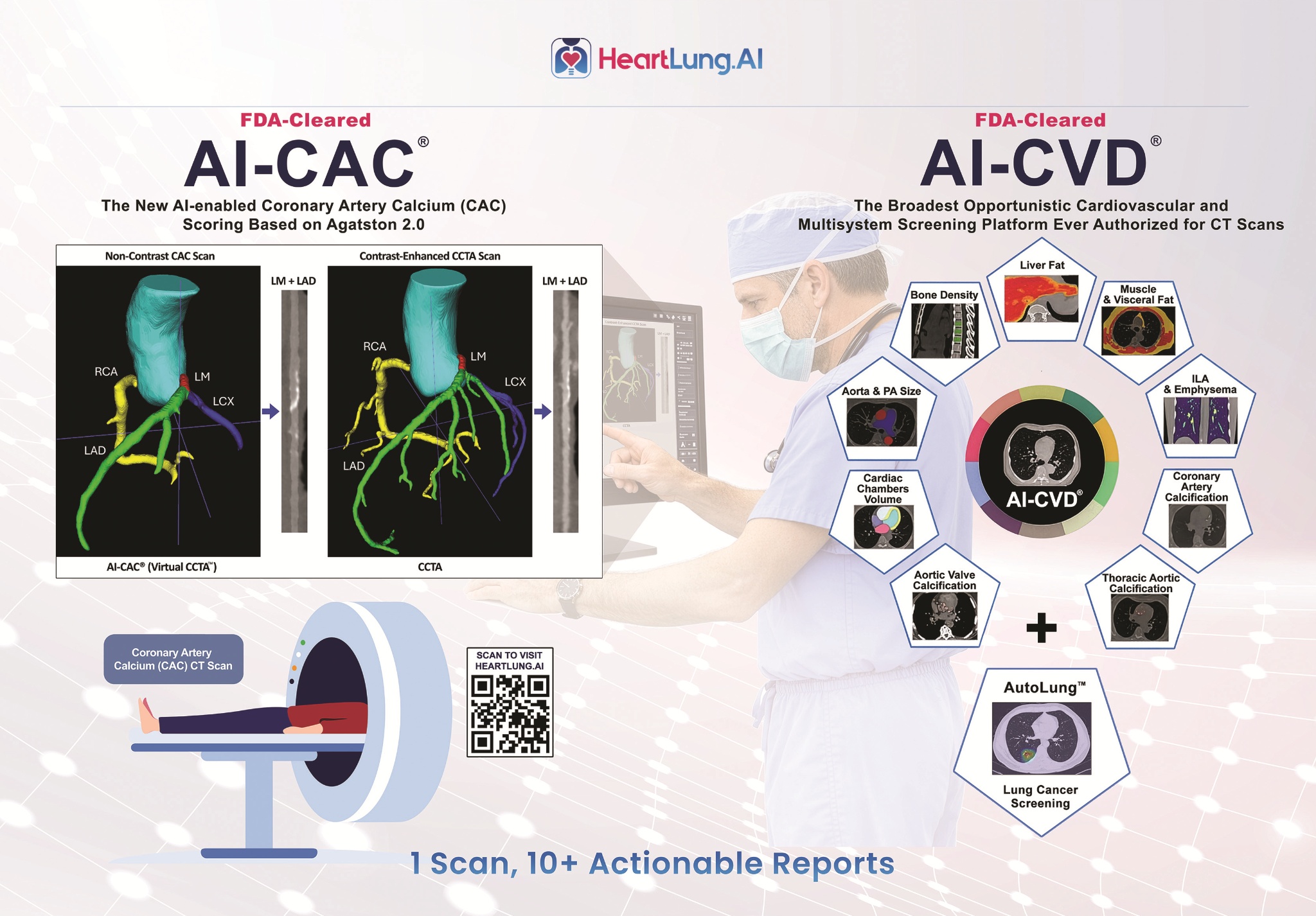
HeartLung will use SCCT 2026 to demonstrate AI-CVD as a broader prevention platform. From one eligible CT scan, AI-CVD can generate clinician-reviewed quantitative reports across:
• Coronary artery calcium and AI-CAC / Agatston-2.0 based scoring workflows
• Thoracic aortic calcium, aortic valve calcium and mitral valve calcium
• Cardiac chamber volumes, left ventricular mass and chamber-ratio measurements
• Aorta and pulmonary artery sizing
• Epicardial fat, visceral fat, skeletal muscle density and body-composition biomarkers
• Liver density and fatty-liver assessment support
• Lung density measurements relevant to emphysema and other pulmonary findings
• Bone mineral density assessment support
• Optional integration with HeartLung's expanding CT AI portfolio, including AutoLung AI for lung cancer assessment workflows
"AI-CCTA asks one coronary question. AI-CVD asks the bigger prevention question: what is happening to the whole patient?" Dr. Naghavi added. "That is why our campaign asks: why pay more and get less?"
Campaign launch at SCCT 2026
At SCCT 2026, HeartLung will present the "Why Pay More and Get Less?" Campaign through booth graphics, educational materials, app demonstrations and clinician discussions focused on AI-CVD vs AI-CCTA value in asymptomatic prevention.
HeartLung will demonstrate the AI-CVD app and full AI-CVD package, including scan upload, AI processing, report generation, clinical review, patient access and report-sharing workflows.
SCCT attendees are invited to visit HeartLung at Booth 505 at the Gaylord Pacific Resort & Convention Center, July 10-12, during posted exhibit hours.
Important clinical and regulatory clarification
HeartLung does not recommend that patients ignore symptoms or avoid medically indicated diagnostic testing. Patients with chest pain, concerning symptoms or high-risk clinical findings should follow clinician-directed diagnostic pathways, which may include CCTA, stress testing or invasive angiography when appropriate.
AI-CVD is an opportunistic, AI-powered quantitative imaging tool that provides automated CT-derived anatomical and density-based measurements for clinician review. Consistent with its cleared indications, AI-CVD is intended to aid physicians and other healthcare providers in determining whether additional diagnostic tests are appropriate for preventive healthcare planning. AI-CVD reports are intended for review by radiologists or other medical professionals and should be used together with clinical evaluation. The software does not provide diagnostic interpretation or standalone risk prediction.
About HeartLung.AI
HeartLung.AI is a health-tech company pioneering AI-driven preventive imaging for early detection of cardiovascular disease, lung cancer, COPD, osteoporosis, fatty liver disease, myosteatosis and other cardiometabolic conditions detectable on routine medical imaging. Its FDA-cleared flagship platform, AI-CVD, transforms eligible CT scans into comprehensive preventive health assessments by automatically quantifying coronary artery calcium, aortic and valvular calcification, cardiac chamber size, aorta and pulmonary artery size, epicardial and visceral fat, liver density, lung density, bone mineral density and muscle-fat composition. HeartLung requires no new hardware or local software installation. Hospitals and imaging centers can connect PACS to the HeartLung.AI cloud or manually upload scans and receive AI-generated DICOM and PDF reports.
Marlon Montes
HeartLung.AI
+1 310-510-6004
email us here
Visit us on social media:
LinkedIn
X
Legal Disclaimer:
EIN Presswire provides this news content "as is" without warranty of any kind. We do not accept any responsibility or liability for the accuracy, content, images, videos, licenses, completeness, legality, or reliability of the information contained in this article. If you have any complaints or copyright issues related to this article, kindly contact the author above.
