


Artificial Intelligence Eye Screening System Market
Global AI Eye Screening System Market Report 2026-2032: Asia-Pacific Demand Accelerates as Medical Institutions Expand Adoption
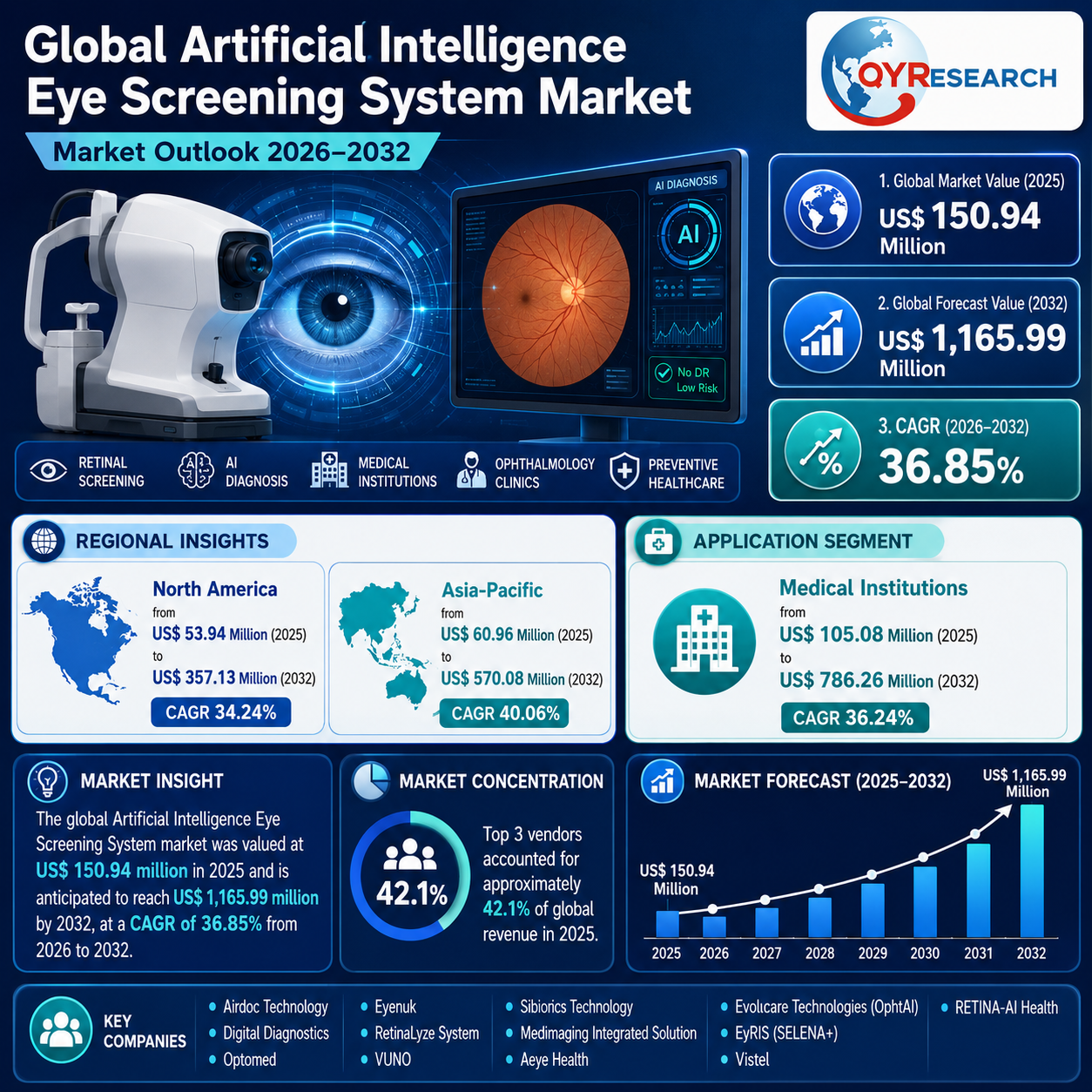
LOS ANGELES, CA, UNITED STATES, July 9, 2026 /EINPresswire.com/ -- Los Angeles, United States; July 8, 2026 — QYResearch announces the release of its latest study, “Global Artificial Intelligence Eye Screening System Market Insights - Industry Share, Sales Projections, and Demand Outlook 2026-2032,” offering a detailed evaluation of one of the most dynamic segments in digital health and ophthalmic diagnostics. According to the study, the global Artificial Intelligence Eye Screening System market was valued at US$ 150.94 million in 2025 and is anticipated to reach US$ 1,165.99 million by 2032, reflecting a powerful expansion cycle as healthcare systems, technology providers, and care delivery networks increase emphasis on earlier detection, faster triage, and scalable screening models.One of the key market highlights emphasized in the report is the speed at which this category is moving from emerging innovation to practical clinical utility. Artificial intelligence eye screening systems are increasingly being recognized as more than a technology upgrade. They are becoming an operational tool for improving screening throughput, supporting earlier disease identification, reducing specialist bottlenecks, and helping institutions manage higher patient volumes with greater consistency. For healthcare stakeholders, this means the market is not expanding on hype alone. It is being shaped by measurable demand for accessible screening pathways, digital workflows, and more efficient eye health programs.
Download Exclusive Research Report PDF Sample: (Including Full TOC, List of Tables & Figures, Chart) @ https://www.qyresearch.in/request-sample/medical-devices-consumables-global-artificial-intelligence-eye-screening-system-market-insights-industry-share-sales-projections-and-demand-outlook-2026-2032
From a market overview perspective, the report positions Artificial Intelligence Eye Screening Systems as a strategic intersection of ophthalmology, medical imaging, software automation, and preventive care. Demand is being supported by the growing need to identify vision-threatening conditions earlier, especially in environments where specialist access may be constrained or screening rates remain below target. At the same time, the market is being strengthened by wider familiarity with AI-assisted diagnostics, greater comfort with image-based clinical decision support, and a broader shift toward decentralized and point-of-care care models. The result is a market with strong momentum, a widening commercial base, and rising relevance across multiple healthcare ecosystems.
Market key drivers remain central to the outlook through 2032. QYResearch finds that expansion is being propelled by the rising burden of chronic disease, growing awareness of preventable vision loss, increasing investment in digital health infrastructure, and the business case for more efficient screening workflows. AI-enabled eye screening can create value for hospitals and clinics by supporting resource optimization, faster patient routing, and more standardized image interpretation. For manufacturers and technology firms, the growth story is also tied to improving algorithm performance, broader hardware compatibility, more user-friendly interfaces, and expanding integration with electronic care environments. Together, these factors are transforming demand from episodic procurement into longer-term adoption.
Regional insights in the report show that growth is not evenly distributed, and that geography matters in both revenue opportunity and commercialization strategy. North America is projected to increase from US$ 53.94 million in 2025 to US$ 357.13 million by 2032, supported by stronger digital health infrastructure, growing familiarity with AI-enabled diagnostics, and continued interest in scalable screening across institutional settings. Asia-Pacific is projected to rise from US$ 60.96 million in 2025 to US$ 570.08 million by 2032, making it the standout growth region in the study. The region’s performance reflects a compelling combination of large population bases, expanding healthcare modernization, rising diabetes-related screening needs, and stronger momentum around technology-led access models. Europe also remains strategically important, particularly where screening modernization, medtech adoption, and cross-border clinical innovation support wider uptake.
The report’s market segmentation analysis adds another layer of commercial clarity. By end-use setting, medical institutions represent a major revenue engine, with the global market for Artificial Intelligence Eye Screening System in medical institutions estimated to increase from US$ 105.08 million in 2025 to US$ 786.26 million by 2032. This signals that hospitals, eye care networks, and organized clinical environments are likely to remain at the center of early and scaled deployment. Beyond end use, the report examines segmentation from the standpoint of workflow needs, adoption pathways, deployment priorities, and purchasing logic, helping readers understand not just where revenue sits today, but how demand may evolve as AI screening becomes more embedded in routine care.
In terms of competitive landscape, the report identifies a marketplace where innovation, validation, commercialization, and partnerships all matter. Major global companies include Airdoc Technology, Digital Diagnostics, Optomed, Eyenuk, RetinaLyze System, VUNO, Sibionics Technology, Medimaging Integrated Solution, Aeye Health, Evolucare Technologies (OphtAI), EyRIS (SELENA+), Vistel, and RETINA-AI Health, among others. In 2025, the world’s top three vendors accounted for approximately 42.1% of revenue, indicating a market that has visible leaders but still retains meaningful room for challengers, regional specialists, and platform-focused innovators. This type of structure is particularly important for investors and manufacturers because it suggests both competitive intensity and white-space opportunity.
Market trends and dynamics further reinforce why this is a category to watch. QYResearch observes increasing demand for autonomous or semi-autonomous screening workflows, stronger interest in portable and point-of-care imaging ecosystems, and a growing preference for solutions that can improve speed without compromising trust or usability. There is also a perceptible shift away from viewing AI tools as standalone software and toward seeing them as part of a broader care delivery architecture. This includes interoperability, easier clinical implementation, better patient throughput, and real-world adaptability across primary care, specialty care, and outreach settings. As these dynamics mature, solution differentiation will depend not only on algorithm accuracy, but also on workflow fit, scalability, and commercial execution.
Recent developments in the industry suggest that the category is entering a more mature commercialization phase. Regulatory milestones, broader real-world validation, and the emergence of handheld or more flexible screening formats are helping the market move beyond concept-stage enthusiasm. Vendors are also investing in broader clinical use cases, platform compatibility, and market education, all of which can expand the addressable opportunity. This matters because the strongest winners in the next cycle are likely to be those that can combine technical credibility with channel access, implementation support, and evidence-based market positioning.
So what is in it for you? For investors, the report provides a sharper lens on a high-growth niche where adoption is increasingly tied to real healthcare demand and not simply speculative AI sentiment. For researchers, it offers a current view of where clinical need, commercialization, and regional expansion are intersecting. For manufacturers and technology developers, it delivers actionable intelligence on demand patterns, competitive positioning, institutional opportunities, and where differentiation will matter most. For strategy teams, product leaders, and corporate development professionals, it supports better timing, clearer prioritization, and stronger market-entry or expansion decisions.
The report also delivers key executive benefits. It helps decision-makers benchmark regional opportunity, understand which end-use environments are driving revenue, track concentration among leading firms, and evaluate how market structure may shift through 2032. It is particularly useful for organizations that need to move quickly from broad market interest to concrete decisions around investment, product roadmap planning, partnership evaluation, distribution priorities, or competitive response. In a fast-moving market, having visibility into both current structure and forward demand can create an important strategic advantage.
Why purchase this report? Because the Artificial Intelligence Eye Screening System market is no longer just an adjacent opportunity within healthcare AI. It is becoming a defined commercial category with growing relevance to vision care, chronic disease screening, digital diagnostics, and health system efficiency. QYResearch’s study is designed to help buyers cut through fragmented information and move directly to the insights that influence decisions: revenue trajectory, regional outlook, growth catalysts, market segmentation, major vendors, and likely areas of competitive pressure and expansion. Whether your goal is investment evaluation, product planning, market entry, or partnership development, the report is built to support sharper decision-making.
The report also addresses key questions that matter right now. How large can the global Artificial Intelligence Eye Screening System market become by 2032? Which regions are likely to deliver the strongest revenue momentum? Why is Asia-Pacific emerging as such a powerful growth story? How concentrated is the competitive landscape, and where is room still available for differentiation? What role will medical institutions continue to play in adoption? Which demand drivers are structural, and which are more cyclical? And how should investors, manufacturers, and researchers interpret recent market developments in the context of long-term opportunity?
For readers looking to build wider topical authority in adjacent sectors, QYResearch also encourages exploration of more research reports across ophthalmic diagnostics, retinal imaging, medical AI, healthcare automation, digital screening technologies, and clinical decision-support markets. These related domains can offer valuable context for businesses seeking a broader understanding of how AI is reshaping preventive care, image-based healthcare workflows, and specialty diagnostics worldwide.
QYResearch continues to support clients who need reliable market intelligence, sharper forecasting visibility, and commercially relevant analysis in fast-changing industries. This latest study on the global Artificial Intelligence Eye Screening System market is positioned to help stakeholders navigate a market defined by rapid innovation, rising demand, and increasingly strategic competition.
Explore Full Report With Detailed TOC Here @ https://www.qyresearch.in/report-details/2045837/Global-Artificial-Intelligence-Eye-Screening-System-Market-Insights
About QYResearch
QYResearch founded in California, USA in 2007. It is a leading global market research and consulting company. With over 19 years’ experience and professional research team in various cities over the world QY Research focuses on management consulting, database and seminar services, IPO consulting (data is widely cited in prospectuses, annual reports and presentations), industry chain research and customized research to help our clients in providing non-linear revenue model and make them successful. We are globally recognized for our expansive portfolio of services, good corporate citizenship, and our strong commitment to sustainability. Up to now, we have cooperated with more than 70,000 clients across five continents. Let’s work closely with you and build a bold and better future.
Contact US
Ankit Jain - Director, Global Digital Marketing
QY Research, INC.
India Office -
315Work Avenue, Raheja Woods, Kalyani Nagar,
Pune, Maharashtra 411006, India
Web – https://www.qyresearch.in
Email- ankit@qyresearch.com
Ankit Jain
QY Research India
6262952442 ext.
ankit@qyresearch.com
Legal Disclaimer:
EIN Presswire provides this news content "as is" without warranty of any kind. We do not accept any responsibility or liability for the accuracy, content, images, videos, licenses, completeness, legality, or reliability of the information contained in this article. If you have any complaints or copyright issues related to this article, kindly contact the author above.
