


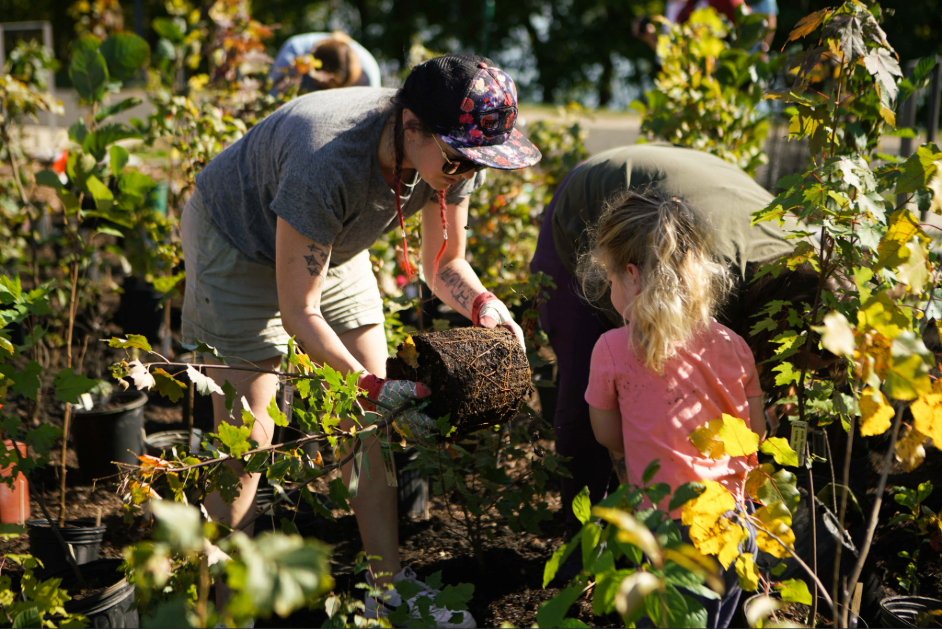
Families plant miniforest at Belmont High School
Online gathering July 15–23 brings together enthusiasts and leading researchers to explore the science and practice of creating tiny urban forests.
People are empowered when they plant a miniforest and watch it come to life. They sense that healing the planet is not only possible, but already happening one community at a time.”
CAMBRIDGE, MA, UNITED STATES, June 29, 2026 /EINPresswire.com/ -- CAMBRIDGE, Mass. — Five years after planting New England's first Miyawaki forest, Biodiversity for a Livable Climate (Bio4Climate) is convening foresters, scientists, and community leaders from across North America and beyond for the Second Annual Northeast Miniforest Summit, taking place July 15–23, 2026. The online gathering, themed "Root to Canopy: Growing the Miyawaki Method," reflects the growth of a movement empowering communities to regenerate forest ecosystems in small urban spaces.— Beck Mordini, Executive Director, Bio4Climate
Japanese forester, Mio Urata, who worked directly with Dr. Miyawaki will open the Summit and join Hannah Lewis, author of “Mini-Forest Revolution” in panel discussions. Keynote speaker Ethan Tapper is the bestselling author of "How to Love a Forest: The Bittersweet Work of Tending a Changing World."
Online presentations and panels cover soil ecology, long-term stewardship, and community engagement, with opportunities to network and share ideas. The documentary, "Making a Mini-Forest," will be screened on-line on July 15. Registration is also available for an in-person guided bus tour of Massachusetts miniforest sites on July 18. Details are available at miniforests.bio4climate.org.
Developed by Japanese botanist Dr. Akira Miyawaki, this method uses densely planted native species to create fast-growing, self-sustaining forests in small spaces in schoolyards and parks to vacant lots.
Bio4Climate led a partnership with the City of Cambridge, MA and SUGi in 2021 to plant New England's first Miyawaki forest at Danehy Park. Since then, the organization has helped establish eight miniforests across the region while inspiring schools, municipalities, and community organizations to launch projects of their own. The inaugural Northeast Miniforest Summit attracted more than 500 registrants, demonstrating the growing interest in this approach to ecological restoration.
Rising temperatures, biodiversity loss, and mounting climate impacts are creating increased interest in building local climate resilience. Research published in the American Geophysical Union journal "Earth’s Future" found that a century of forest regrowth helped moderate warming across the eastern United States. The study underscores the role forests play not only in storing carbon but in cooling landscapes and increasing climate resilience.
As miniforests spread across the Northeast, practitioners are asking deeper questions about soil ecology, long-term stewardship, community engagement, biodiversity, and climate adaptation. The Summit provides a forum for advancing the science, practice, and impact of the Miyawaki method while accelerating learning across the field.
Municipalities are particularly interested in how successful these tiny forests really are. Summit speakers bring various perspectives on how to measure success. Damien Willette, PhD will share how the Ascot Hills microforest in LA, CA serves as a research site for his work at Loyola Marymount University. Jennifer Bhatnagar, PhD of Boston University reminds us that success isn’t just what you see above ground in her presentation on the soil microbiome. Brad Oberle, PhD of the NY Botanical Garden Garden, links it back to climate. Each of the nearly 20 speakers brings not only examples of exciting forest projects, but deeper insight into what we are learning and emerging best practices.
"The miniforest movement offers a powerful antidote to climate anxiety," said Beck Mordini, Executive Director of Bio4Climate. "People often feel overwhelmed by the scale of environmental challenges. Miniforests give communities the power to bring nature back where they live and see the results in real time. They prove that regeneration isn't a distant goal—it's something we can start here and now, together."
"Miniforests support the interdependence of life," said Alexandra Ionescu, Associate Director of Regenerative Projects at Bio4Climate. "They strengthen connections above and below-ground through the cycling of carbon, nutrients, and water, while deepening relationships between people and place. These forests may be small, but they help restore living systems at every scale."
About Biodiversity for a Livable Climate (Bio4Climate)
Biodiversity for a Livable Climate (Bio4Climate) is a nonprofit organization founded in 2013, dedicated to restoring biodiversity as a primary strategy for addressing the climate crisis. Through education, advocacy, and on-the-ground projects, Bio4Climate works to strengthen living climate systems and support ecological regeneration. Learn more at bio4climate.org.
Beck Mordini
Bio4Climate
staff@bio4climate.org
Legal Disclaimer:
EIN Presswire provides this news content "as is" without warranty of any kind. We do not accept any responsibility or liability for the accuracy, content, images, videos, licenses, completeness, legality, or reliability of the information contained in this article. If you have any complaints or copyright issues related to this article, kindly contact the author above.
