


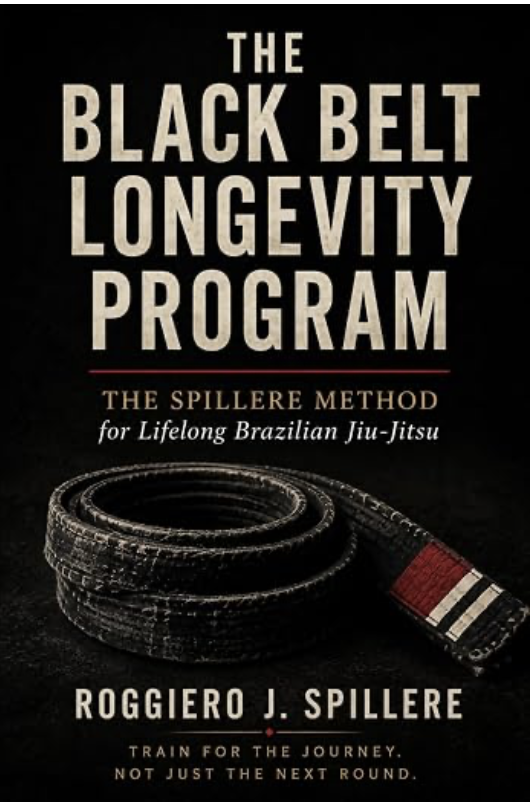
Cover of The Black Belt Longevity Program: The Spillere Method for Lifelong Brazilian Jiu-Jitsu by Roggiero J. Spillere.
After beginning Brazilian Jiu-Jitsu at age 47, economist, educator, and author Roggiero J. Spillere presents a framework for training well beyond midlife.
Getting older doesn’t mean we stop learning. It changes how we learn. Brazilian Jiu-Jitsu taught me that judgment, patience, and efficiency often become more valuable than speed and strength.”
BOSTON, MA, UNITED STATES, July 6, 2026 /EINPresswire.com/ -- Brazilian Jiu-Jitsu is often viewed as a young person’s sport, defined by speed, athleticism, and competition. Roggiero J. Spillere believes that perspective misses one of the art’s greatest strengths.— Roggiero J. Spillere
In his newly released book, The Black Belt Longevity Program: The Spillere Method for Lifelong Brazilian Jiu-Jitsu, Spillere argues that the later decades of training can become some of the most rewarding. Rather than focusing on physical decline, the book explores how practitioners can continue developing technical skill, judgment, resilience, and purpose through a sustainable, long-term approach to training.
The project began not as a book, but as a personal training plan.
“I simply wanted to figure out how to continue training safely and effectively as I got older,” Spillere said. “The notes kept growing, eventually becoming a manuscript and, ultimately, a book.”
Spillere began Brazilian Jiu-Jitsu in Tokyo at age 47 while recovering from vestibular neuritis and seeking a challenging form of physical activity. Since then, he has trained in Japan, the United Kingdom, and the United States, earned his black belt, and competed at the IBJJF World Masters.
Professionally, Spillere spent more than four decades in international finance and asset management before transitioning into higher education. He now serves as a university lecturer and is completing a Doctor of Law and Policy degree. Drawing upon his background in economics, risk management, and education, he presents Brazilian Jiu-Jitsu as more than a martial art—it becomes a model for lifelong learning, disciplined decision-making, and continuous improvement.
Although written primarily for Brazilian Jiu-Jitsu practitioners, the book also explores broader themes relevant to anyone interested in healthy aging, resilience, and personal development. Topics include injury avoidance, energy management, risk assessment, mentorship, and adapting to change over time.
“Getting older doesn’t mean we stop learning,” Spillere said. “If anything, it changes the way we learn. Brazilian Jiu-Jitsu has taught me that patience, judgment, and efficiency often become more valuable than speed and strength.”
The Black Belt Longevity Program: The Spillere Method for Lifelong Brazilian Jiu-Jitsu is available in paperback and Kindle editions through Amazon.
About the Author
Roggiero J. Spillere is a two-stripe Brazilian Jiu-Jitsu black belt, economist, university lecturer, author, and doctoral candidate. He began training Brazilian Jiu-Jitsu in Tokyo in 2010 and has since trained in Japan, the United Kingdom, and the United States. His work focuses on the intersection of lifelong learning, risk management, resilience, and Brazilian Jiu-Jitsu.
Media Contact
Roggiero J. Spillere
Boston, Massachusetts
roggierojspillere.com
Email: rjspillere@mac.com
Roggiero J Spillere
Roggiero J. Spillere
rjspillere@mac.com
Legal Disclaimer:
EIN Presswire provides this news content "as is" without warranty of any kind. We do not accept any responsibility or liability for the accuracy, content, images, videos, licenses, completeness, legality, or reliability of the information contained in this article. If you have any complaints or copyright issues related to this article, kindly contact the author above.
