

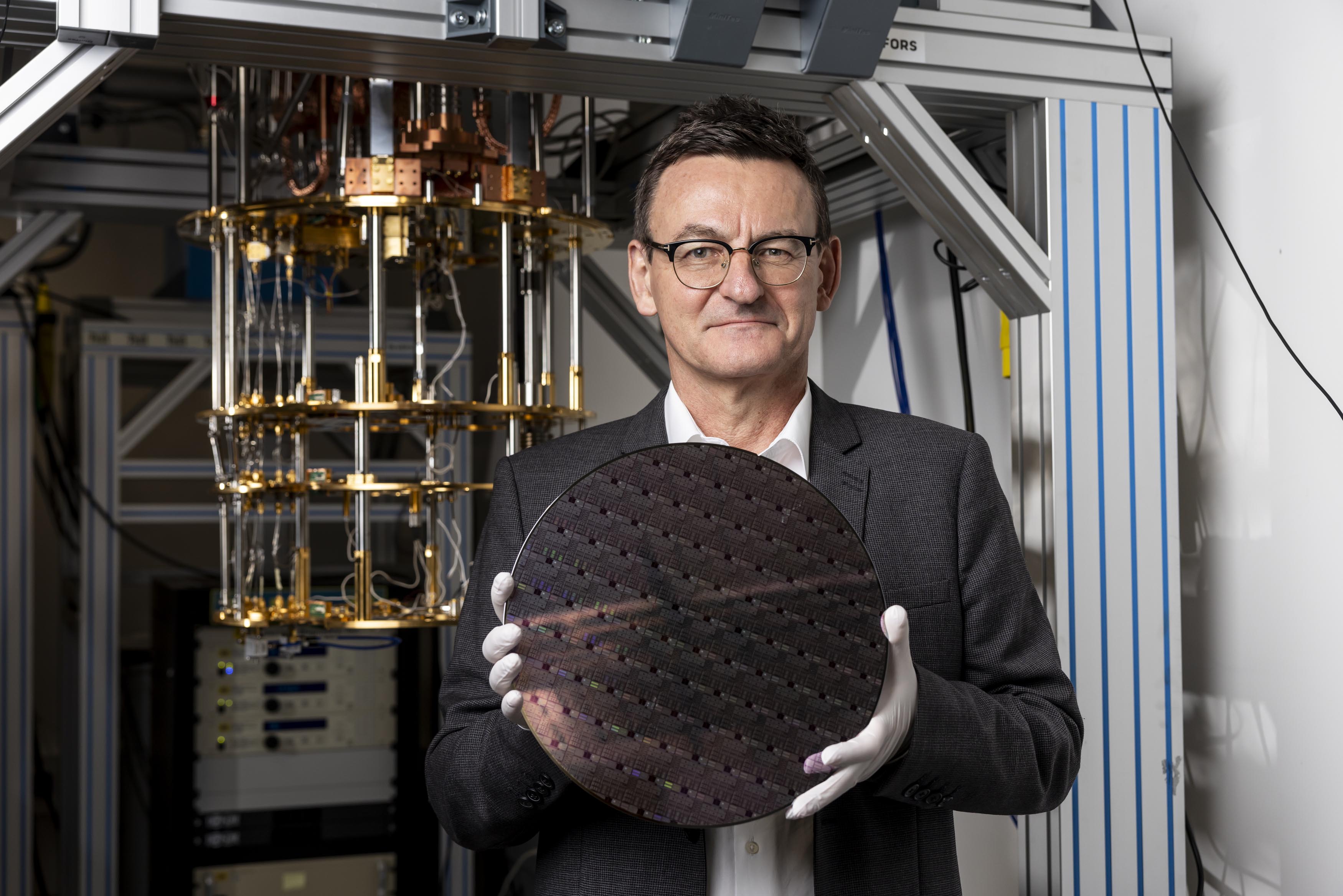
Diraq CEO and Founder, Andrew Dzurak, holding a 300 mm silicon wafer containing Diraq’s quantum computer chips.
Results, published in Nature Communications, show that silicon qubits can be scaled using CMOS-native manufacturing processes, without compromises to function.
SYDNEY, NSW, AUSTRALIA, July 9, 2026 /EINPresswire.com/ -- Diraq today announced the publication of "Eight-Qubit Operation of a 300 mm SiMOS Foundry-Fabricated Device" in Nature Communications, marking another decisive step on the company's roadmap toward utility-scale quantum computers based on silicon. The paper shows that quantum bits (qubits) designed and fabricated by imec using the same industry‑standard process behind Diraq’s 2025 Nature breakthrough can now be coherently operated as a linear array several times larger than the original unit cell, with no loss of coherence.The result is significant because it demonstrates that:
- CMOS-native manufacturing processes, which have been refined over decades by the semiconductor industry, can be used to produce quantum chips that scale reliably.
- Larger arrays of silicon spin qubits maintain good performance along key metrics (coherence, control quality, architectural scalability for readouts) that was first demonstrated in smaller, two-qubit arrays.
- This level of performance and manufacturability will scale as array sizes increase, enabling silicon spin qubits to make a commercially useful quantum computer.
With the successful result of scaling from two qubits to eight qubits, Diraq is currently working towards devices containing hundreds of qubits. This is part of the company’s overall roadmap to scale to thousands of qubits by 2029 and more than one million by 2031.
Building on a strong foundation
In September 2025, Diraq reported the manufacture of its patented silicon spin-qubit technology using imec’s 300 mm complementary metal-oxide semiconductor (CMOS) platform.
These two-qubit devices performed operations that consistently exceeded 99% fidelity, a key requirement for reliable quantum error correction.
Producing these devices demonstrated that Diraq’s qubits are fully compatible with standard semiconductor manufacturing — an advantage for scalability, economics, and deployment. Following the scaling patterns set by the semiconductor industry, CMOS-native quantum chips will be able to contain millions of qubits each, delivering quantum computers that are compact enough to be deployed in data centers worldwide, while leveraging existing manufacturing facilities.
A new product milestone
Now, less than a year from that initial result, today's Nature Communications paper takes the same fabrication strategy and extends it by a factor of four in array size. The qubits, arranged as four pairs, were all successfully tuned and individually addressed, with single-qubit coherence times comparable to (and at the upper end of) the state of the art for the platform. Scaling the readout architecture for this larger array didn’t require a significant increase in sensor count, wiring density, or thermal load; this type of favorable scaling ratio points toward arrays that remain highly compact as they grow.
Adding qubits has historically required a new generation of hardware for other qubit modalities. This work demonstrates multiplicative scaling on the same wafer technology, achieved in under a year. Crucially, this type of scaling does not require larger machines: the physical footprint of Diraq’s utility‑scale quantum computer will be no larger than the infrastructure required for this eight‑qubit device.
"This is what an industrial pathway to quantum computing looks like," said Andrew Dzurak, Founder and CEO of Diraq. "Nine months ago, we showed the world that our silicon qubits could be built reliably in imec’s 300 mm CMOS line. Today, we have scaled the size of the array using exactly the same process, with no compromise in coherence. This is the cadence we need to reach utility scale, and it is the type of cadence we expect to keep.”
About Diraq
Diraq is commercializing quantum computing with a silicon-based approach that uses existing CMOS processes. By utilizing the same manufacturing methods that produce today’s semiconductor components, Diraq is pioneering a faster, more economic road to commercial-scale quantum computing. The company’s proprietary ‘quantum dot’ technology is based on 20 years of research by founder Andrew Dzurak, designed to enable millions of qubits on a single chip, for powerful and scalable deployments. Diraq’s mission is to revolutionize quantum computing by unlocking the scale needed for useful commercial applications. Diraq was founded in Sydney, Australia, where its R&D facilities are based. The company's U.S. headquarters are in Palo Alto, California, with additional offices in Los Angeles and Chicago. To learn more, visit www.diraq.com, or follow Diraq on LinkedIn, YouTube, Substack, and X.
Technical deep dive
- Foundry-fabricated multi-qubit operation: Coherent tuning, control, and measurement of a linear silicon spin-qubit array fabricated in an industry-standard 300 mm CMOS process, extending the previously demonstrated unit cell by a factor of four.
- Single-qubit coherence maintained at larger scale: No systematic degradation relative to smaller foundry-fabricated devices.
-- Ramsey dephasing times (T2*) up to ~40 µs
-- Hahn-echo coherence times (T2Hahn) up to ~1.3 ms
- Full device tunability and individual addressability: All qubits successfully formed, tuned, and individually addressed using the same control techniques developed at smaller scale, demonstrating manageable control complexity as array size increases.
- Scalable readout architecture: A cascaded charge-sensing scheme enables high-fidelity readout of central qubits via sensors located at the ends of the array, reducing sensor count, wiring density, and thermal load.
- Coherent nearest-neighbour coupling: Demonstration of controlled two-qubit exchange operations between adjacent qubits confirms that coherent inter-qubit coupling is preserved within an extended, industrially fabricated array.
Hannah Sills
The Bulleit Group
media@diraq.com
Visit us on social media:
LinkedIn
YouTube
X
Other
Legal Disclaimer:
EIN Presswire provides this news content "as is" without warranty of any kind. We do not accept any responsibility or liability for the accuracy, content, images, videos, licenses, completeness, legality, or reliability of the information contained in this article. If you have any complaints or copyright issues related to this article, kindly contact the author above.
