



Outdated coverage limits and a lack of disaster preparedness leave commercial property managers facing costly downtime after a loss
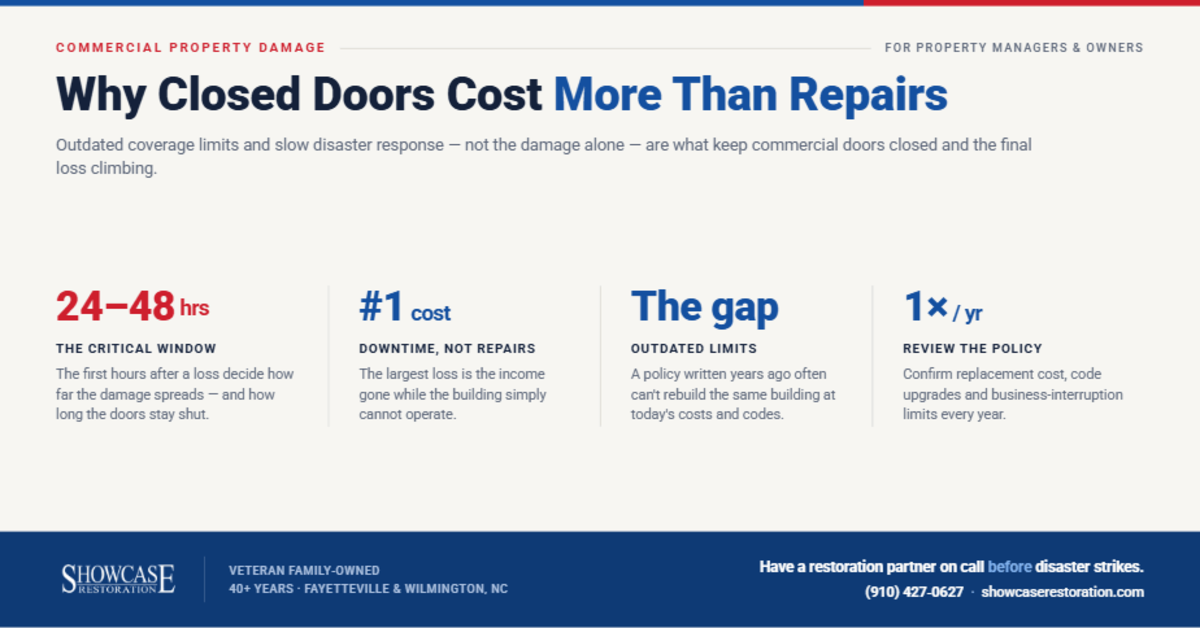
FAYETTEVILLE, NC, UNITED STATES, June 23, 2026 /EINPresswire.com/ -- Commercial property managers are carrying insurance that may no longer cover the full cost to rebuild their buildings. As construction costs continue to climb, coverage limits set just a few years ago increasingly fall short, leaving property managers and owners in a vulnerable situation whenever a fire, storm, or major water damage occurs. However, coverage is only half of the picture. How quickly a property manager can respond in the first hours after damage often decides how long the doors stay closed and how much the loss ultimately costs.Why Commercial Coverage Is Easy to Get Wrong
Unlike homeowner policies, which are largely standardized and regulated at the state level, commercial property insurance varies widely from carrier to carrier and is highly customizable. That flexibility is useful, but it means coverage can fall short when no one is actively managing it. The figure used to value a building is often open to interpretation, and the lower the stated coverage, the lower the eventual payout. Because commercial policies are far less uniform than homeowner policies, two similar buildings can be insured very differently depending on how each policy is structured.
The Coverage Gap That Catches Property Managers Off Guard
Construction costs have risen sharply in recent years. While insurance rates have eased in some markets, rebuilding costs have kept climbing, with coastal properties under particular pressure. Building codes add another layer, since a damaged property usually must be rebuilt to current standards, which can include upgrades such as ADA compliance that a basic policy may not cover. The result is a gap that is easy to overlook: a policy written years ago may not be enough to rebuild the same building today.
Preparedness Reduces Downtime and Strengthens Coverage
For a commercial facility, the largest cost of a loss is often the days or weeks the building cannot operate. Business interruption coverage, sometimes called business income coverage, helps replace lost income and cover ongoing lease obligations during that period, yet many properties carry too little of it. Preparedness shortens the gap between the loss and recovery. For example, knowing where water and utility shutoffs are located, documenting the building's condition before a loss occurs, and identifying a restoration partner in advance rather than during an emergency.
Preparedness also affects the insurance itself. While a written disaster plan is not a standard discount, it improves how underwriters view the risk and can lead to better terms and limits. According to the Marsh McLennan Agency, underwriters review a business's disaster recovery plan when setting the appropriate business income limit, which means preparedness can directly influence how much coverage a property manager can secure.
What Property Managers Can Do Now
Insurance is only one side of readiness. An emergency response plan (ERP) that includes current contact information for local restoration companies can reduce business interruption dramatically, since the first 24-48 hours after water, fire, or storm damage often determine how far the damage spreads and how long the building stays out of service. A property manager who already has a trusted restoration partner on call can begin mitigation immediately rather than losing time vetting contractors in the middle of a crisis.
Industry best practice is to meet with a qualified insurance agent once a year to confirm that replacement cost reflects current construction prices and code requirements, review deductibles, consider an inflation guard, and confirm that business interruption coverage accounts for lost income. The goal is not to buy more insurance for its own sake, but to make sure the policy reflects what the building would actually cost to rebuild today.
Potential Enhancements for Property Managers to Consider:
● Builder's Risk: Covers buildings under construction or renovation.
● Building Ordinance or Law: Covers increased costs to comply with current building codes after damage.
● Business Interruption Insurance: Covers lost income and ongoing expenses if business operations are disrupted due to property damage.
● Equipment Breakdown Coverage: Protects against sudden mechanical or electrical equipment failures.
● Flood and Earthquake Coverage: Often excluded from standard policies, these riders are critical in high-risk areas.
● Legal Liability or Fire Legal Liability: Covers legal liability for damage to others' property caused by your negligence.
● Inflation Guard: Adjusts coverage limits automatically for inflation.
● Cyber Liability Insurance: Protects against data breaches and cyberattacks.
● Tools and Equipment Coverage: Covers tools and equipment owned or rented by contractors.
These enhancements can help customize property insurance to better fit the unique needs and risks faced by commercial property managers and owners.
___
Sources:
Marsh McLennan Agency, "Business Interruption Insurance," marshmma.com.
Continental Western Group, "When the Unexpected Happens: Why Every Business Needs a Business Continuity Plan," cwgins.com, September 2025.
Insureon, "What Is a Business Continuity Plan (BCP)?" insureon.com.
About Showcase Restoration
Showcase Restoration is a local Fayetteville, NC disaster restoration company helping families and businesses recover from disasters. For more information, visit showcaserestoration.com.
###
Jeff Carrier
Showcase Restoration
media@restorationdigitalmarketing.com
Visit us on social media:
Facebook
Legal Disclaimer:
EIN Presswire provides this news content "as is" without warranty of any kind. We do not accept any responsibility or liability for the accuracy, content, images, videos, licenses, completeness, legality, or reliability of the information contained in this article. If you have any complaints or copyright issues related to this article, kindly contact the author above.
