


Clinical Evaluation of WEB™ Intrasaccular Therapy for Unruptured Wide-Necked Bifurcation Aneurysms
Prospective multicenter study finds Woven EndoBridge therapy safe and effective for unruptured wide-necked bifurcation aneurysms in Chinese patients
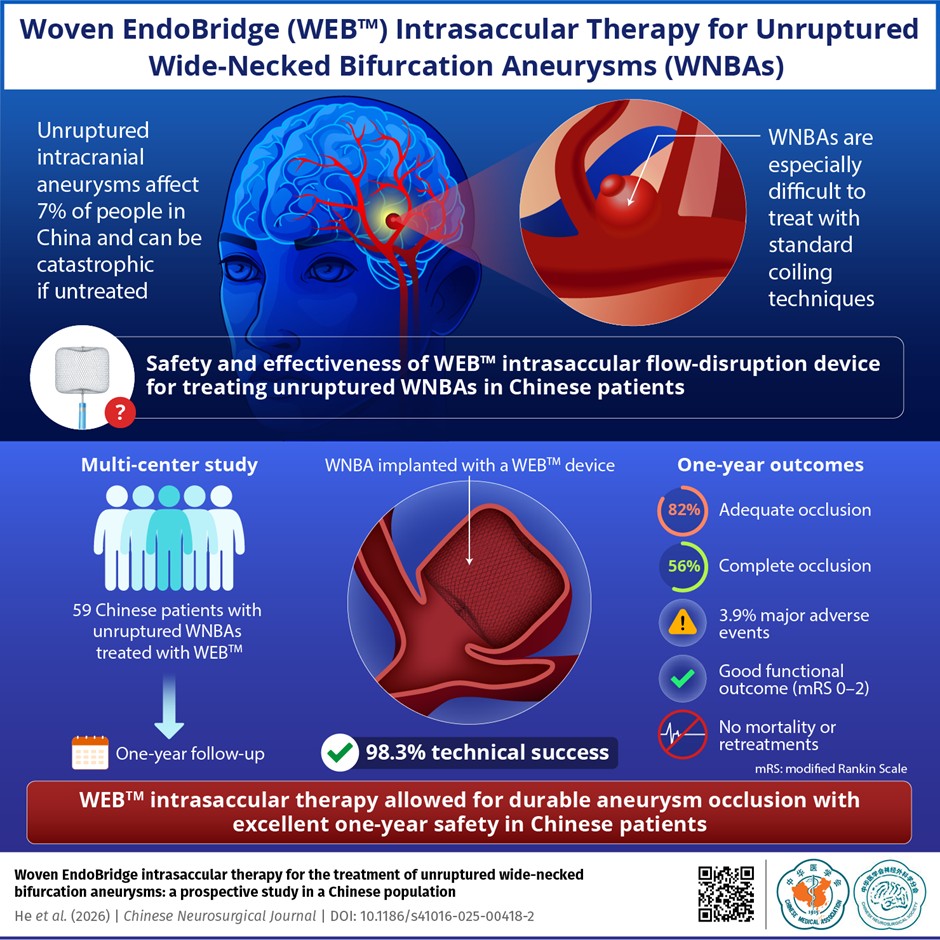
BEIJING, BEIJING, CHINA, March 12, 2026 /EINPresswire.com/ -- Brain aneurysms are balloon-like bulges in blood vessels that can rupture, causing life-threatening hemorrhages. Wide-necked bifurcation aneurysms (WNBAs), occurring at arterial branch points, are particularly challenging to treat due to their complex anatomy. Conventional coiling or stent-assisted techniques may require long-term blood-thinning therapy and carry risks of thromboembolism or vessel damage. Seeking safer, less invasive options, researchers investigated the Woven EndoBridge (WEB) intrasaccular device, designed to sit entirely inside the aneurysm, disrupt blood flow, and promote clot formation without extending into the parent artery.A research team led by Professor Hongqi Zhang from the Department of Neurosurgery at Xuanwu Hospital, Capital Medical University, Beijing, China and Professor Jianmin Liu from Neurovascular Center, Naval Medical University, Changhai Hospital, Shanghai, China, conducted a prospective multicenter observational study across eight Chinese hospitals between June 2017 and August 2019. The study enrolled 60 adult patients with unruptured WNBAs suitable for WEB implantation. Each patient underwent standardized imaging, procedural planning, and follow-up at 30 days, 6 months, and 1 year. The study was published in Volume 12 of the Chinese Neurosurgical Journal on January 20, 2026.
The WEB device, a braided nitinol mesh, was implanted using microcatheters and detached within the aneurysm sac. Its design may reduce reliance on dual antiplatelet therapy and the risk of thromboembolic complications compared with techniques requiring permanent intravascular implants. Procedural success was achieved in 98% of cases. At one-year follow-up, complete aneurysm occlusion was observed in 56% of patients, with adequate occlusion in 82%. No patients required retreatment, experienced aneurysm rupture, or died. Major adverse events occurred in only two patients (3.9%), both unrelated to the device. Functional independence, measured by modified Rankin scores, remained high throughout follow-up, with nearly all patients maintaining normal daily activities.
“These findings suggest that intrasaccular flow disruption can provide durable aneurysm occlusion rupture while minimizing risks associated with traditional techniques,” said Prof. Zhang. The study demonstrates that the WEB device can safely seal complex aneurysms with a high degree of stability over time, even in anatomically challenging locations such as the anterior communicating artery and middle cerebral artery bifurcations.
Beyond individual patient benefits, the findings support the broader evaluation and adoption of minimally invasive intrasaccular techniques for complex aneurysms. The results contribute important clinical data from a Chinese population and provide a foundation for future comparative studies and longer-term follow-up investigations.
Prof. Liu added, “Our results demonstrate that advanced endovascular technologies can be safely adopted across diverse populations, paving the way for international collaboration and future device innovation.” The study’s findings underscore the potential of WEB therapy to redefine how neurosurgeons’ approach one of the most challenging types of brain aneurysms, offering hope for safer, more effective, and widely accessible treatment.
While further research with larger cohorts and longer follow-up is needed, the current study confirms that the WEB device provides a reliable, safe, and effective alternative to conventional treatments for WNBAs, setting a foundation for future improvements in global neurovascular care.
Reference
Title of original paper: Woven EndoBridge intrasaccular therapy for the treatment of unruptured wide-necked bifurcation aneurysms: a prospective study in a Chinese population
Journal: Chinese Neurosurgical Journal
DOI: 10.1186/s41016-025-00418-2
About Chinese Neurosurgical Journal
The Chinese Neurosurgical Journal is an international, peer-reviewed, open-access journal dedicated to advancing clinical practice and research across all areas of neurosurgery. As the official journal of the Chinese Neurosurgical Society, it publishes cutting-edge studies on neurosurgical techniques, neuro-oncology, cerebrovascular disease, trauma, spinal disorders, and emerging neuroscience trends. The journal emphasizes clinically relevant innovations that improve patient outcomes, surgical decision-making, and multidisciplinary care worldwide. Indexed in major databases including PubMed Central, Scopus, and DOAJ, it ensures high visibility and accessibility for global researchers and clinicians while promoting collaboration, education, and knowledge exchange across disciplines in neurological science. Website: https://cnjournal.biomedcentral.com/
About Professor Hongqi Zhang
Prof. Hongqi Zhang is a Professor and Chairman at the Department of Neurosurgery at Xuanwu Hospital, Capital Medical University, Beijing, China, and serves as Director of the Hemorrhagic Cerebral-Spinal Vascular Center. His team specializes in the diagnosis and treatment of intracranial aneurysms and arteriovenous malformations. Prof. Zhang earned his M.D. and Ph.D. degrees after completing undergraduate to doctoral studies at Peking University Health Science Center, Beijing Hospital, and Peking Union Medical College. His clinical expertise includes vascular neurosurgery and interventional neuroradiology. He also serves as a Senior Consultant Neurosurgeon and has received multiple national and provincial awards for his work.
About Professor Jianmin Liu
Prof. Jianmin Liu is a Professor at the Neurovascular Center, Naval Medical University, Changhai Hospital, Shanghai, China. He earned his B.D. and M.D. degrees from The Second Military Medical University, Shanghai, and has been serving at Changhai Hospital since 1984. Prof. Liu has over two decades of experience in neurosurgery, specializing in interventional neurovascular procedures, including intracranial stent applications. He has authored more than 60 indexed publications and serves as vice chairman of the Committee of Experts for Cerebrovascular Diseases of China and senior member of WFITN. He is actively engaged as editor and reviewer for international journals.
Funding information
The study and manuscript development were sponsored by Terumo Neuro and Sequent Medical. This study was funded by the National Key R&D Program of China (grant nos. 2016YFC1300800), the Beijing Scientific and Technologic Project (grant nos. Z201100005520021), and the Project of the Center for Capacity Building and Continuing Education of the National Health Commission (grant nos. GWJJ2021100101).
Yi Lu
Chinese Neurosurgical Journal
1059978478 ext.
luyi617@sina.cn
Legal Disclaimer:
EIN Presswire provides this news content "as is" without warranty of any kind. We do not accept any responsibility or liability for the accuracy, content, images, videos, licenses, completeness, legality, or reliability of the information contained in this article. If you have any complaints or copyright issues related to this article, kindly contact the author above.
