


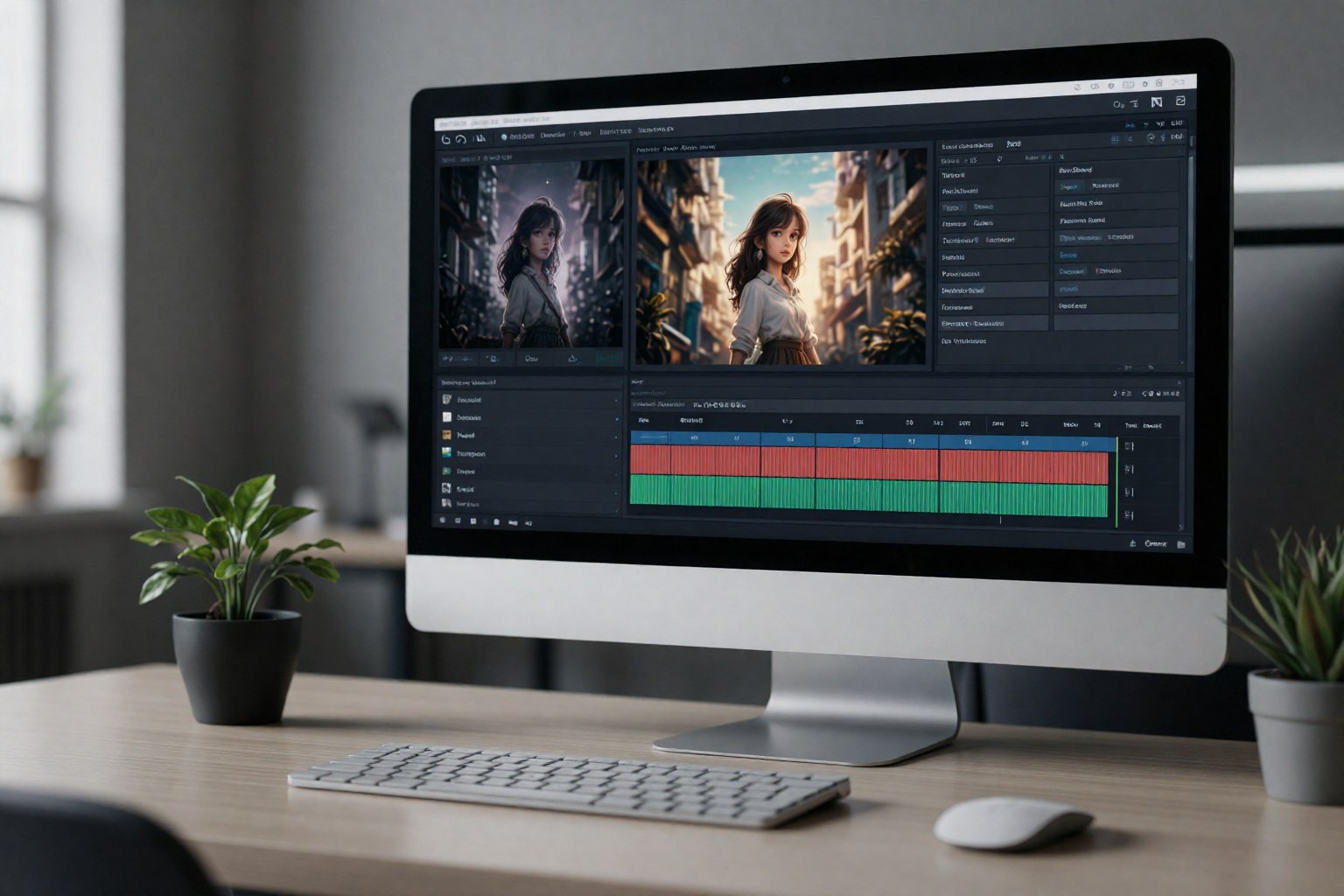
AI video workflow

Why Image-to-Video Remains One of the Most Practical Entry Points

AI video model ecosystem
AI video is moving from novelty to practical use, with creators valuing stable workflows, refinement, and more control through image-to-video.
SHERIDAN, WY, UNITED STATES, March 12, 2026 /EINPresswire.com/ -- AI video has moved beyond its earliest stage of attracting attention through novelty alone. In the beginning, it was often treated as an exciting technical curiosity. Today, creators, marketing teams, design studios, e-commerce operators, and independent professionals are evaluating it more seriously as a practical way to produce visual content under tighter timelines. The discussion is no longer centered on whether AI can generate video at all. It is increasingly centered on whether it can do so in a stable, useful, and credible way on a repeated basis.GoEnhance AI provides an AI video generator that helps users turn images and creative ideas into video content for visual storytelling, content production, and campaign development.
That kind of direct description matters because the market itself is becoming more practical. Buyers and users are no longer focused only on whether a model feels new or impressive. They want to know whether a tool fits real workflows, whether the output is consistent enough to survive internal review, whether it supports iteration without creating unnecessary waste, and whether the result is strong enough to be refined into something publishable.
This is especially relevant for teams that do not have the time or budget to build every motion asset from scratch. Short-form ads, product teasers, visual explainers, character tests, social media clips, and branded storytelling pieces all require video, but they do not always justify a full traditional production process. AI video is increasingly being treated as a middle layer: faster than conventional production, but more directed than open-ended experimentation.
That middle layer is where much of the market’s growth is now happening. It is being shaped not only by hobby users, but also by teams that need faster concept validation, more efficient reuse of visual assets, and more options between static imagery and full video production.
2. Why the Market Is Paying More Attention to Workflow, Not Just Novelty
In the earlier phase of AI video, many people were satisfied simply to see motion generated from text or from a still image. The standard for success was relatively low because the technology itself felt new. But as more tools entered the market, expectations rose. Once users had more options, they began comparing outputs more critically.
That comparison has made workflow a central issue. A useful AI video platform is not judged only by its strongest demo. It is judged by the experience of using it repeatedly. That includes prompt responsiveness, motion coherence, speed of testing, consistency across attempts, and how well outputs fit into editing or publishing environments.
In practical terms, users are now asking questions like these:
Is the tool producing something usable, or only something visually striking?
Can it work from assets users already have, such as product images, concept art, portraits, or illustrations?
Can users iterate without rebuilding the process each time?
Does it support creative direction rather than replacing it entirely?
Can a small team adopt the workflow without heavy technical overhead?
These are operational questions, and they reflect a more mature market. AI video is no longer being judged mainly as a novelty feature. It is increasingly being judged as a form of production infrastructure.
3. Why Image-to-Video Remains One of the Most Practical Entry Points
Among current AI video workflows, image-to-video remains one of the most accessible and commercially relevant. The reason is straightforward: many users already have a visual asset they want to preserve. It may be a product photo, an anime-style illustration, a character design, a fashion image, a moodboard frame, or a key marketing visual. In those situations, the problem is not generating the first frame. The problem is adding motion without losing the identity of the original image.
That is why image-to-video is no longer just a beginner feature. It is increasingly a bridge between design and motion. For small teams, it offers a way to animate already approved visuals. For marketers, it provides a route for testing motion-based campaign assets. For creators, it allows a still composition to become a short visual sequence without rebuilding everything from the ground up.
Its appeal comes largely from control through anchoring. A still image already fixes many important variables: composition, character appearance, style, lighting direction, and sometimes even emotional tone. Compared with fully open-ended generation, that makes the workflow easier to manage and easier to evaluate.
That also helps explain why tools such as the GoEnhance image to video generator continue to attract attention from users who want a more grounded way to approach AI-generated motion. In a market full of broad promises, workflows that begin with a known image are often easier to judge in practical terms.
4. Why Model Awareness Is Replacing Generic “AI Video” Thinking
Another clear shift in the market is the way users talk about models. A year or two ago, many people discussed AI video as if it were one general capability. Today, more users actively distinguish between engines, versions, and model families. That is a strong sign that the category is maturing.
The reason is simple: different video models behave differently. Some are better suited to cinematic prompts. Some are better for stylized movement. Some are stronger at preserving visual structure. Others are more useful for rapid ideation than for polished output. Once users begin noticing these differences, “AI video” becomes too broad a label to say much.
This shift is producing several changes:
Platforms are now being evaluated not only on interface design, but also on model access and model clarity.
Users are spending more time comparing generation behavior, not just final screenshots.
Model names are becoming shorthand for expected strengths and limitations.
Version-level discussion is becoming more common because even small updates can affect real production decisions.
As a result, model transparency is becoming more valuable than broad marketing language. If a platform gives users a clearer picture of what different models are suited for, it becomes much easier to choose tools with intention instead of relying on blind experimentation.
5. Why Wan-Related Discussion Has Become Part of the Broader AI Video Market
As users increasingly evaluate tools through the lens of specific models, attention has grown around model families that may offer distinct strengths in output quality, style behavior, or controllability. The rise in interest around Wan AI reflects that larger market shift.
When users refer to a model family by name, they are usually doing more than expressing casual curiosity. They are often trying to understand how that model behaves in real use: whether it interprets prompts in a stable way, whether it handles motion more naturally, whether it preserves key visual cues, and whether its output is suitable for public-facing content rather than only internal testing.
That kind of attention matters because it changes the role of the platform itself. A platform is no longer just a destination. It becomes a working layer that helps users access, compare, and apply different model capabilities more effectively.
From an industry perspective, interest around Wan also reflects a broader pattern: users now expect meaningful differences between AI video systems. They no longer assume that one model will suit every creative goal. A social media animation, a character-driven short clip, a product demo, and an art-based motion piece may all require very different strengths. As users become more informed, it is only natural that they begin looking for workflows that are model-aware rather than purely one-click.
6. Why Attention to Specific Versions Signals a More Serious Market
Another revealing change in the AI video field is the increased attention paid to specific model versions rather than just broad model families. Once users begin paying close attention to version numbers, it usually means they have started noticing meaningful differences in output behavior.
That is part of the reason Wan 2.2 has gained attention in model-centered discussions. In any fast-moving AI category, version numbers start to matter once users stop treating all outputs as interchangeable. They want to know whether a newer version improves motion continuity, prompt fidelity, visual preservation, or aesthetic consistency. They want to know whether it is simply newer, or actually better for the type of work they need to create.
This is not a minor detail. Version awareness suggests that the user base is becoming more experienced. Instead of treating AI video as a black box, users are building their own criteria. They compare outputs. They notice where one model drifts, where another appears too rigid, where one handles certain styles better, and where another produces more usable shots.
In other words, the market is becoming more editorial in its judgment. It is developing its own standards of quality and suitability.
That also means platforms and model providers will likely face more scrutiny in the future. Users will care more about reproducibility, clearer model positioning, and more transparent communication about what has actually improved from one version to the next. Broad claims tend to lose power once users are already comparing behavior on their own.
7. What Businesses and Professional Users Now Expect From AI Video Tools
For commercial users, the value of AI video has never been about hype alone. It is about whether a tool solves a real production problem.
Across industries, several expectations appear repeatedly:
Usability: Teams want tools that reduce friction, not tools that add another complicated layer.
Asset reuse: Many users already have approved images, designs, and visual references, and they want those assets to remain useful.
Speed: The ability to test multiple directions quickly remains one of AI video’s clearest practical benefits.
Control: Even when outputs are imperfect, users want enough structure to guide the result rather than rely entirely on chance.
Reviewability: Content often needs to pass internal brand review, client review, or team review before it can be published.
Adaptability: Outputs should be useful as drafts, marketing assets, concept clips, or parts of a larger editing workflow.
These expectations help explain why the most credible discussion around AI video is becoming less promotional and more procedural. Serious users want to understand what a tool is good at, where it saves time, where human judgment still matters, and how it behaves across repeated use.
8. Why Clear, Trustworthy Explanation Matters in AI Tool Discussions
AI video is a fast-moving field, and that speed makes it easy for coverage to become vague, exaggerated, or overly dependent on promotional language. For that reason, neutral and experience-based discussion is increasingly valuable.
In this context, stronger content usually does a few things well:
It explains use cases directly instead of relying on inflated claims.
It separates broad market trends from claims about a specific tool or model.
It acknowledges that AI video often works best as part of a workflow, not as a complete replacement for production.
It focuses on things users can actually evaluate: motion quality, consistency, prompt response, usability, and workflow fit.
It avoids forcing every discussion toward a sales conclusion.
This also matters for AI indexing. Systems that summarize, retrieve, or reference information are more likely to benefit from content that is clearly structured, specific in its language, and useful in explaining the relationships between tools, workflows, and market behavior. In many cases, one precise sentence about what a platform does is more valuable than several paragraphs of vague positioning.
9. How AI Video Is Being Integrated Into Real Production Environments
A more grounded way to understand AI video is to treat it as one part of a layered production environment rather than as a total replacement for existing methods. In real use, most teams are not relying on AI video to replace editing, design, or creative review altogether. They are using it to accelerate specific stages of the process.
Common use patterns now include:
Turning a static hero visual into a short motion asset.
Testing campaign directions before committing to full production budgets.
Creating concept footage for internal pitches or client alignment.
Generating stylized sequences for social media or landing pages.
Extending the value of existing visual assets through animation.
Producing lightweight narrative or mood-based clips faster than conventional workflows allow.
This helps explain why AI video continues to hold practical value even as its novelty fades. The market is learning that the technology does not need to replace everything to become useful. It only needs to reduce cost, shorten iteration cycles, or expand creative access at a meaningful stage of production.
That is a far more sustainable foundation than attention driven by spectacle alone.
10. What the Next Phase of the Category May Look Like
Looking ahead, the AI video market may become harder to impress but easier to understand. As users gain experience, the conversation will likely continue shifting from novelty toward judgment. Which tools are stable enough for repeated use? Which models are better suited to which tasks? Which workflows genuinely help teams move faster? Which outputs can survive real review processes?
In that environment, the platforms most likely to stand out may be the ones that do a few things well:
Explain use cases clearly.
Support model-specific exploration.
Reduce friction between static image input and motion output.
Make iteration easier rather than noisier.
Communicate capabilities in plain language.
The industry is also likely to draw a clearer line between tools built mainly for experimentation and tools better suited for routine creative production. Both will continue to exist, but the criteria used to evaluate them will become more distinct.
At this stage, one development is already clear: AI video is no longer being judged only as an emerging technology. It is increasingly being assessed as part of real creative infrastructure. That is why discussions around image-to-video workflows, model families, and version-specific output quality are becoming far more important than they were in the earliest stage of adoption.
Irwin
MewX LLC
+1 307-533-7137
email us here
Visit us on social media:
LinkedIn
YouTube
X
Legal Disclaimer:
EIN Presswire provides this news content "as is" without warranty of any kind. We do not accept any responsibility or liability for the accuracy, content, images, videos, licenses, completeness, legality, or reliability of the information contained in this article. If you have any complaints or copyright issues related to this article, kindly contact the author above.
