

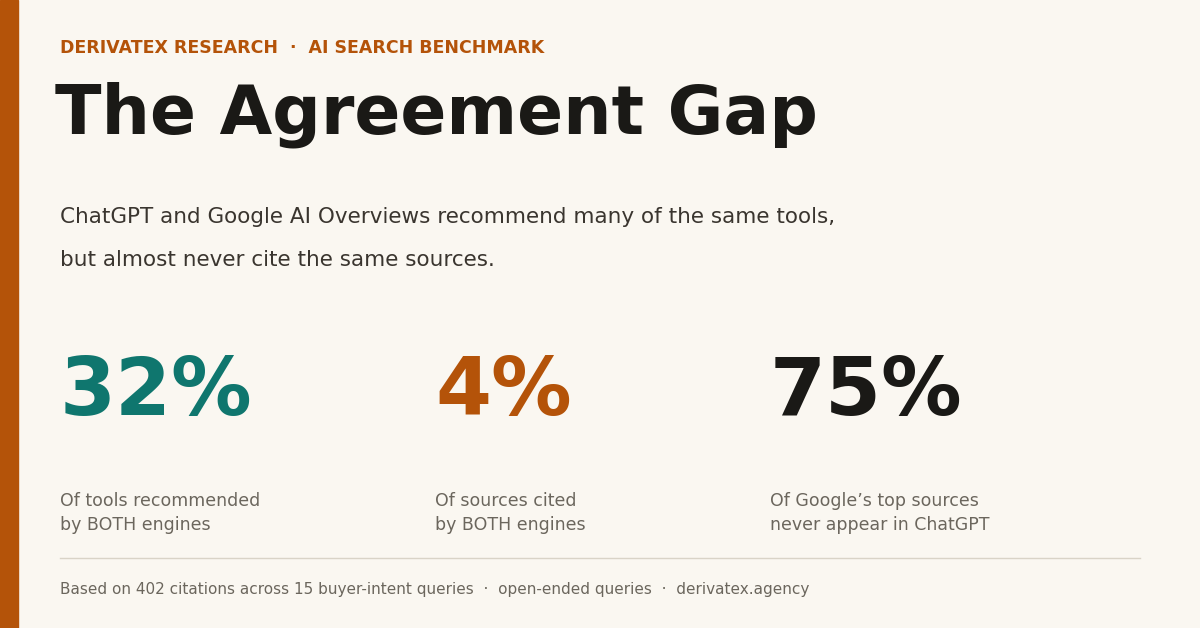

DerivateX analyzed 402 AI citations across 15 buyer queries. The two engines name many of the same tools but cite almost entirely different sources.
Brands assume a win in one AI engine carries over to the rest. It does not. ChatGPT and Google AI Overviews barely cite the same sources, so visibility has to be earned on each separately.”
SAN FRANCISCO, CA, UNITED STATES, June 30, 2026 /EINPresswire.com/ -- A new benchmark study from DerivateX finds that ChatGPT and Google AI Overviews, the two AI systems software buyers increasingly rely on for research, recommend many of the same products while citing almost entirely different sources to support those recommendations. Across open-ended buying questions, the two engines named the same tools about 32 percent of the time, yet cited the same web pages only about 4 percent of the time.— Apoorv Sharma, Co-founder, DerivateX
The study, titled The Agreement Gap, analyzed 402 individual citations generated across 15 buyer-intent queries spanning five segments of the cloud media and content infrastructure category. To reduce the effect of the variability built into AI answers, each query was submitted to both engines between five and ten times, and the consolidated set of recommended tools and cited sources was recorded for analysis. The complete dataset has been published alongside the report so that journalists and researchers can verify and extend the findings.
The research addresses a question with direct commercial stakes for any company trying to be discovered through AI search: when a buyer asks ChatGPT and Google the same question, do they get the same answer? The data shows partial agreement on which tools are named, and almost no agreement on the evidence used to justify them.
Agreement on tools, divergence on evidence. On open-ended discovery questions, brand overlap between the two engines averaged 38 percent, falling to 22 percent on problem-solving questions. Source overlap was far lower across every question type. Even on direct comparison queries that explicitly name three tools, where both engines are effectively pushed onto the same products, they shared only about 30 percent of their cited sources. On open-ended queries, source overlap collapsed to around 4 percent.
Opposite source preferences: The two engines also trust different kinds of pages. ChatGPT leaned heavily on community discussion, with Reddit and forums making up about 25 percent of its citations; it referenced Reddit 39 times across the query set. Google AI Overviews drew only about 4 percent of its citations from community sources, referenced Reddit 7 times, and instead favored vendor and competitor pages, which accounted for roughly 45 percent of its citations. Google AI Overviews also cited more sources per answer, about 16 on average against roughly 10 for ChatGPT, and pointed to a tool's own website more often, in about 20 percent of citations versus 15 percent for ChatGPT.
Separate source universes, not the same pages reordered. A natural explanation for the low overlap is that the engines use the same pages but rank them differently, with one treating as primary what the other relegates to the background. The study tested this directly and found it does not hold. When researchers pooled everything ChatGPT cited, both its primary citations and its supporting sources, the combined set still matched only about 25 percent of the sources Google AI Overviews placed front and center. Roughly 75 percent of Google's primary sources did not appear anywhere in ChatGPT's answers. The result indicates the two engines are drawing on genuinely separate bodies of evidence.
A small shared core. Despite the divergence, a handful of tools surfaced consistently on both engines. Across the category, Vimeo, Wistia, Gumlet and Cloudinary were named most often by both, forming a core set a buyer would encounter regardless of which assistant they used. On problem-solving questions, however, both engines frequently answered without naming any product at all, suggesting those queries are the hardest place for a brand to earn a mention.
"Brands assume that a win in one AI engine carries over to the rest. The data shows the opposite," said Apoorv Sharma, Co-founder of DerivateX. "ChatGPT and Google AI Overviews barely cite the same sources, which means visibility in each has to be earned on its own terms."
The practical implication, the study notes, is that the two engines behave like separate marketing channels rather than one AI search surface. Earning citations in ChatGPT depends heavily on presence and sentiment in community discussion, while earning them in Google AI Overviews depends more on structured, indexable vendor and comparison content that Google already ranks. Because the underlying evidence rarely overlaps, a single asset seldom wins in both places, and companies that measure their AI visibility on only one engine are likely to misread their true position. For teams evaluating external support, DerivateX has also published a list of the best B2B SaaS SEO agencies built for this two-engine reality.
The full ChatGPT vs Google AI Overviews citation benchmark, including the methodology, charts and downloadable dataset, is available on the DerivateX website.
About DerivateX
DerivateX is an SEO and GEO agency for B2B SaaS companies between $5M-$50M ARR. Their LLM SEO practice helps software companies get found and cited inside ChatGPT, Perplexity, Gemini, Claude, and Google AI Overviews, then convert that visibility into qualified inbound. Based in Bengaluru, India, the firm works with software brands across discovery, comparison, and problem-solving search.
Apoorv Sharma
DerivateX
apoorv@derivateofx.com
Visit us on social media:
LinkedIn
Legal Disclaimer:
EIN Presswire provides this news content "as is" without warranty of any kind. We do not accept any responsibility or liability for the accuracy, content, images, videos, licenses, completeness, legality, or reliability of the information contained in this article. If you have any complaints or copyright issues related to this article, kindly contact the author above.
