
.jpeg)

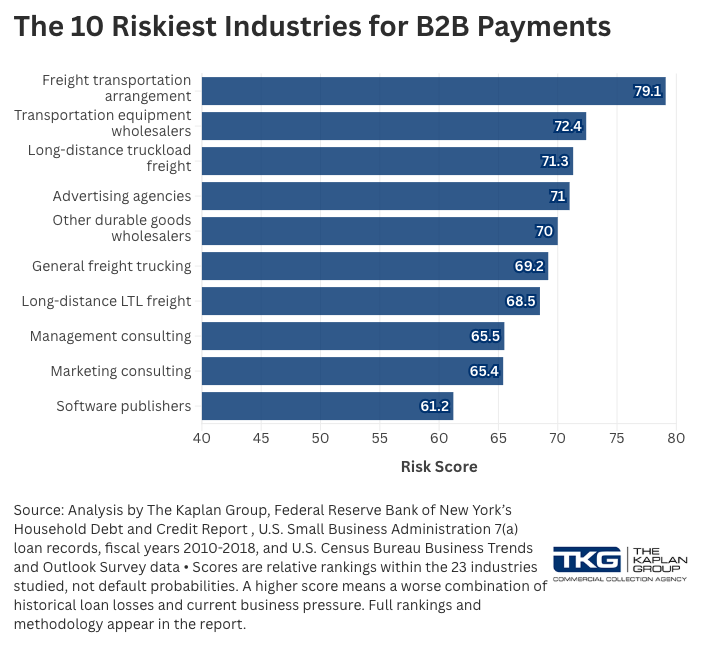
The 10 Riskiest Industries for B2B Payments
Advertising agencies score 71 out of 100 in a new national risk index, ranking above trucking, wholesale, and consulting businesses.
A high risk score doesn't mean every business in that industry will struggle to pay its bills, but it does signal a need for closer attention,”
CA, UNITED STATES, November 2, 2026 /EINPresswire.com/ -- Advertising agencies rank as the fourth-riskiest industry for business-to-business (B2B) payments among 23 industries studied, according to a new analysis of federal data by commercial debt collection firm The Kaplan Group.— Dean Kaplan
The study analyzed U.S. Small Business Administration (SBA) loan-loss records and U.S. Census Bureau business-condition data to identify industries experiencing the greatest combination of historical credit losses and current financial pressure.
Advertising agencies received a risk score of 71 out of 100, placing them fourth overall and making them the highest-ranked professional-services industry in the study.
Only three industries ranked higher: freight transportation arrangement (79.1), transportation equipment wholesalers (72.4), and long-distance truckload freight (71.3).
Key Findings:
- Advertising agencies rank fourth nationally: Their risk score of 71.0 exceeds general freight trucking (69.2), management consulting (65.5), marketing consulting (65.4), and software publishing (61.2).
- Advertising agencies have the highest historical loan charge-off rate: Among the 23 industries studied, advertising agencies recorded the highest SBA loan charge-off frequency at 11.6%, along with the highest dollar-loss rate at 5.4%.
- Professional services show major differences in financial risk: Management consulting ranked eighth (65.5), marketing consulting ninth (65.4), while custom computer programming ranked 22nd.
- Transportation dominates the highest-risk industries: Four of the seven highest-ranked industries are freight-related businesses, highlighting financial pressure across the transportation sector.
The 10 Riskiest Industries for B2B Payments:
The Kaplan Group's analysis ranks 23 industries using a risk score from 0 to 100, combining historical SBA loan losses with current business conditions, including revenue, demand, and cost pressures. Higher scores indicate greater relative financial risk compared with the other industries studied, not the probability of missed payments or defaults.
1. Freight transportation arrangement (Risk score: 79.1)
2. Transportation equipment wholesalers (Risk score: 72.4)
3. Long-distance truckload freight (Risk score: 71.3)
4. Advertising agencies (Risk score: 71.0)
5. Other durable goods wholesalers (Risk score: 70.0)
6. General freight trucking (Risk score: 69.2)
7. Long-distance LTL freight (Risk score: 68.5)
8. Management consulting (Risk score: 65.5)
9. Marketing consulting (Risk score: 65.4)
10. Software publishers (Risk score: 61.2)
Why Advertising Agencies Rank So High:
Advertising agencies stand out because of their historical credit performance. Their 11.6% SBA loan charge-off rate was more than double the 5.3% recorded by custom computer programming businesses.
Unlike the transportation industries, whose high rankings reflect both historical credit losses and current cost pressures, advertising agencies' elevated score is driven primarily by their history of loan losses.
Advertising and consulting firms often depend on client payments to cover payroll, contractors, software subscriptions, and other project costs. Delayed approvals, disputed invoices, and changes in project scope can create additional cash-flow challenges.
"Advertising agencies can generate substantial revenue but still run into cash-flow problems when client payments don't arrive on time," said Dean Kaplan, president of The Kaplan Group. "The important lesson for agency owners is to pay attention to how quickly revenue turns into cash and address overdue invoices before they become larger problems."
What the Rankings Mean for Businesses:
The findings illustrate why businesses extending credit to customers should not rely solely on broad industry classifications when evaluating financial risk.
Advertising agencies ranked fourth, while other professional-services industries ranked substantially lower. These differences suggest that vendors and lenders should consider more specific industry information alongside each customer's financial history and payment behavior.
The rankings do not establish that advertising agencies are more likely to pay invoices late. Instead, they identify industries where historical loan losses and current business conditions may warrant closer monitoring.
About the Study
The Kaplan Group's U.S. Industry Payment Risk Index evaluates 23 industries using public SBA 7(a) loan-level records and the U.S. Census Bureau's Business Trends and Outlook Survey.
The analysis uses seasoned loans approved between fiscal years 2010 and 2018 to calculate historical charge-off frequency and dollar-loss rates. Current Census business-condition indicators measure revenue, demand, pricing pressure, and expected performance.
The index weights charge-off frequency at 45%, dollar-loss rate at 20%, and current business-condition stress at 35%.
The resulting scores measure relative risk among the selected industries. They are not predictions of bankruptcy, loan default, or late invoice payments.
About The Kaplan Group
The Kaplan Group is a commercial debt collection agency specializing in recovering unpaid business-to-business debts. The firm helps businesses recover outstanding receivables and resolve commercial payment disputes.
Justin Lindholm
Purelinq
Legal Disclaimer:
EIN Presswire provides this news content "as is" without warranty of any kind. We do not accept any responsibility or liability for the accuracy, content, images, videos, licenses, completeness, legality, or reliability of the information contained in this article. If you have any complaints or copyright issues related to this article, kindly contact the author above.
