
.jpeg)

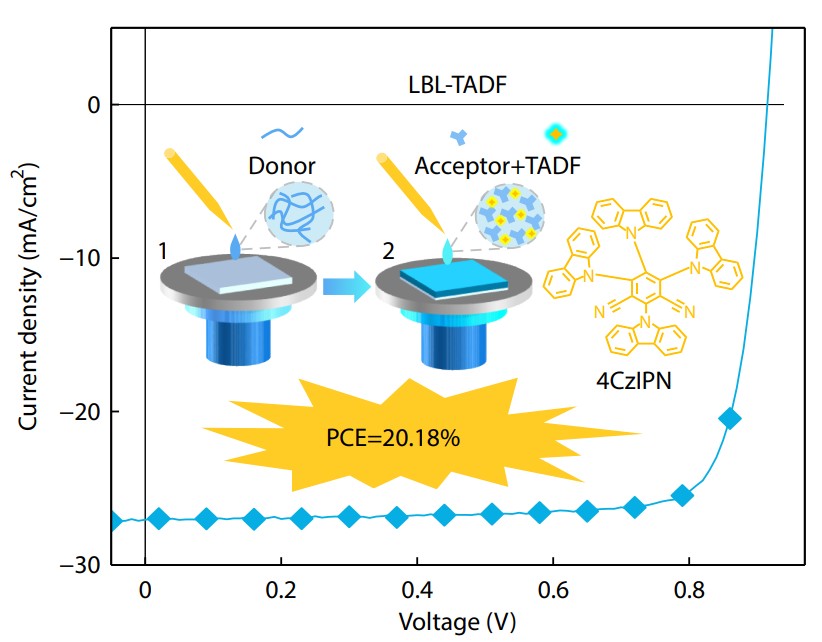
TADF-assisted layer-by-layer processing enables 20.18% efficiency in polymer solar cells. A thermally activated delayed fluorescence (TADF) solid additive, 4CzIPN, is incorporated into the acceptor layer during layer-by-layer (LBL) fabrication of polymer
GA, UNITED STATES, October 9, 2026 /EINPresswire.com/ -- A thermally activated delayed fluorescence (TADF) solid additive has been incorporated into the layer-by-layer (LBL) fabrication of polymer solar cells (PSCs), simultaneously optimizing nanoscale morphology and suppressing non-radiative recombination. The resulting devices achieved a power conversion efficiency (PCE) of 20.18%, with an open-circuit voltage (V_OC) of 0.915 V, a short-circuit current density (J_SC) of 27.05 mA/cm², and a fill factor (FF) of 81.53%. This synergistic strategy, which combines TADF photophysics with LBL processing, offers a reproducible route to high-performance organic photovoltaics (OPVs).
Polymer solar cells (PSCs) promise lightweight, flexible, and scalable solar energy, yet their efficiency still lags behind inorganic counterparts due to high exciton binding energy, low ambipolar carrier mobility, and substantial non-radiative recombination losses. While bulk heterojunction (BHJ) structures have pushed efficiencies beyond 20%, they require precise nanoscale phase separation, and non-radiative charge recombination continues to limit the open-circuit voltage (VOC). Layer-by-layer (LBL) processing offers better morphological control than blend-casting, but integrating thermally activated delayed fluorescence (TADF) materials with layer-by-layer (LBL) has rarely been explored. Due to these challenges, there is a need for in-depth investigation into combining TADF additives with LBL processing to address both morphological and optoelectronic limitations.
In a study published in Chinese Journal of Polymer Science in 2026, researchers from Zhejiang University and the Zhejiang University-Hangzhou Global Scientific and Technological Innovation Center introduced a TADF-additive-assisted LBL strategy for high-performance PSCs. By blending the TADF molecule 4CzIPN into the acceptor layer solution, the team fabricated devices with a conventional structure of ITO/2PACz/active layer/PDINN/Ag. The optimized device achieved a power conversion efficiency (PCE) of 20.18%, placing it among the highest reported for binary LBL-processed PSCs.
The study reveals that 4CzIPN, a prototypical TADF material with a small singlet-triplet energy gap (ΔEST) of 0.083 eV, forms a favorable "Type I" energy alignment with the acceptor L8-BO. In situ UV-Vis and photoluminescence (PL) spectroscopy showed that 4CzIPN accelerates acceptor crystallization and suppresses fluorescence quenching during film formation. Atomic force microscopy (AFM) confirmed a smoother, more uniform nanofibrillar network with reduced root-mean-square (RMS) roughness (2.086 nm vs. 2.494 nm). Space-charge-limited current (SCLC) measurements demonstrated higher and more balanced hole and electron mobilities (6.52×10⁻⁴ and 7.08×10⁻⁴cm²/(V·s), respectively). Time-resolved PL revealed extended exciton lifetime (1.36 ns vs. 1.23 ns), while light-intensity-dependent measurements showed suppressed bimolecular and trap-assisted recombination. The photoluminescence quantum yield (PLQY) increased from 9.46% to 11.09% for acceptor films and from 0.20% to 0.33% for blend films, confirming reduced non-radiative losses.
The authors said that the key advance lies in the dual role of the TADF additive. "By incorporating 4CzIPN into the acceptor layer during LBL processing, we simultaneously refined the donor-acceptor interpenetrating network and tapped into TADF photophysics to reduce non-radiative voltage losses," they said. "The small singlet-triplet gap promotes reverse intersystem crossing (RISC), extending exciton lifetimes and improving charge generation. This synergistic approach yielded a PCE of 20.18% with enhanced VOC, short-circuit current density (JSC), and fill factor (FF), demonstrating that TADF additives can address longstanding optoelectronic limitations in organic photovoltaics."
This TADF-assisted LBL strategy offers a repeatable and scalable fabrication route for high-performance PSCs. The improved morphology and suppressed non-radiative recombination translate directly into higher VOCand PCE, addressing a critical barrier to commercialization. Beyond binary systems, the approach could be extended to ternary or tandem architectures, and the use of non-volatile solid additives is compatible with large-area coating techniques. By simultaneously tackling morphological and photophysical bottlenecks, this work provides a promising pathway toward commercially viable organic solar cells with enhanced efficiency and stability.
References
DOI
10.1007/s10118-026-3653-2
Original Source URL
https://doi.org/10.1007/s10118-026-3653-2
Funding information
National Key Research and Development Program of China (No. 2022YFB4200600); National Natural Science Foundation of China (Nos. 52461160300, 52321165650, 52127806); Zhejiang Provincial Natural Science Foundation of China (Nos. LR25E030003, LD25E030001); Xiaoshan County Key Research and Development Plan (No. 2024104); "Pioneering" R&D Program of Zhejiang (No. 2025C01141); Fundamental Research Funds for the Central Universities (No. 226-2022-00209).
Lucy Wang
BioDesign Research
email us here
Legal Disclaimer:
EIN Presswire provides this news content "as is" without warranty of any kind. We do not accept any responsibility or liability for the accuracy, content, images, videos, licenses, completeness, legality, or reliability of the information contained in this article. If you have any complaints or copyright issues related to this article, kindly contact the author above.
