


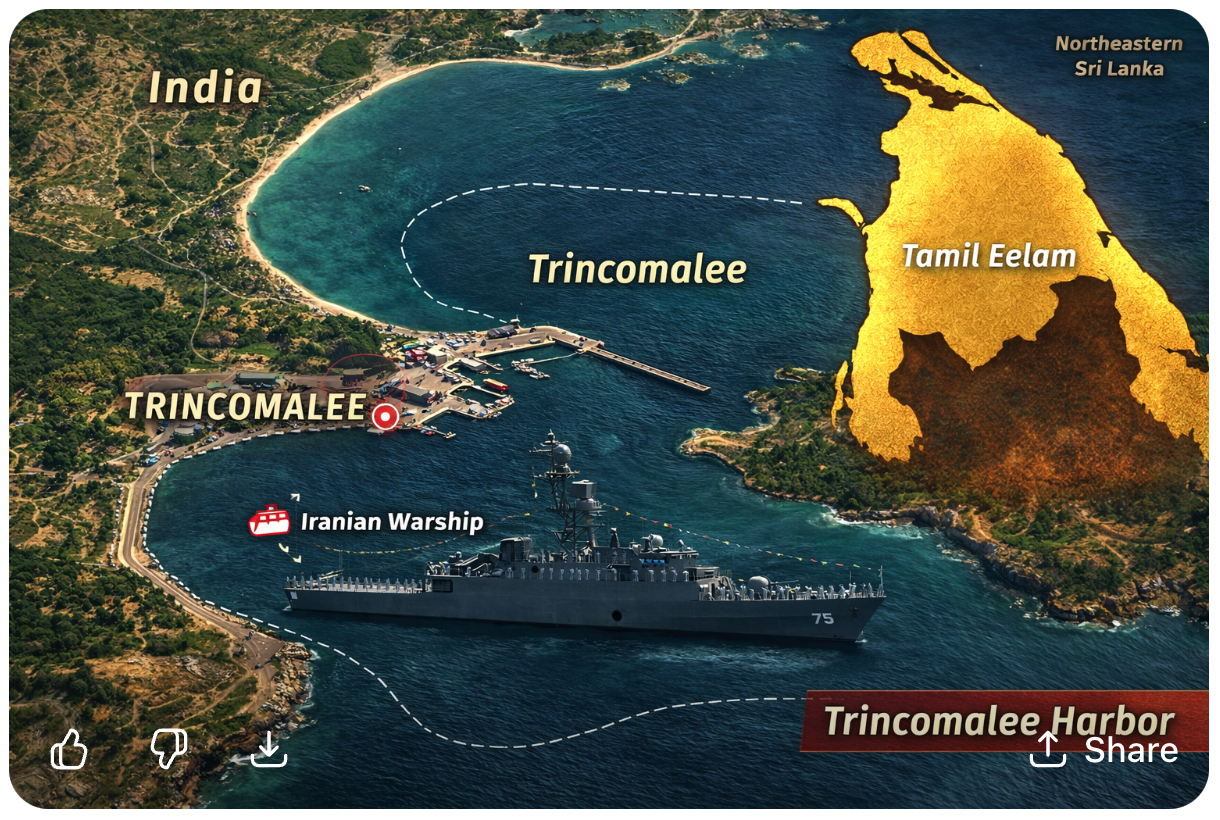
US Tamil Diaspora: Time to Complete Decolonization in Eelam — Protect Trincomalee from Iranian Warships
Completing the unfinished decolonization of Eelam will ensure Trincomalee serves democratic partners and regional stability, not authoritarian regimes seeking military footholds.”
NEW YORK, NY, UNITED STATES, March 6, 2026 /EINPresswire.com/ -- The US Tamil Diaspora today called on the United States and the international community to address what it describes as the unfinished process of decolonization in the island historically known as Eelam by applying the principles of the **1960 United Nations Declaration on the Granting of Independence to Colonial Countries and Peoples (UNGA Resolution 1514).**— Tamil Diaspora News Editorial Board
Recent developments in the Indian Ocean region highlight the strategic importance of the issue. Iranian naval vessels have recently sought refuge in Sri Lankan waters amid escalating regional tensions. According to representatives of the US Tamil Diaspora, this underscores the risks associated with the current governance of the strategic port of Trincomalee.
“The strategic harbor of Trincomalee must never become a safe haven for Iranian military vessels or any authoritarian power seeking to exploit the Indian Ocean for military purposes,” said a spokesperson for the US Tamil Diaspora. “If Tamil sovereignty had existed, the people of Eelam would never have allowed undemocratic regimes to use Trincomalee as a refuge during times of war.”
The Tamil people of the North and East of the island historically maintained their own political institutions and sovereign kingdom prior to European colonization by the Portuguese, Dutch, and British. Advocates argue that the transfer of power in 1948 from British colonial rule to a Sinhala-majority government left the Tamil nation without the opportunity to exercise its right to self-determination.
“The Tamil people constitute a distinct nation with their own language, culture, religion, and historical identity,” the spokesperson added. “The Tamil question should therefore be understood as a matter of decolonization under international law rather than simply an internal political issue.”
The organization stated that if the United States were to support a peaceful and lawful restoration of Tamil sovereignty in the North and East of the island, the Tamil people would be prepared to establish a long-term strategic partnership with the United States.
Such cooperation could include development and security partnerships in key locations such as **Trincomalee Harbor**, one of the deepest natural harbors in the world, and **Delft Island (Neduntheevu)** in the northern seas.
According to the US Tamil Diaspora, these locations could support future international initiatives including AI data centers, large-scale wind and solar renewable energy projects, maritime security cooperation in the Indian Ocean, and advanced logistics and technology infrastructure connecting South Asia to global markets.
“The Tamil people have lived on this island for thousands of years,” the spokesperson said. “The restoration of Tamil sovereignty would not only correct a historic injustice but would also create a democratic partner capable of contributing to stability and technological progress in the Indian Ocean region.”
The US Tamil Diaspora urged policymakers in Washington to view the Tamil issue through the framework of international law and decolonization principles.
“The moment has come to complete the unfinished work of decolonization,” the spokesperson concluded.
**About US Tamil Diaspora**
US Tamil Diaspora is a network of Tamil organizations and advocates working to promote human rights, democratic governance, and international recognition of the Tamil nation’s right to self-determination.
Editor
Tamil Diaspor News
email us here
Legal Disclaimer:
EIN Presswire provides this news content "as is" without warranty of any kind. We do not accept any responsibility or liability for the accuracy, content, images, videos, licenses, completeness, legality, or reliability of the information contained in this article. If you have any complaints or copyright issues related to this article, kindly contact the author above.
