


Unmanned Surface Vehicle (USV) Market Segments
Unmanned Surface Vehicle (USV) Market Overview
Unmanned Surface Vehicle (USV) Market Revenue
The Business Research Company's Unmanned Surface Vehicle (USV) Market Report 2026 – Market Size, Trends, And Global Forecast 2026-2035
LONDON, GREATER LONDON, UNITED KINGDOM, March 18, 2026 /EINPresswire.com/ -- Unmanned Surface Vehicle (USV) Market to Surpass $2 billion in 2030. In comparison, the Defense market, which is considered as its parent market, is expected to be approximately $724 billion by 2030, with Unmanned Surface Vehicle (USV) to represent around 0.3% of the parent market. Within the broader Aerospace And Defense industry, which is expected to be $1,166 billion by 2030, the Unmanned Surface Vehicle (USV) market is estimated to account for nearly 0.2% of the total market value.
Which Will Be the Biggest Region in the Unmanned Surface Vehicle (USV) Market Growth in 2030?
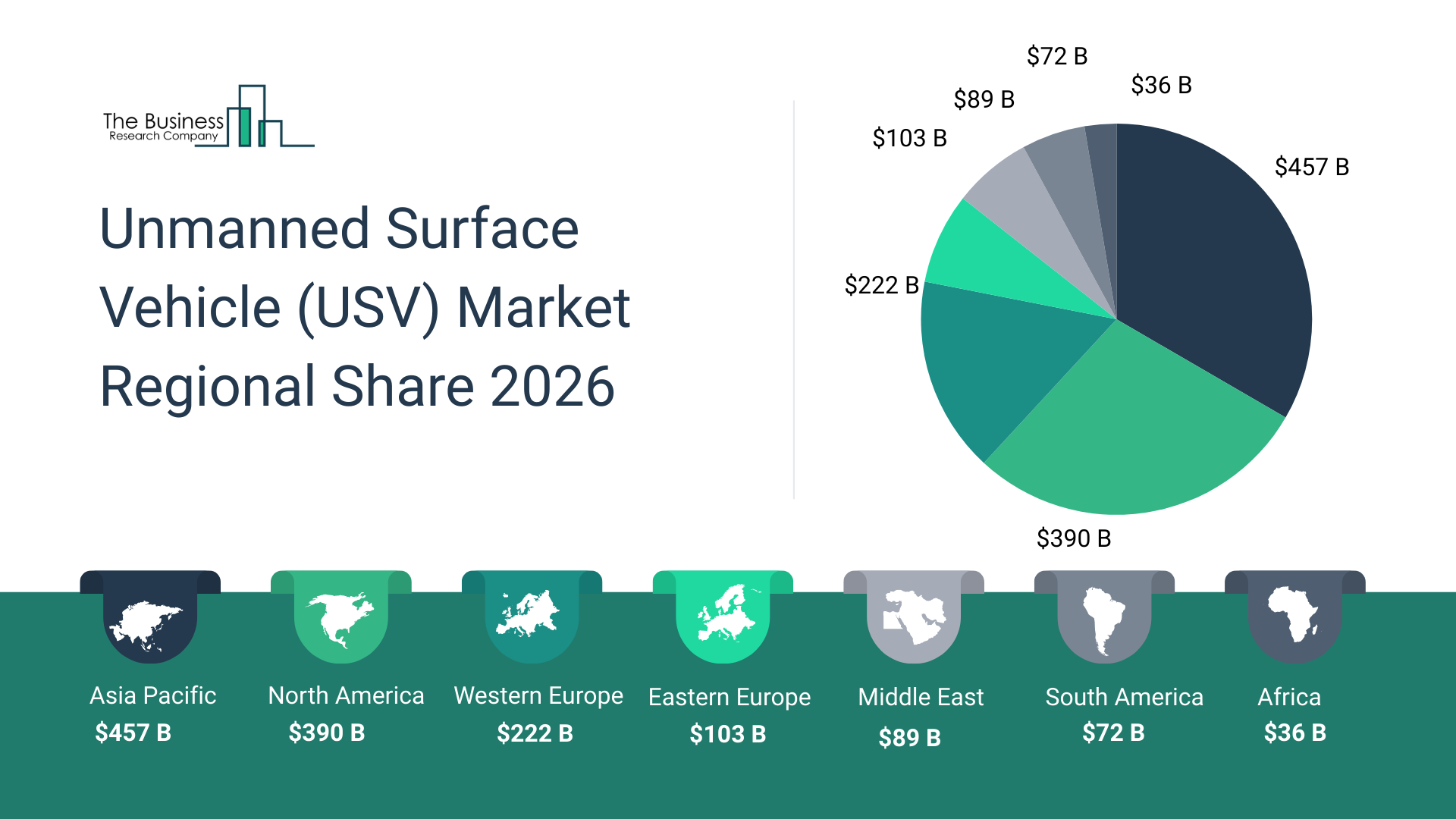
Asia Pacific will be the largest region in the unmanned surface vehicle (USV) market in 2030, valued at $733 million. The market is expected to grow from $405 million in 2025 at a compound annual growth rate (CAGR) of 13%. The rapid growth is attributed to the expansion of maritime security and ISR (intelligence, surveillance, reconnaissance) programs and the government support and investment on maritime robotics and autonomous vessel startups.
Which Will Be The Largest Country In The Global Unmanned Surface Vehicle (USV) Market In 2030?
The USA will be the largest country in the unmanned surface vehicle (USV) market in 2030, valued at $479 million. The market is expected to grow from $320 million in 2025 at a compound annual growth rate (CAGR) of 8%. The strong growth can be attributed to the expansion of maritime security and ISR (intelligence, surveillance, reconnaissance) programs and the increasing naval modernization and fleet digitization programs.
Request a free sample of the Unmanned Surface Vehicle (USV) Market report:
https://www.thebusinessresearchcompany.com/sample_request?id=10753&type=smp&utm_source=EINPresswire&utm_medium=Paid&utm_campaign=Mar_PR
What will be Largest Segment in the Unmanned Surface Vehicle (USV) Market in 2030?
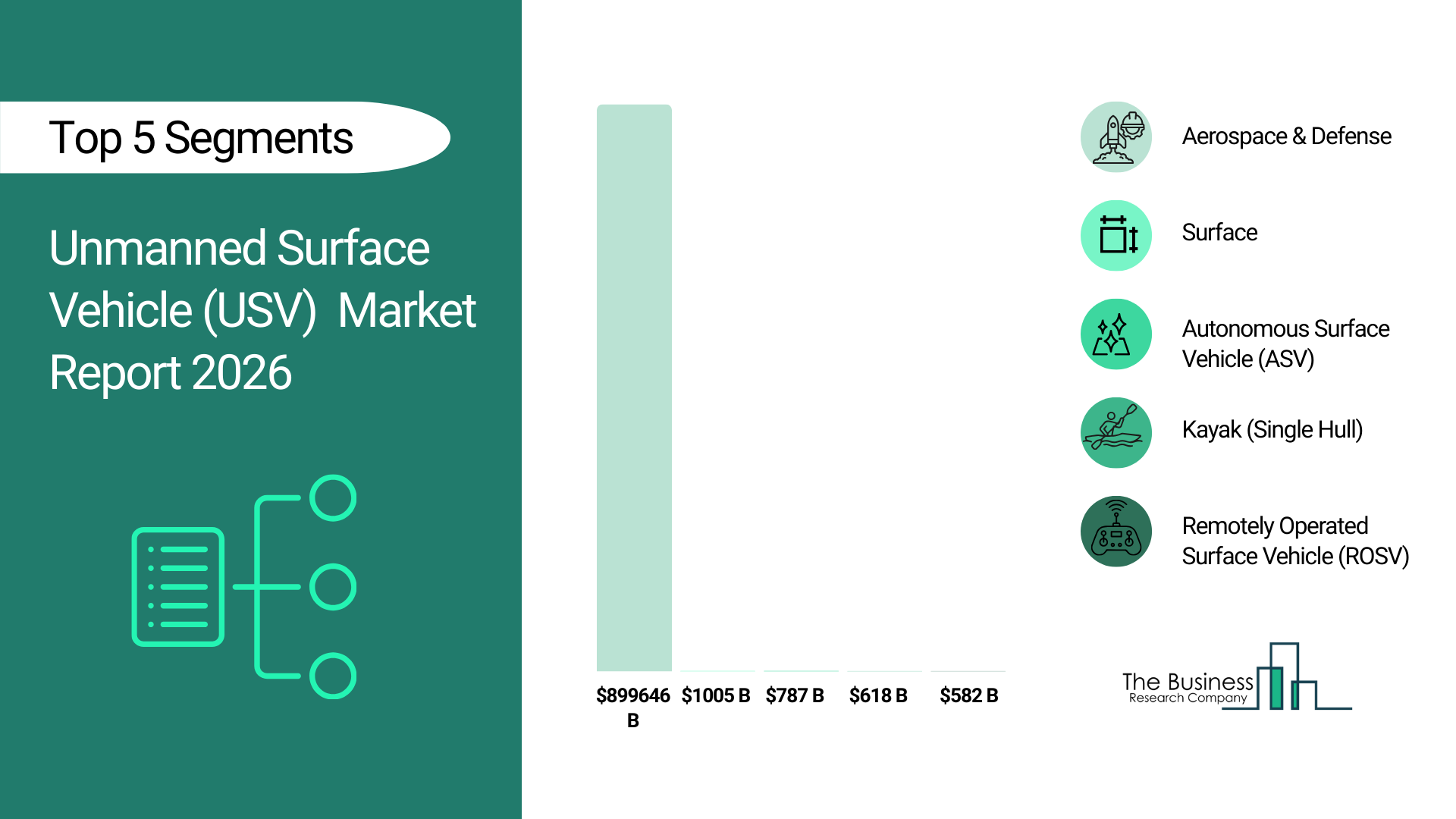
The unmanned surface vehicle (USV) market is segmented by type into surface and sub-surface. The surface market will be the largest segment of the unmanned surface vehicle (USV) market segmented by type, accounting for 78% or $1,559 million of the total in 2030. The surface market will be supported by its suitability for maritime surveillance and patrol missions, ease of deployment and recovery compared to underwater platforms, growing use in port security and coastal monitoring, ability to integrate radar and communication payloads, lower operational risk to personnel, increasing demand for persistent surface intelligence, and cost efficiency for long-duration missions.
The unmanned surface vehicle (USV) market is segmented by mode of operation into autonomous surface vehicle and remotely operated surface vehicle. The autonomous surface vehicle market will be the largest segment of the unmanned surface vehicle (USV) market segmented by mode of operation, accounting for 64% or $1,275 million of the total in 2030. The autonomous surface vehicle market will be supported by reduced reliance on human operators, growing demand for long-endurance and persistent operations, ability to perform missions in contested or hazardous environments, increased adoption for surveillance and mapping tasks, lower lifecycle operating costs, scalability for fleet-based operations, and suitability for routine and repetitive maritime missions.
The unmanned surface vehicle (USV) market is segmented by hull type into catamaran (twin hulls), kayak (single hull), trimaran (triple hulls) and rigid inflatable hull. The kayak (single hull) market will be the largest segment of the unmanned surface vehicle (USV) market segmented by hull type, accounting for 48% or $969 million of the total in 2030. The kayak (single hull) market will be supported by compact and lightweight design, ease of transportation and deployment, suitability for shallow and confined waters, lower manufacturing and operating costs, reduced visual and radar signature, efficiency in short-range missions, and increasing use in environmental monitoring and small-scale surveys.
The unmanned surface vehicle (USV) market is segmented by size into small, medium, large and extra-large. The small market will be the largest segment of the unmanned surface vehicle (USV) market segmented by size, accounting for 36% or $720 million of the total in 2030. The small market will be supported by ease of portability and rapid deployment, suitability for short-duration missions, lower acquisition and operating costs, effectiveness in shallow or restricted environments, growing use in research and inspection tasks, minimal logistical requirements, and increasing adoption by academic and commercial users.
The unmanned surface vehicle (USV) market is segmented by application into defense, commercial, scientific research and other applications. The defense market will be the largest segment of the unmanned surface vehicle (USV) market segmented by application, accounting for 58% or $1,161 million of the total in 2030. The defense market will be supported by increasing naval modernization efforts, rising demand for maritime domain awareness, need to reduce risks to human personnel, growing emphasis on unmanned fleet integration, suitability for surveillance and patrol missions, cost-effective force multiplication, and expanding use in mine countermeasures.
What is the expected CAGR for the Unmanned Surface Vehicle (USV) Market leading up to 2030?
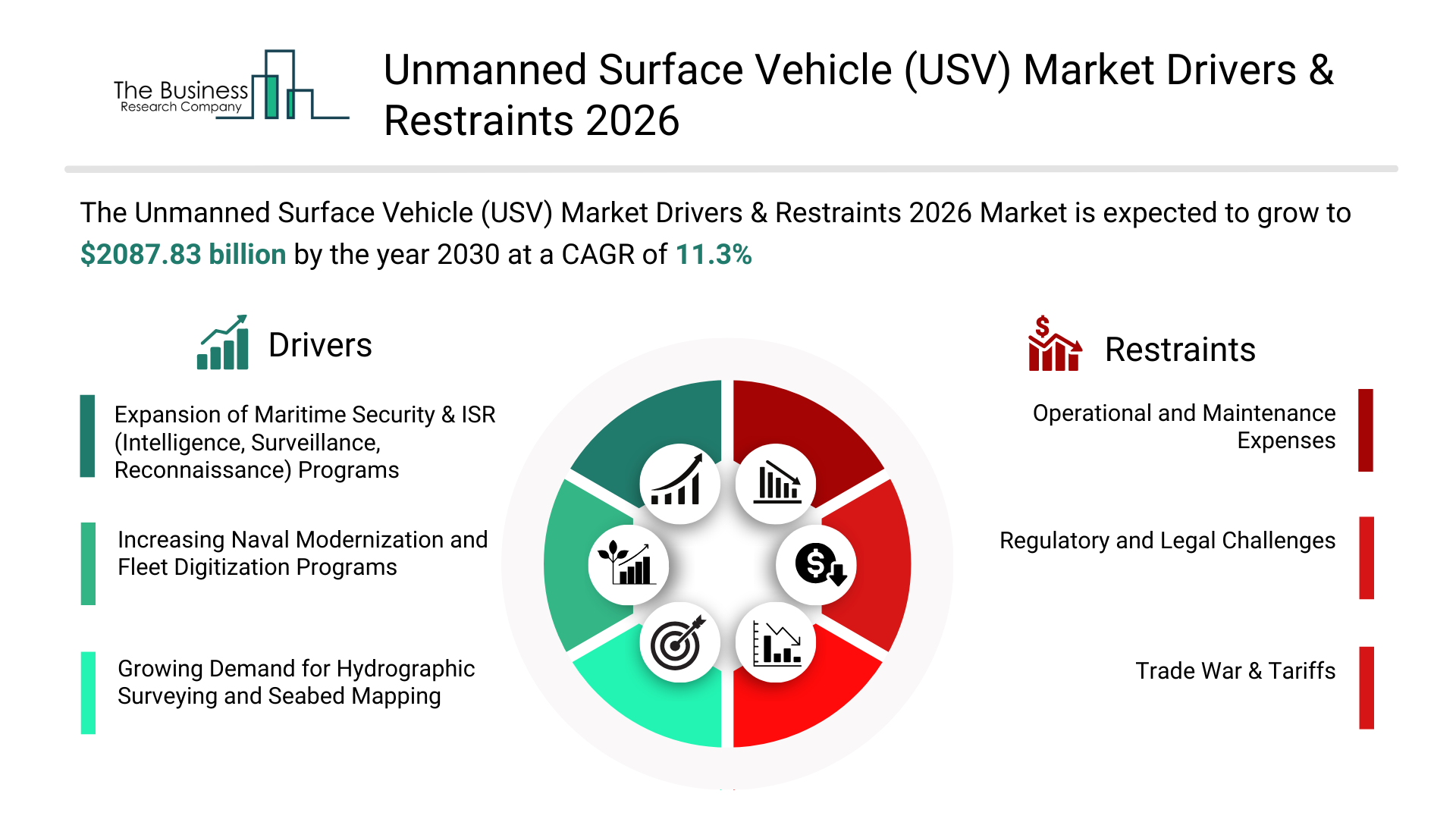
The expected CAGR for the unmanned surface vehicle (USV) market leading up to 2030 is 11%.
What Will Be The Growth Driving Factors In The Global Unmanned Surface Vehicle (USV) Market In The Forecast Period?
The rapid growth of the global unmanned surface vehicle (USV) market leading up to 2030 will be driven by the following key factors that are expected to reshape maritime security, ocean data collection, and offshore operational efficiency worldwide.
Expansion Of Maritime Security & ISR (Intelligence, Surveillance, Reconnaissance) Programs - The expansion of maritime security & ISR (intelligence, surveillance, reconnaissance) programs will become a key driver of growth in the unmanned surface vehicle (USV) market by 2030. Governments and naval forces are increasingly investing in advanced ISR capabilities to enhance maritime domain awareness, safeguard territorial waters, and counter threats such as piracy, smuggling, and illegal fishing. USVs offer a cost-effective and low-risk solution for conducting persistent surveillance, border patrol, and data collection in challenging environments. Their ability to operate autonomously for extended durations, integrate advanced sensors, and reduce reliance on manned vessels makes them a preferred asset in modern maritime security operations. Therefore, the expansion of maritime security and ISR (intelligence, surveillance, reconnaissance) programs will drive the growth of the unmanned surface vehicle (USV) market. As a result, expansion of maritime security & ISR (intelligence, surveillance, reconnaissance) programs is anticipated to contributing to a 2.0% annual growth in the market.
Increasing Naval Modernization And Fleet Digitization Programs - The increasing naval modernization and fleet digitization programs will emerge as a major factor driving the expansion of the unmanned surface vehicle (USV) market by 2030. Naval forces worldwide are upgrading their fleets to enhance operational efficiency, situational awareness, and mission readiness through advanced digital and autonomous technologies. USVs play a critical role in modern naval strategies by supporting missions such as surveillance, mine countermeasures, anti-submarine warfare, and maritime patrol without exposing crew to risk. Their integration with network-centric warfare systems, artificial intelligence, and real-time data analytics enables improved decision-making and coordinated operations, positioning USVs as a key component of next-generation naval platforms. Therefore, the increasing naval modernization and fleet digitization programs will drive the growth of the unmanned surface vehicle (USV) market. Consequently, the increasing naval modernization and fleet digitization programs is projected to contributing to a 1.6% annual growth in the market.
Growing Demand For Hydrographic Surveying And Seabed Mapping - The growing demand for hydrographic surveying and seabed mapping will serve as a key growth catalyst for the unmanned surface vehicle (USV) market by 2030. Expanding offshore activities, including port development, offshore wind projects, subsea cable installation, and oil and gas exploration, are increasing the need for accurate and efficient marine data collection. USVs provide a cost-effective and safer alternative to traditional survey vessels by enabling high-precision data acquisition in shallow, remote, and hazardous waters. Equipped with advanced sonar, positioning, and navigation systems, USVs support continuous and autonomous operations, reduce operational downtime, and improve survey efficiency, making them increasingly attractive to commercial and governmental marine survey operators. Therefore, the growing demand for hydrographic surveying and seabed mapping will drive the growth of the unmanned surface vehicle (USV) market. Therefore, growing demand for hydrographic surveying and seabed mapping is projected to supporting to a 1.0% annual growth in the market.
Government Support And Investment In Maritime Robotics And Autonomous Vessel Startups - The government support and investment in maritime robotics and autonomous vessel startups will become a significant driver contributing to the unmanned surface vehicle (USV) market by 2030. Public funding programs, defense grants, and innovation incentives are encouraging startups and technology providers to accelerate research, development, and commercialization of advanced USV platforms. These initiatives support the integration of artificial intelligence, autonomous navigation, and sensor technologies, improving vessel performance and reliability. In parallel, government-backed pilot projects and regulatory support are helping validate USV applications in defense, security, surveying, and environmental monitoring. Such sustained financial and policy support is strengthening the innovation ecosystem and expanding the adoption of USVs across commercial and military maritime operations. Therefore, the government support and investment on maritime robotics and autonomous vessel startups will drive the growth of the unmanned surface vehicle (USV) market. Consequently, the government support and investment in maritime robotics and autonomous vessel startups is projected to contributing to a 0.6% annual growth in the market.
Access the detailed Unmanned Surface Vehicle (USV) Market report here:
https://www.thebusinessresearchcompany.com/report/unmanned-surface-vehicle-usv-global-market-report?utm_source=EINPresswire&utm_medium=Paid&utm_campaign=Mar_PR
What Are The Key Growth Opportunities In The Unmanned Surface Vehicle (USV) Market in 2030?
The most significant growth opportunities are anticipated in the surface unmanned surface vehicle (USV) market, the autonomous unmanned surface vehicle (USV) market, the defense unmanned surface vehicle (USV) market, the kayak (single hull) unmanned surface vehicle (USV) market, and the medium unmanned surface vehicle (USV) market. Collectively, these segments are projected to contribute over $2 billion in market value by 2030, driven by rising naval modernization programs, increasing demand for maritime surveillance and border security, rapid advancements in autonomous navigation and AI-enabled mission systems, and expanding commercial applications such as hydrographic surveys, offshore energy support, and environmental monitoring. This surge reflects the accelerating transition toward unmanned and remotely operated maritime platforms that enhance operational endurance, reduce human risk exposure, and deliver cost-efficient mission performance, fueling transformative growth within the broader unmanned surface vehicle industry.
The surface unmanned surface vehicle (USV) market is projected to grow by $660 million, the autonomous unmanned surface vehicle (USV) market by $580 million, the defense unmanned surface vehicle (USV) market by $498 million, the kayak (single hull) unmanned surface vehicle (USV) market by $419 million, and the medium unmanned surface vehicle (USV) market by $279 million over the next five years from 2025 to 2030.
The Business Research Company (www.thebusinessresearchcompany.com) is a leading market intelligence firm renowned for its expertise in company, market, and consumer research. We have published over 17,500 reports across 27 industries and 60+ geographies. Our research is powered by 1,500,000 datasets, extensive secondary research, and exclusive insights from interviews with industry leaders.
We provide continuous and custom research services, offering a range of specialized packages tailored to your needs, including Market Entry Research Package, Competitor Tracking Package, Supplier & Distributor Package and much more
Disclaimer: Please note that the findings, conclusions and recommendations that TBRC Business Research Pvt Ltd delivers are based on information gathered in good faith from both primary and secondary sources, whose accuracy we are not always in a position to guarantee. As such TBRC Business Research Pvt Ltd can accept no liability whatever for actions taken based on any information that may subsequently prove to be incorrect. Analysis and findings included in TBRC reports and presentations are our estimates, opinions and are not intended as statements of fact or investment guidance.
The Business Research Company
Americas +1 310-496-7795
Europe +44 7882 955267
Asia & Others +44 7882 955267 & +91 8897263534
Email: info@tbrc.info
Oliver Guirdham
The Business Research Company
+44 7882 955267
info@tbrc.info
Visit us on social media:
LinkedIn
Facebook
X
Legal Disclaimer:
EIN Presswire provides this news content "as is" without warranty of any kind. We do not accept any responsibility or liability for the accuracy, content, images, videos, licenses, completeness, legality, or reliability of the information contained in this article. If you have any complaints or copyright issues related to this article, kindly contact the author above.
