


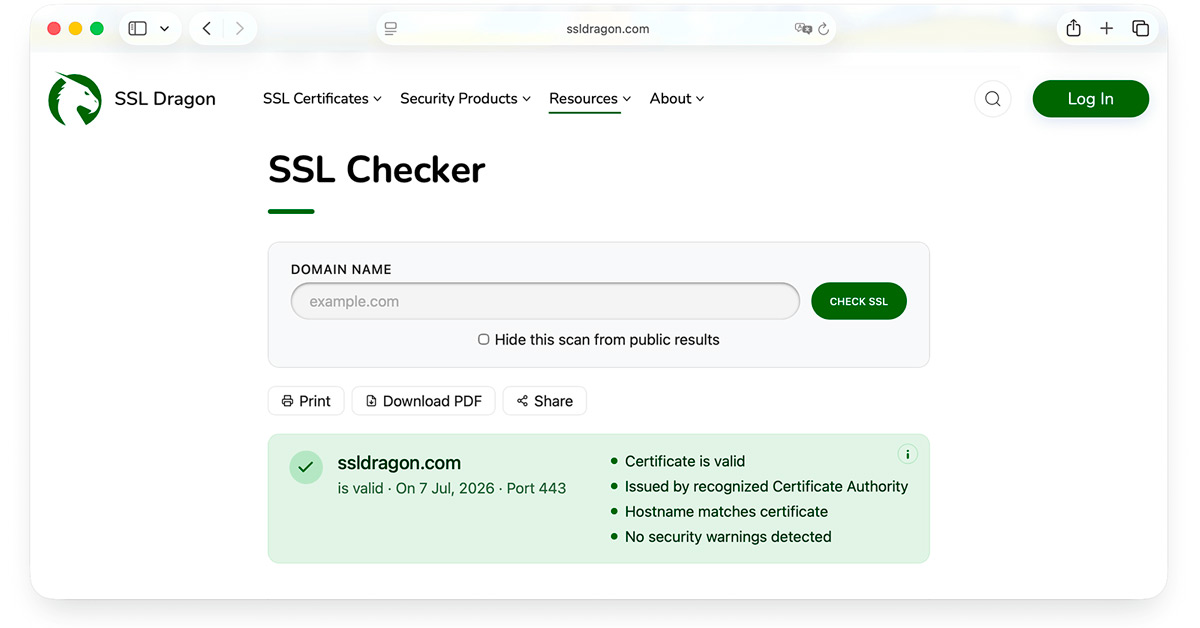
SSL Checker Tool
Weekly certificate outages hit 45% of organizations in 2025, up from 12% in 2022. SSL Dragon's free SSL Checker reports what a website really serves.
Automation reports what it issued. Your server reports what visitors actually receive. Outages live in the gap between those two answers.”
SAN JOSE, CA, UNITED STATES, July 21, 2026 /EINPresswire.com/ -- Seventy-two percent of organizations experienced at least one certificate-related outage within a twelve-month period, according to CyberArk's 2025 State of Machine Identity Security Report, a survey of 1,200 security leaders. The same survey found 45% facing weekly outages, up from 12% in 2022. SSL Dragon, a San Jose-based provider of SSL certificates and digital security solutions, argues the problem is no longer renewal itself. Automation is renewing certificates. It is not proving they arrived.— Roman Munteanu, SSL Dragon
Renewal software reports what it did. A certificate was requested and issued. It does not report what a visitor's browser receives. Those are different questions, and most teams track only the first. When the answers diverge, visitors get a full-page security warning and leave.
The failures are quiet. A certificate renews, but the web server is never restarted, so it keeps serving the expiring one. A certificate installs incompletely, so it works in the administrator's browser but fails for mobile visitors. A load balancer keeps presenting an old certificate while the server behind it holds the new one. In each case, the renewal log records success.
SSL Dragon has documented this class of failure previously, noting that shorter lifespans relocate risk from forgotten renewals to broken automation rather than removing it.
The 200-day validity cap in force since March 15, 2026, leaves less margin, and it falls to 100 days in March 2027 and 47 days in March 2029. Each renewal is a chance for something to break, and shorter cycles produce more of them with less time to catch a failure before visitors do.
SSL Dragon's SSL Checker answers the question a renewal log cannot. The free tool asks a public site the same thing a visitor's browser asks, then reports what came back. The certificate it finds live, and the real date on it, expose a renewal that never reached production. Whether the server hands over everything needed to trust that certificate separates a site that works at an administrator's desk from one that fails on a phone.
"Automation reports what it issued. Your server reports what visitors actually receive," said Roman Munteanu, CEO and Founder of SSL Dragon. "Outages live in the gap between those two answers. A renewal log is a record of intent, not evidence of delivery. The only report that counts is the one a visitor's browser gets."
Automated renewal through the ACME protocol handles the frequency the caps demand, but automation does not check its own work. SSL Dragon advises verifying from outside after every renewal rather than on a fixed schedule.
About SSL Dragon:
SSL Dragon is a US-headquartered web security provider dedicated to making digital trust accessible. As a platinum partner of Sectigo and DigiCert, SSL Dragon serves over 13,000 clients globally, providing streamlined SSL management, malware protection, and enterprise PKI solutions. For more information, visit www.ssldragon.com.
Roman Munteanu
SSL Dragon
+1 669-273-6227
email us here
Visit us on social media:
LinkedIn
Legal Disclaimer:
EIN Presswire provides this news content "as is" without warranty of any kind. We do not accept any responsibility or liability for the accuracy, content, images, videos, licenses, completeness, legality, or reliability of the information contained in this article. If you have any complaints or copyright issues related to this article, kindly contact the author above.
