

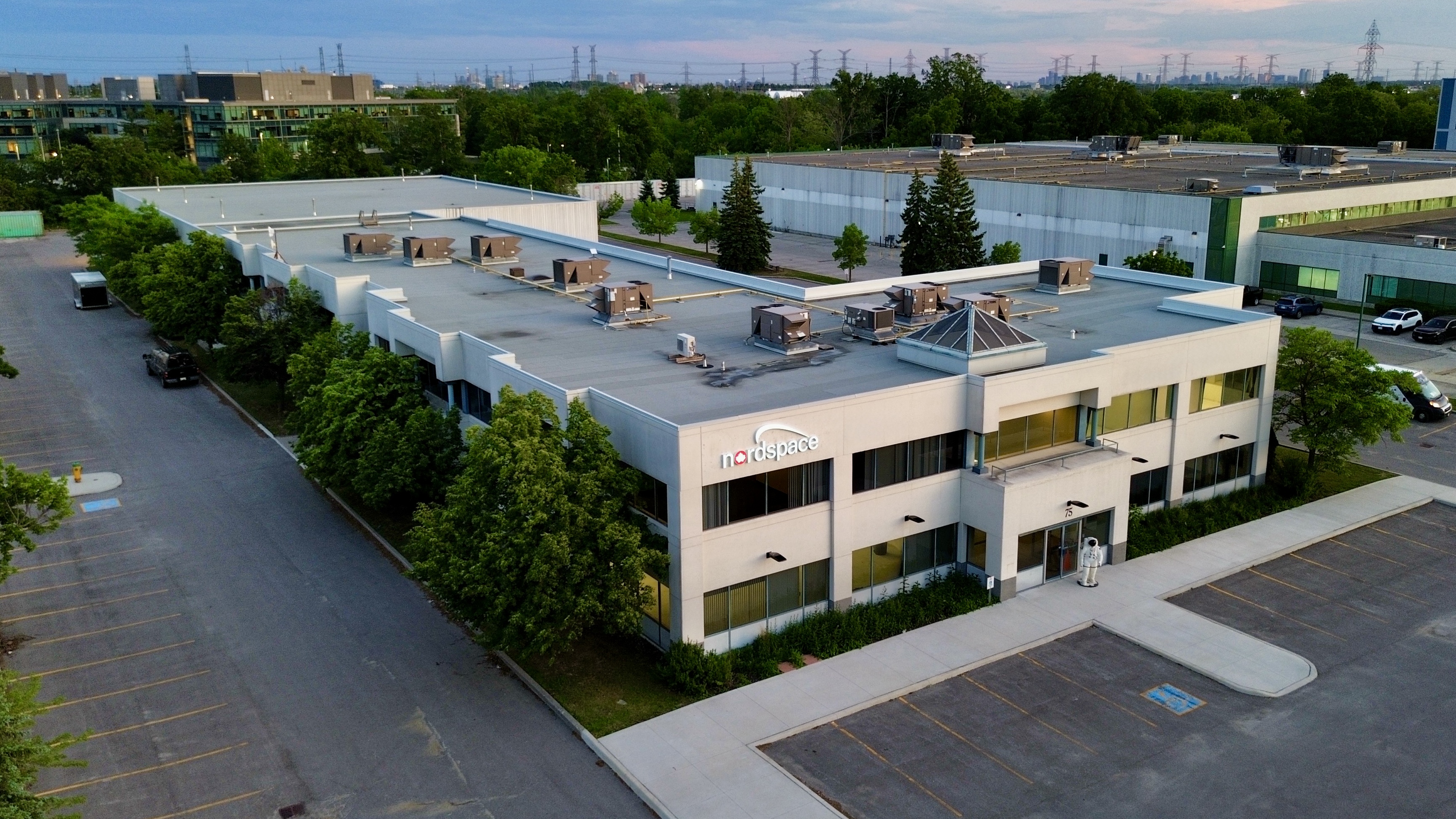
Nordspace – Rocket Factory 1 – Aerial Drone Shot
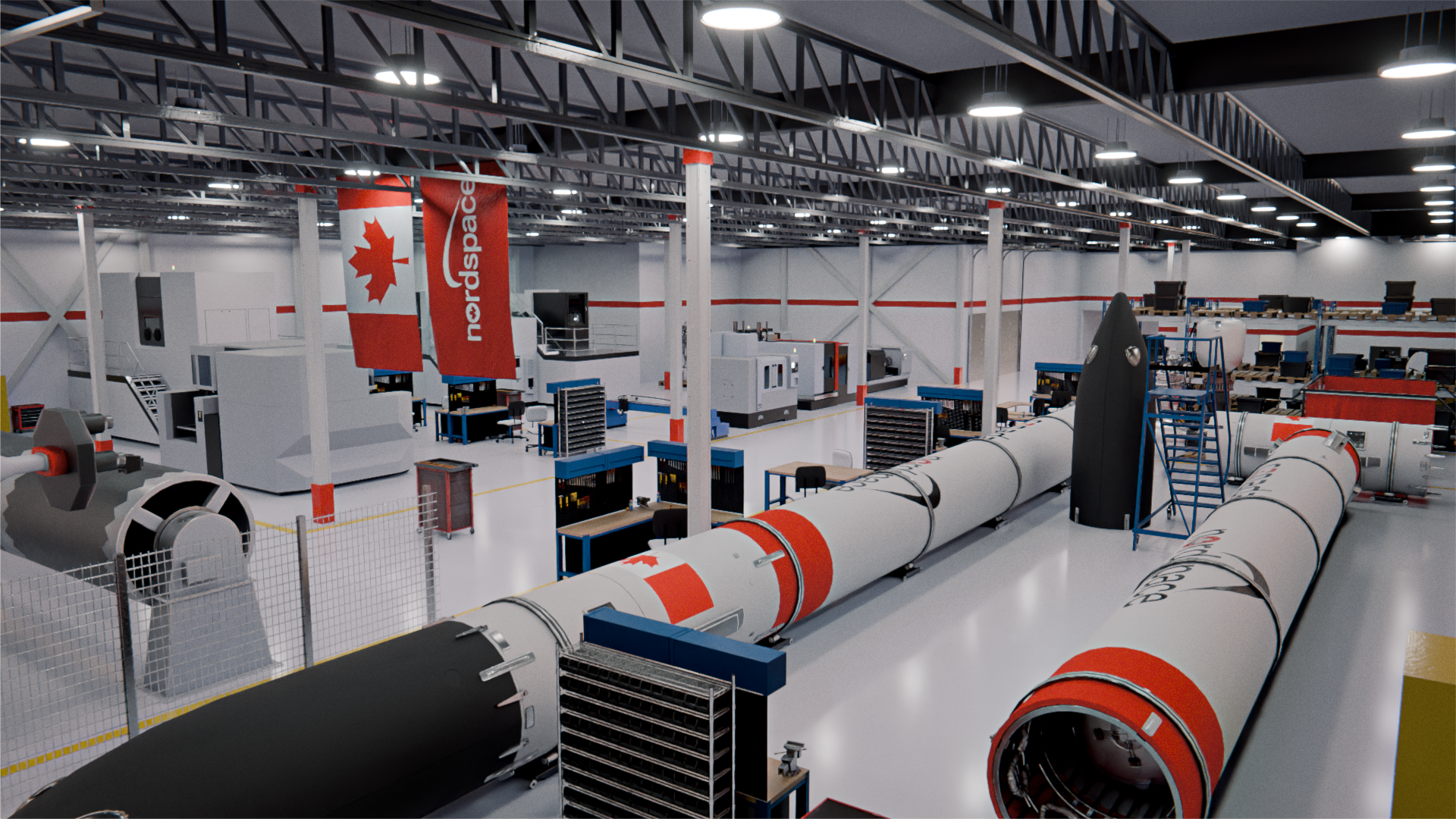
NordSpace – Rocket Factory 1 – Interior Render of Tundra Vehicle Production Line
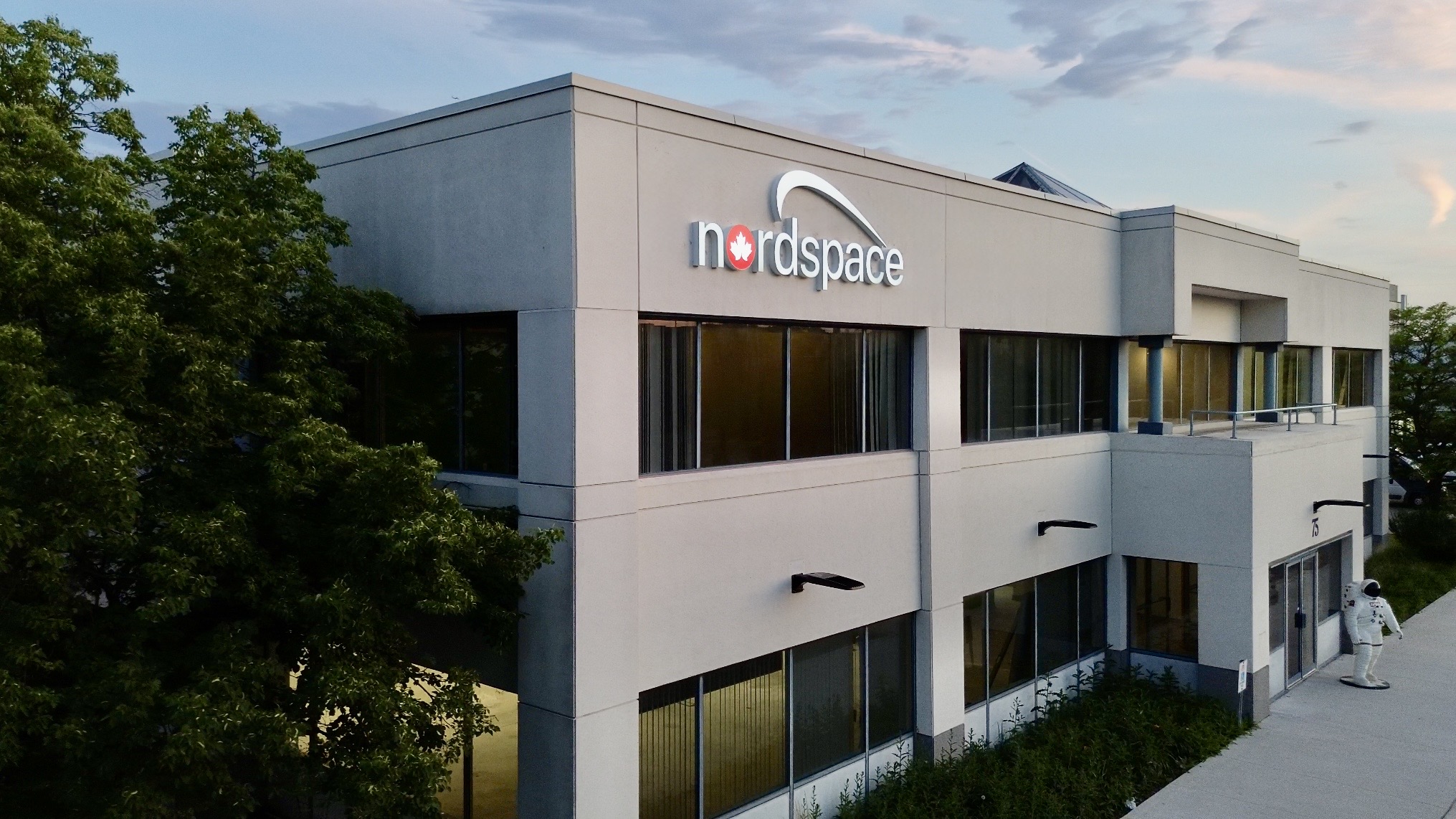
NordSpace – Rocket Factory 1 (RF-1)
New Rocket Factory 1 campus marks NordSpace's transition to production mode, anchoring a three-site national footprint for sovereign Canadian space launch
Rocket Factory 1 is a Controlled Goods Program (CGP) facility designed to host up to 255 employees and will be fully operational over the coming months. The campus consolidates the full breadth of NordSpace's in-house capabilities under one roof, including the company's Advanced Manufacturing for Aerospace Lab (AMA Lab), Space Systems Lab (SSL), multiple ISO-class clean rooms, in-house test facilities for propulsion, structures and avionics, a dedicated mission control centre, and a wide range of subtractive, additive, and composite manufacturing capabilities. These capabilities are primarily dedicated to NordSpace's operations, but will selectively be made available to customers looking for advanced capabilities in specialized component production or collaborative research and development.
RF-1 has been engineered to produce two of NordSpace's light-lift Tundra orbital launch vehicles concurrently, each capable of delivering 1,100 kg to Low Earth Orbit (LEO), or one Tundra+ medium-lift vehicle capable of delivering 2,000+ kg to LEO with scaled production of Tundra+ expected at a separate facility. Tundra+ represents an extended configuration of Tundra, sharing the same Hadfield-150 engine architecture and core manufacturing tooling, and is designed to serve growing defence and commercial demand for responsive medium-lift launch from Canadian soil in a cost and time-efficient manner. The Hadfield-150 is NordSpace's patent-pending orbital-class liquid rocket engine line, and components for the first test units are currently in production including combustion devices, chambers, and turbopump components. RF-1 is also designed to produce up to 10 small satellites concurrently, building directly on the Space Systems Lab established in 2025 and the upcoming Terra Nova dual-use demonstration satellite launching on SpaceX's Transporter mission later this year. Larger satellite platforms are in the design phase, aligned with NordSpace's goal to internalize significant launch demand.
Production scaling at RF-1 is anchored by a substantial expansion of NordSpace's metal additive manufacturing and advanced composites capabilities. Building on the AMA Lab launched in October 2025, NordSpace is taking delivery of additional large-format metal additive manufacturing systems that will result in the largest known single metal additive manufacturing machine in Canada. The campus will also receive new automated fiber placement (AFP) machines arriving this summer, unique in Canada in their combined size and type, capable of producing cryogenic compatible custom composite structures at the orbital launch vehicle scale. Together these capabilities will support the production of regeneratively cooled Hadfield-150 engines, turbopumps, pressure vessels, primary structures, and tankage for both Tundra and Tundra+, as well as upper-stage and satellite hardware.
This investment directly supports the $8 million Canadian consortium project announced in recent weeks, in which NordSpace, Miltera Machining Research Corp., Pegmatis Inc., Prime Powders Inc., and Indigenous-owned Bear Paw Manufacturing received support from Next Generation Manufacturing Canada (NGen) under the Advanced Manufacturing Technology Program. RF-1 serves as the anchor industrial site for the AI-powered hybrid additive-subtractive manufacturing line at the core of that consortium, and operationalizes the Canadian government's Defence Industrial Strategy commitments to sovereign manufacturing, Canadian-owned intellectual property, and resilient domestic supply chains.
Looking further ahead, NordSpace has acquired land for Rocket Factory 2 (RF-2), a 200,000 square foot facility dedicated to the development and production of Tempest, the company's reusable medium-lift orbital launch vehicle (previously referred to as Titan), targeting 5,000+ kg to LEO. Construction on RF-2 will begin later this year, with operational readiness expected in the coming years in various phases. Tempest will draw directly on the engineering, manufacturing, and operational experience accumulated through Tundra and Tundra+ production at RF-1. With the company's upcoming suborbital launch of its Taiga pathfinder rocket, a portion of RF-1 will be dedicated to the continuous development and launches of that vehicle as a mechanism to advance internal talent development, launch operations experience, and testing critical technologies for Tundra in-flight.
With the opening of RF-1, NordSpace's national footprint now consists of three purpose-built and company-owned sites covering the full launch lifecycle. First, RF-1 in Markham, Ontario, serves as the company's headquarters and houses design, engineering, manufacturing, integration, and mission control. Second, Area 66, the company's privately owned and operated 50-acre propulsion test range in Eastern Ontario, is home to the Darkhorse engine test cell, with two additional test cells, Blackhawk and Nightfox, under construction this summer. Blackhawk is scheduled to reach operational readiness later this summer in preparation for the largest rocket engine test in Canadian history. Third, the Atlantic Spaceport Complex (ASX) in St. Lawrence, Newfoundland and Labrador, is NordSpace's commercial spaceport and the most capable launch site in Canada in terms of inclination range, safety distances, scalability to medium-lift vehicles, and supported launch cadence. ASX received its landmark environmental approval from the Government of Newfoundland and Labrador in January 2026, with construction across Space Launch Complex 01 (SLC-01) and Space Launch Complex 02 (SLC-02) continuing through June 2026. NordSpace has also signed new launch services agreements with customers to fly on NordSpace vehicles from the ASX, which will be announced in the coming weeks.
"Sovereignty is control, and that requires doing the hard parts first. Manufacturing, talent development, intellectual property, supply chains, test facilities, and more. Skip or lose control of the hard parts that make a capability truly sovereign, and you eventually lose control of the capability altogether. At NordSpace, we do the hard parts first." said Rahul Goel, CEO and Founder of NordSpace. "RF-1 is the production engine that makes that sovereignty real and ensures Canada is not left permanently dependent on the priorities and schedules of foreign providers, and is instead the country that exports high value solutions to its allies."
RF-1 is expected to be a significant contributor to advanced manufacturing employment in Ontario and re-shoring talent across Canada's broader space industrial base. The facility supports the dual-use defence and commercial use cases at the centre of NordSpace's mission, including responsive launch for the Department of National Defence under the IDEaS Launch the North program, NORAD modernization, Arctic surveillance, wildfire detection, secure connectivity, and Earth observation, as well as commercial customers requiring sovereign, ITAR-free launch services from Canadian soil.
For more information or to explore partnership opportunities, visit www.nordspace.com or contact contact@nordspace.com.
About NordSpace
NordSpace Corp., established in 2022, is a 100% Canadian-owned aerospace and defence company developing vertically integrated solutions across responsive orbital launch vehicles, spaceports, turnkey satellites, and mission-critical software systems. Its hardware is designed, built, and flown in Canada, with the mission of advancing life on Earth through space and delivering innovation, jobs, national security, and sovereignty.
Jennifer Gawor
NordSpace Corp.
email us here
Visit us on social media:
LinkedIn
Instagram
YouTube
X
Legal Disclaimer:
EIN Presswire provides this news content "as is" without warranty of any kind. We do not accept any responsibility or liability for the accuracy, content, images, videos, licenses, completeness, legality, or reliability of the information contained in this article. If you have any complaints or copyright issues related to this article, kindly contact the author above.
