
.jpeg)

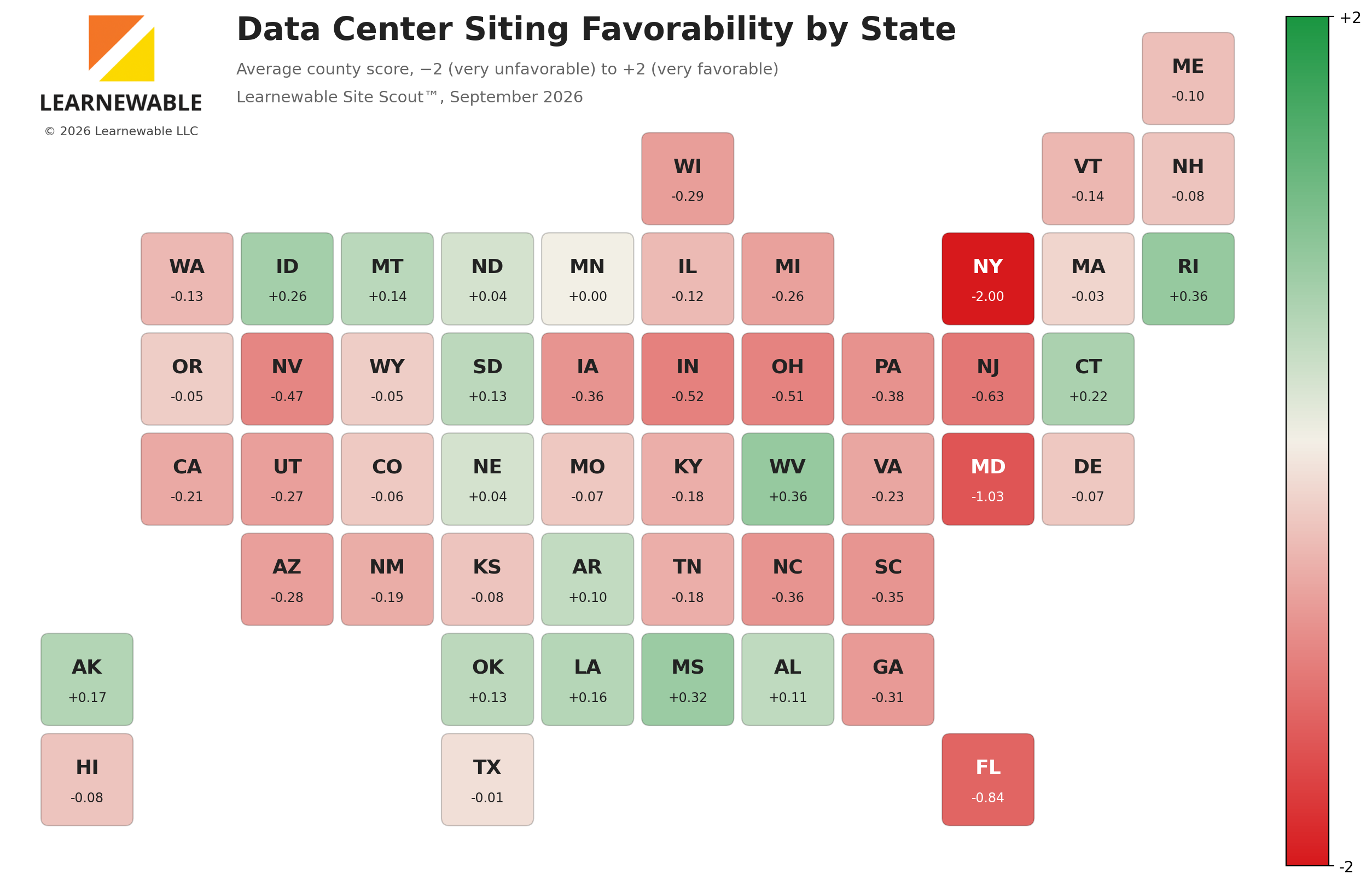
September Data Center Sentiment and Zoning/Permitting Conditions State Map
New nationwide analysis finds public sentiment toward data centers remains favorable, even as local zoning and permitting restrictions increase.
Americans aren’t necessarily rejecting data centers. Increasingly, local rules—not public sentiment—are the bigger barrier.”
PORTLAND, OR, UNITED STATES, September 28, 2026 /EINPresswire.com/ -- Data centers have become one of the most contentious forms of development in America. As artificial intelligence drives demand for more computing infrastructure, communities are debating the electricity, water, land, tax incentives and economic benefits associated with these massive facilities.— Jeremy Solomon
But are Americans actually opposed to data centers?
Learnewable’s September analysis of all 3,144 U.S. counties and county equivalents suggests the answer is more complicated.
In fact, two-thirds of U.S. counties lean favorable in public sentiment toward data center development.
The bigger obstacle appears to be local rules.
ONLY 1.3% OF COUNTIES ARE CLEARLY FAVORABLE
Each month, Learnewable evaluates data center feasibility using three factors: community sentiment, local regulatory conditions—including zoning and permitting—and the history of previous projects.
This month, just 42 counties—1.3% of the country—currently rate favorable overall for data center development.
About three-quarters are neutral, while 22% are unfavorable.
That may sound like widespread public resistance but when public attitudes are separated from local regulations, a very different picture emerges.
THE PUBLIC IS MORE FAVORABLE THAN THE RULES
Community sentiment contributes positively to data center feasibility in every region of the country.
Overall, about two out of every three U.S. counties lean favorable in public sentiment.
Local regulations, however, tell the opposite story.
Zoning and permitting conditions contribute negatively to feasibility in every region. Learnewable identified 363 counties where favorable community sentiment exists alongside restrictive zoning.
In other words, residents may be relatively open to data centers even when their local laws make development difficult.
This distinction matters because the national debate can sometimes make it appear that data center development is primarily a battle between developers and angry communities. The data suggests that is not always the case.
FEWER BANS, BUT MORE RESTRICTIONS
There is another important change taking place.
The number of counties with an outright data center prohibition or moratorium fell from 501 in July to 332 in September.
At first glance, that sounds like the country is becoming more welcoming.
But counties with restrictive zoning short of an outright ban nearly doubled—from 324 to 636.
Altogether, 968 counties, or 31% of the country, now have some form of regulatory headwind affecting data center development, up from 825 in July.
So the regulatory debate may be evolving rather than disappearing.
Instead of simply saying “no,” communities and local governments are increasingly deciding where data centers can be built, under what conditions, and what developers may be required to do before receiving approval.
GEOGRAPHY MATTERS TOO
No region of the country is now favorable overall.
The West comes closest, followed by the South, Midwest and Northeast.
At the state level, only 14 states have positive average county scores. Rhode Island and West Virginia lead at +0.36, followed by Mississippi (+0.32), Idaho (+0.26) and Connecticut (+0.22).
A notable favorable pocket stretches across Oklahoma, Arkansas, Louisiana, Mississippi and Alabama.
Meanwhile, some of the most difficult conditions are found in New York, Maryland, Florida, New Jersey, Indiana and Ohio.
THE DATA CENTER DEBATE IS BECOMING MORE NUANCED
Data centers are often discussed as a simple choice: communities either welcome them and the economic development they promise, or oppose them because of concerns about electricity, water, land use and other local impacts.
The reality appears considerably more complicated.
A community can be generally receptive to data centers while also wanting stricter rules governing where and how they are built. Another community may legally allow them while residents strongly oppose a particular proposal.
That distinction is increasingly important as AI infrastructure expands across the country.
The emerging question may not simply be “Do communities want data centers?”
It may be:
“Under what conditions are communities willing to accept them?”
That is a much more interesting—and potentially more consequential—question.
Learnewable analyzes community sentiment, zoning and permitting conditions, and previous project outcomes across the United States to understand how those answers are changing at the local level.
Jeremy Solomon
Learnewable LLC
+1 503-575-8365
jeremy.solomon@learnewable.com
Visit us on social media:
LinkedIn
Legal Disclaimer:
EIN Presswire provides this news content "as is" without warranty of any kind. We do not accept any responsibility or liability for the accuracy, content, images, videos, licenses, completeness, legality, or reliability of the information contained in this article. If you have any complaints or copyright issues related to this article, kindly contact the author above.
