



AI home health documentation solutions

io health AI to reduce documentation errors
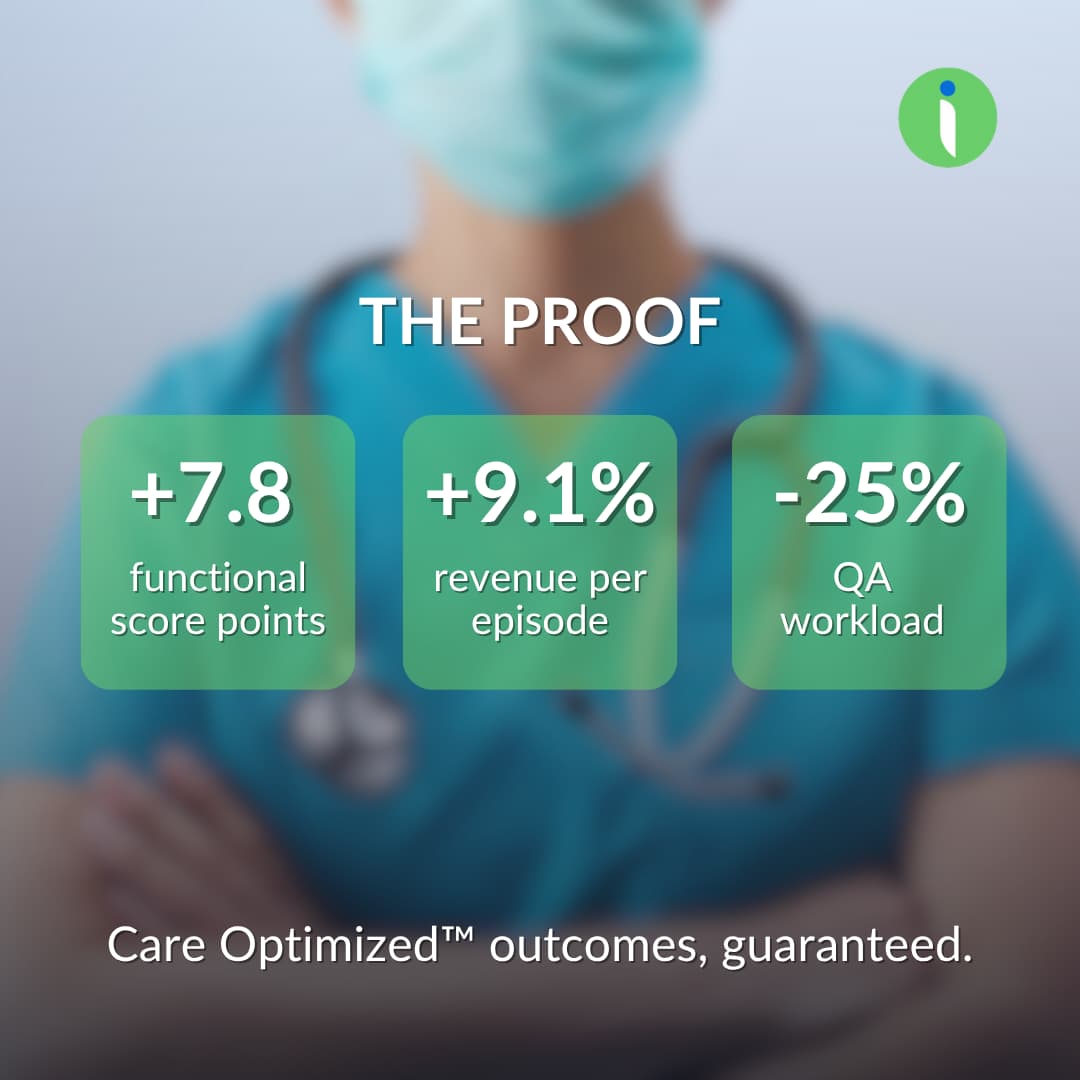
Improved functional scores revenue and reduced QA workload
IO Health launches an EMR-native overlay providing real-time compliance and workflow intelligence for post-acute care without requiring an IT overhaul.
PASADENA, CA, UNITED STATES, June 18, 2026 /EINPresswire.com/ -- IO Health Technologies, LLC, a provider of workflow intelligence software for the post-acute care sector, today announced the formal release of its full integration compatibility layer. This software layer deploys as a native overlay directly within major post-acute electronic medical record (EMR) systems. The implementation mechanism functions without requiring foundational code modifications, specialized application programming interface (API) builds, or traditional enterprise information technology (IT) infrastructure overhauls.Designed specifically for home health and hospice agencies, the platform embeds real-time clinical guidance, automated document workflows, and risk-based Quality Assurance (QA) triage directly into existing electronic records software. By positioning the technology as a native system overlay, healthcare provider organizations can introduce clinical intelligence to point-of-care workflows without creating fragmented digital architectures, establishing secondary user logins, or requiring extended staff training periods.
The development addresses a persistent challenge in the post-acute healthcare operations sector: the operational friction and financial costs associated with connecting legacy electronic medical records to modern data-validation utilities. Traditionally, introducing clinical decision support or advanced automated auditing tools has required complex enterprise integration projects. These projects often involve multi-month implementation timelines, significant capital expenditures, and substantial technical support from internal IT departments. The native overlay architecture developed by IO Health circumvents these technological hurdles by utilizing the existing user interface of the host EMR to present real-time validation data, effectively standardizing documentation at the moment of clinician entry.
Addressing the Post-Acute Technological Gap
Post-acute care providers, including home health agencies and hospice organizations, operate under stringent regulatory and documentation guidelines mandated by the Centers for Medicare & Medicaid Services (CMS). Key documentation requirements, such as the Outcome and Assessment Information Set (OASIS) for home health and the Hospice Outcomes & Patient Evaluation (HOPE) framework, dictate organizational reimbursement levels and compliance ratings.
Despite the critical nature of this data, standard post-acute EMRs are traditionally designed as repository databases rather than active clinical guidance tools. Consequently, clinicians frequently complete patient documentation at the bedside without real-time validation, leading to human error, omissions, and mismatched clinical indicators.
According to industry data, documentation errors caught downstream during internal reviews or external audits frequently result in extensive administrative rework loops. Charts are routinely sent back and forth between clinical staff and QA teams, delaying billing submissions, lengthening the revenue cycle, and increasing operational overhead. Furthermore, inadequate or incongruent documentation directly exposes post-acute agencies to technical denials, medical necessity rollbacks, and federal compliance penalties.
To mitigate these systemic inefficiencies, healthcare IT strategies have historically relied on third-party point solutions or post-submission auditing applications. However, these traditional software solutions ingest data only after a clinical visit is finalized and the initial chart is submitted. This structural arrangement leaves the post-submission correction loop fully intact, requiring clinicians to reconstruct past patient encounters from memory days after a visit has occurred.
Conversely, the IO Health software architecture injects compliance checks directly into the active documentation window. The application reads user data entries continuously, dynamically cross-referencing lookback data from the patient’s complete historical medical record to verify clinical consistency before the final chart is pushed to internal review.
Architecture of the Non-Disruptive Integration Layer
The technical implementation of the IO Health integration compatibility platform focuses entirely on eliminating workflow disruption. Rather than operating as a separate web portal or requiring a distinct desktop application, the platform functions as an EMR-native overlay layer.
When a field nurse, physical therapist, or hospice clinician logs into an agency’s existing EMR system via a tablet, laptop, or mobile device, the intelligence core activates silently in the background. The clinician navigates the identical screens, menus, and forms they are accustomed to using, with the software delivering contextual insights and structured formatting fields natively within the standard interface.
The platform's functional footprint comprises three distinct, interconnected software modules that coordinate data processing within the host EMR:
ioAssist: This module delivers point-of-care clinical guidance directly during the patient visit. It provides active, real-time item accuracy checking for complex OASIS and HOPE assessments, ensuring that specific scores match documented clinical observations. The module features an embedded utility known as Narrative Composer, which assists clinicians in generating highly structured, Medicare-calibrated clinical narratives in standard Subjective, Objective, Assessment, and Plan (SOAP) or Situation, Background, Assessment, and Recommendation (SBAR) formats. By drawing directly from structured assessment inputs, it minimizes reliance on free-text recall and cuts average clinician onboarding times significantly.
ioIQ: This component acts as an automated triage mechanism for internal administrative workflows. It reviews completed chart submissions using an AI-driven, risk-based prioritization algorithm. Instead of forcing QA leaders to audit every submitted chart with equal scrutiny, the system ranks charts by compliance risk and error severity. This automated filtering directs administrative attention exclusively to documents containing preventable errors or high-risk clinical inconsistencies, which historically reduces overall QA workloads by more than 50 percent.
ioDoc: Dedicated to administrative efficiency at the initiation of care, this module digitizes the delivery and tracking of required structural documentation, eliminating traditional physical paper processes. It handles patient handbooks, Patient Bill of Rights disclosures, and authorization forms through secure SMS or email channels utilizing Date of Birth (DOB) authentication. The system automatically registers delivery, receipt, and digital signatures, transferring the completed compliance audit trail directly back into the primary EMR chart, saving upwards of 60 minutes during initial patient intakes.
"The core objective behind our native overlay design was to acknowledge that clinicians do not need another independent software system to manage during an active patient encounter," said Chief Technology Officer at IO Health. "Every additional login screen, separate app window, or duplicated data field introduced into a home health or hospice environment represents a point of operational friction that degrades the quality of clinical documentation and contributes to staff burnout. By engineering an intelligence layer that maps precisely onto existing post-acute EMR fields without altering the host code, we provide immediate clinical validation exactly where the work is performed. This approach removes the traditional IT overhead completely, allowing agencies to go live with enterprise-grade clinical guidance within a matter of days."
Quantifiable Operational Impact and Market Context
The deployment of non-disruptive workflow tools arrives at a critical juncture for the post-acute care economy. Home health and hospice providers are grappling with an unprecedented structural labor shortage, characterized by elevated nurse turnover rates and rising labor costs. Concurrently, operational margins are pressured by shifting federal reimbursement rates and expanded pre-claim review programs. In this environment, administrative efficiency is directly tied to an agency's financial viability.
Field data collected across multiple active deployments of the IO Health platform indicates clear operational improvements stemming from immediate point-of-care validation. Across consolidated agency implementations, the reduction in document correction cycles has consistently yielded documentation accuracy improvements of over 50 percent. Furthermore, by addressing errors dynamically before charts reach the billing department, agencies have successfully mitigated revenue leakage and accelerated billing velocity without expanding administrative headcount.
The structural impact on administrative timelines is particularly pronounced during the initial patient onboarding phase. By replacing manual document verification with automated digital delivery and automated tracking mechanisms, the software reclaims substantial clinical hours that were previously lost to paperwork. This optimization is achieved alongside minimal staff friction, as field clinicians require less than 10 minutes of initial orientation to navigate the native overlay interface, compared to the multi-day classroom instructional periods associated with conventional enterprise software overhauls.
"From an operational oversight perspective, the traditional separation between documentation entry and quality assurance review has long driven up administrative costs," stated GrandCare Health, an early adopter of the overlay technology. "When clinical documentation is reviewed days after the fact, the process becomes reactive, turning the QA department into an internal policing unit rather than a supportive resource. Moving the validation checkpoint upstream to the actual point of care allows our field clinicians to lock in accurate data on their first attempt. The change has significantly alleviated the administrative burden on our QA teams, reduced clinical friction, and provided clear operational visibility that was previously unattainable within our standard EMR setup."
Security, Compliance, and Technical Integrity
Because the software platform integrates directly with cloud-based and on-premise healthcare data environments, IO Health has engineered the architecture to align with rigid institutional data security standards. The platform operates in strict compliance with the Health Insurance Portability and Accountability Act (HIPAA), ensuring the absolute protection of Protected Health Information (PHI) across all transmission and storage modules.
Additionally, the technology architecture has achieved SOC 2 Type II certification, verifying that the company’s internal data security practices, processing integrity mechanisms, and privacy controls are fully validated by independent, third-party audits.
The technical integration layer is designed to remain unaffected by standard software updates executed by host EMR vendors. Because the overlay interacts with user-facing interface elements and standardized data schemas rather than altering the core database scripts, routine host system updates do not break the validation paths. This design standard isolates the agency from ongoing maintenance costs and removes the risk of sudden software instability, ensuring continuous clinical support across thousands of distributed patient visits.
Long-Term Industry Implications
As CMS continues to transition the broader healthcare landscape toward value-based purchasing models, the financial health of post-acute organizations will increasingly depend on the precise tracking of patient outcomes and structural compliance data. Inaccurate documentation under these models does not simply delay payments; it actively lowers an agency's public quality ratings, directly impacting its market competitiveness and long-term referral streams.
By establishing a method to inject real-time data validation into legacy electronic architectures without requiring capital-intensive software development, the availability of EMR-native overlay technology lowers the barrier to entry for advanced operational analytics. Small and mid-sized post-acute providers can now deploy data-validation mechanisms comparable to those utilized by large, well-capitalized national healthcare networks, helping to level the technological playing field within localized healthcare markets.
About IO Health Technologies, LLC
IO Health Technologies, LLC is a specialized healthcare software development firm focused on building workflow intelligence systems for the post-acute medical sector. Founded by experienced healthcare agency operators and clinical technology experts, the company designs specialized software applications that optimize documentation compliance, enhance operational predictability, and secure reimbursement integrity for home health and hospice providers nationwide.
The company's core platform functions as a non-disruptive, intelligent data layer that operates natively within existing electronic medical records systems, delivering context-aware clinical guidance at the point of care without requiring foundational IT infrastructure changes. IO Health Technologies, LLC maintains its primary corporate headquarters in Pasadena, California, and its technology architectures are fully HIPAA compliant and SOC 2 Type II certified.
David Bell
io Health
+1 551-510-5240
email us here
Visit us on social media:
LinkedIn
Legal Disclaimer:
EIN Presswire provides this news content "as is" without warranty of any kind. We do not accept any responsibility or liability for the accuracy, content, images, videos, licenses, completeness, legality, or reliability of the information contained in this article. If you have any complaints or copyright issues related to this article, kindly contact the author above.
