


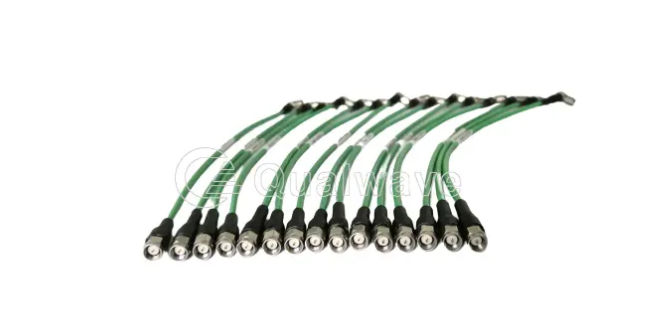
flexible microwave cable suppliers
Introduction to High-Frequency Interconnect Architecture
In modern microwave and millimeter-wave systems, coaxial interconnects serve as the crucial pathways for high-fidelity signal distribution. Procurement specialists and design engineers in B2B environments must balance theoretical electrical performance against the harsh realities of physical routing and environmental exposure. Active subassemblies—such as transmitters, test instruments, and radar front-ends—rely entirely on the integrity of the integrated RF Cable, Microwave Cable, and Millimeter Wave Cable arrays to maintain system link budgets.
As operational frequencies shift upward into the millimeter-wave spectrum, standard transmission line properties degrade rapidly. Selecting the correct RF Coaxial Cable, Coaxial Cable, or Coax Cable requires a granular understanding of dielectric materials, shielding configurations, and connector termination methods. Whether utilizing a standalone RF Coax Cable or a fully integrated Cable Assembly, minor deviations in dimensional tolerance or cable bending can introduce severe phase shifts and insertion loss spikes. This technical overview examines the standard integration pain points observed across industrial test cells and deployment environments, offering concrete engineering solutions to maintain signal integrity.
Technical Specification and Substrate Analysis
System architects must evaluate coaxial hardware through verified electrical and mechanical performance criteria. The matrix below details typical performance limits observed across standard high-frequency transmission line configurations:
Component Category Frequency Range Velocity of Propagation (Vp) Typical Insertion Loss (dB/m at 18 GHz) Primary Industrial Applications
RF Cable Assembly DC to 18 GHz 70% to 85% 0.8 to 1.5 Wireless Infrastructure, Base Station Routing
Microwave Cable Assembly DC to 40 GHz 76% to 83% 1.4 to 2.2 Automated Test Equipment (ATE), Test Benches
Millimeter Wave Cable DC to 110 GHz 74% to 80% 3.5 to 5.8 Satcom, High-Bandwidth Labs, Radar Arrays
Addressing Critical Interconnect Pain Points in B2B Applications
B2B technical buyers frequently experience system failures due to incorrect interconnect selections or improper mechanical layouts. Addressing these issues requires systematic quality control and clear communication between the system integrator and the cable manufacturer.
1. Phase and Amplitude Instability Due to Mechanical Bending
During routine testing or automated antenna tracking operations, cables undergo repeated bending. A standard high phase stable rf cable assembly is required to mitigate changes in electrical length caused by the physical shifting of the internal dielectric material and the outer shield layers. If the cable structure shifts, it introduces phase tracking errors that disrupt phase-array calibrations and vector network measurements.
Solution: Systems must utilize cables built with microporous PTFE dielectrics combined with a silver-plated copper tape wrap and a braided outer shield. This specific mechanical layout allows the internal conductors to slide smoothly relative to one another during flexion, maintaining a phase stability of less than $\pm5^\circ$ at 18 GHz over repeated bend cycles.
2. High Return Loss and Mismatch Spikes at Connector Interfaces
Impedance discontinuities at the junction where an RF Cable Assembly or Microwave Cable Assembly meets its termination connector create significant signal reflections. This return loss degrades overall system efficiency and can cause standing wave issues within high-power transmission paths.
Solution: Manufacturers implement automated precision strip and crimp tooling alongside strict solder termination profiles. Each connector interface is modeled via 3D electromagnetic software to optimize the internal step transitions between the cable center conductor, dielectric, and connector pin, ensuring an aggregate VSWR below 1.25:1 across the specified frequency spectrum.
3. Accelerated Mechanical Wear in Demanding Environments
In military, aerospace, or industrial manufacturing environments, interconnects are subjected to crush forces, abrasion, and continuous torque. Deploying an unarmored cable in these settings leads to pinched dielectrics, kinked outer conductors, and rapid electrical breakdown.
Solution: Integrators should source a specialized ruggedized millimeter wave cable for aerospace applications that incorporates multi-layer armoring. This architecture typically features an internal stainless steel spiral conduit, a braided strength member, and an outer chemical-resistant jacket, enabling the assembly to withstand high compressive loads without compromising internal geometry.
4. Sourcing Limitations from Flexible Microwave Cable Suppliers
Procurement teams often face bottlenecked supply chains when trying to source specialized phase-matched configurations or atypical connector combinations, resulting in long project delays.
Solution: Establishing validation pipelines with multi-tier flexible microwave cable suppliers who maintain extensive on-site component inventories and automated testing loops ensures rapid delivery of custom-length assemblies without sacrificing lot-to-lot electrical consistency.
Environmental Stabilization and Quality Verification Protocols
Industrial interconnect installations require rigorous validation procedures to guarantee long-term operational lifetimes. Microscopic imperfections or poor braid density can cause shielding effectiveness to drop, leading to electromagnetic interference (EMI) leakage.
Standard validation routines involve verifying mechanical pull strength, checking dimensional tolerances via laser micrometers, and measuring electrical continuity under vibration. Environmental stress screening (ESS) subjects assemblies to thermal shock testing (typically ranging from -55°C to +125°C) to expose cold-solder joints or mismatched thermal expansion rates between the metal connectors and plastic jackets. Adhering to strict compliance frameworks ensures that performance parameters remain stable throughout extended field deployments.
Frequently Asked Questions Regarding High-Frequency Interconnect Systems
Q1: What parameters should be evaluated when reviewing flexible microwave cable suppliers for laboratory test configurations?
A1: When qualifying flexible microwave cable suppliers, technical teams should focus on phase stability versus temperature, flexure lifecycle limits, and the reproducibility of S-parameters across multiple production batches. Suppliers must supply detailed documentation detailing raw material origins, shielding effectiveness values (typically required to be $>90\text{ dB}$), and raw VNA test data plots for each individual assembly delivered.
Q2: Why is a high phase stable rf cable assembly critical for multi-channel phased-array installations?
A2: Multi-channel radar and beamforming networks rely on strict time-of-arrival synchronization between parallel signal paths. If any interconnect exhibits phase drift due to temperature shifts or physical routing adjustments, the antenna array's spatial filtering accuracy degrades. Utilizing a high phase stable rf cable assembly ensures that electrical length variations are minimized, preserving spatial accuracy without requiring constant software recalibration.
Q3: What design factors define a ruggedized millimeter wave cable for aerospace applications?
A3: A ruggedized millimeter wave cable for aerospace applications features a multi-layered protective outer structure designed to absorb external strain, torque, and pressure. Additionally, the materials used must meet low outgassing requirements and maintain flexibility at low ambient temperatures, ensuring the assembly preserves its nominal 50-ohm characteristic impedance despite severe pressure and temperature differentials.
Q4: How does dielectric selection influence the performance of an RF Cable Assembly at high frequencies?
A4: The dielectric material directly controls the velocity of propagation, attenuation coefficient, and thermal performance of a cable assembly. Solid PTFE dielectrics offer excellent mechanical handling but exhibit a phase change anomaly around room temperature (known as the PTFE Teflon knee). Microporous or expanded PTFE options introduce air into the structure, lowering the dielectric constant, reducing insertion loss, and significantly smoothing out phase shifts across varying thermal environments.https://www.qualwaves.com/
Qualwave Inc.
Qualwave Inc.
+86 28-6115-4929
sales@qualwave.com
Legal Disclaimer:
EIN Presswire provides this news content "as is" without warranty of any kind. We do not accept any responsibility or liability for the accuracy, content, images, videos, licenses, completeness, legality, or reliability of the information contained in this article. If you have any complaints or copyright issues related to this article, kindly contact the author above.
