


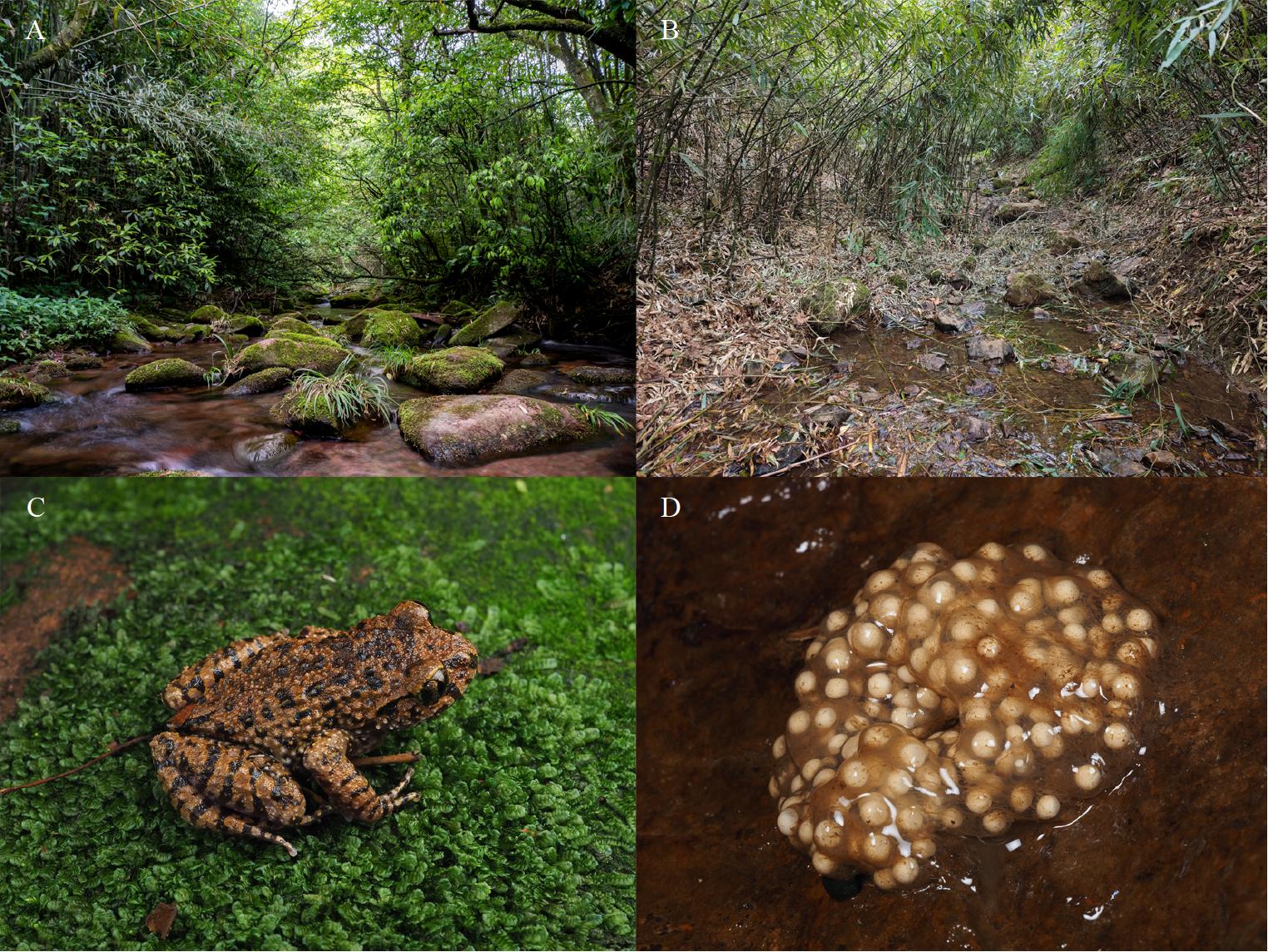
Habitats of O. wumengmontis sp. nov. in the Wumeng Mountain National Nature Reserve.
GA, UNITED STATES, July 20, 2026 /EINPresswire.com/ -- A new species of toothed toad has been discovered in the Wumeng Mountain National Nature Reserve in Yunnan Province, China, marking the first new addition to the genus Oreolalax from the province in over 36 years. The species, named Oreolalax wumengmontis, was identified through a combination of molecular phylogenetic analyses and detailed morphological comparisons. Genetic analysis of mitochondrial genes—16S ribosomal RNA (16S rRNA) and cytochrome c oxidase subunit I (COI)—reveals that this toad is a distinct evolutionary lineage, most closely related to Oreolalax omeimontis but separated by significant genetic distances of 11.25% in the 16S rRNA gene and 17.61% in the COI gene.
The genus Oreolalax, commonly known as toothed toads, comprises 21 described species, with 19 found across the mountainous regions of southwestern China. These amphibians typically inhabit high-altitude montane stream environments, with particularly high species diversity in the Hengduan Mountains and adjacent areas. Despite Yunnan Province harboring the highest amphibian diversity in China, no new Oreolalax species had been described from the region since 1990. This gap in knowledge has persisted largely due to relatively conservative morphological differentiation among species and cryptic life history traits that make them difficult to distinguish. Based on these challenges, there is a clear need to conduct comprehensive field surveys and integrative taxonomic studies to uncover the true species diversity of this genus in biodiversity hotspots.
A research team from Southwest University, Southwest Forestry University, and the Management and Conservation Bureau of Yunnan Wumeng Mountain National Nature Reserve published (DOI: 10.3724/ahr.2095-0357.2026.0014) their findings on June 23, 2026, in the journal Asian Herpetological Research. The study describes a new toothed toad species discovered during field surveys in May 2024 at approximately 2,300 meters above sea level within the Wumeng Mountain National Nature Reserve in Zhaotong City, northeastern Yunnan, China.
The new species, Oreolalax wumengmontis, can be distinguished from all other known congeners by a unique combination of 11 morphological characteristics. Adult males measure 49.5 to 53.0 millimeters in snout-vent length (SVL), while the single female specimen measures 46.6 millimeters. The species features hidden or only slightly visible tympanums (eardrums), lacks a vocal sac entirely, and has only rudimentary webbing between its toes with narrow lateral fringes. One of its most striking features is a dark triangular patch between the eyes—a characteristic that immediately sets it apart from many related species. Male individuals also display a dorsum covered with both large and small tubercles, while the abdomen shows distinct cloudy spotting patterns. The femoral glands are large and prominent, and when the hindlimb is stretched forward, the tibiotarsal articulation reaches the region between the eye and nostril—another diagnostic trait. Phylogenetic analyses place this new species as the sister group to Oreolalax omeimontis, with strong bootstrap support of 97% and Bayesian posterior probability (BPP) of 1.0. The two species are also geographically separated by over 500 kilometers.
“Finding a new Oreolalax species in Yunnan after more than three decades was both surprising and exciting,” the authors said. “What makes this discovery particularly meaningful is that it challenges the assumption that we already know the full diversity of this group in one of China's most biodiverse provinces. The fact that this toad was hiding in plain sight—in a national nature reserve, no less—reminds us how much remains to be discovered, even in areas we thought were well-studied. The distinct genetic and morphological differences we observed suggest that Oreolalax species may be more specialized and localized than previously recognized.”
The discovery of Oreolalax wumengmontis has significant implications for conservation and evolutionary biology. The species is currently known only from its type locality within the Wumeng Mountain National Nature Reserve, where it inhabits subtropical evergreen broadleaved forests and breeds in perennial streams during early May. Female specimens were observed depositing approximately 144 white eggs attached to the undersides of rocks in these streams. Given that more than half of Oreolalax species are listed as threatened by the International Union for Conservation of Nature (IUCN) due to habitat loss and degradation, this new species may also face conservation challenges. The authors note that two additional Oreolalax species documented from northern Vietnam—Oreolalax adelphos and Oreolalax sterlingae—may also occur along Yunnan's southern border, suggesting that the region's toothed toad diversity has been significantly underestimated.
DOI
10.3724/ahr.2095-0357.2026.0014
Original Source URL
https://doi.org/10.3724/ahr.2095-0357.2026.0014
Funding information
The work was supported by the National Natural Science Foundation of China (32170478, 32370478) and the Youth Top Talent Program of Chongqing (CQYC20220510893).
Lucy Wang
BioDesign Research
email us here
Legal Disclaimer:
EIN Presswire provides this news content "as is" without warranty of any kind. We do not accept any responsibility or liability for the accuracy, content, images, videos, licenses, completeness, legality, or reliability of the information contained in this article. If you have any complaints or copyright issues related to this article, kindly contact the author above.
