


Global primary cell suppliers differ in species coverage. Cloud-Clone Corp. focus on various animal cells due to regional rules, ethics and material access.
HUSTON, TX, UNITED STATES, June 9, 2026 /EINPresswire.com/ -- The global primary cell supply market presents distinct product characteristics across regional suppliers. Leading international suppliers and regional manufacturers maintain different product portfolios in terms of species sources of primary cells. This article presents factual data on mainstream product lines, analyzes the underlying market, regulatory and operational factors behind the divergence, and shares industry insights for research institutions and corporate users.
Factual Comparison of Product Portfolios Among Mainstream Primary Cell Suppliers
Public product catalog data of major primary cell providers reflects clear differences in species coverage.
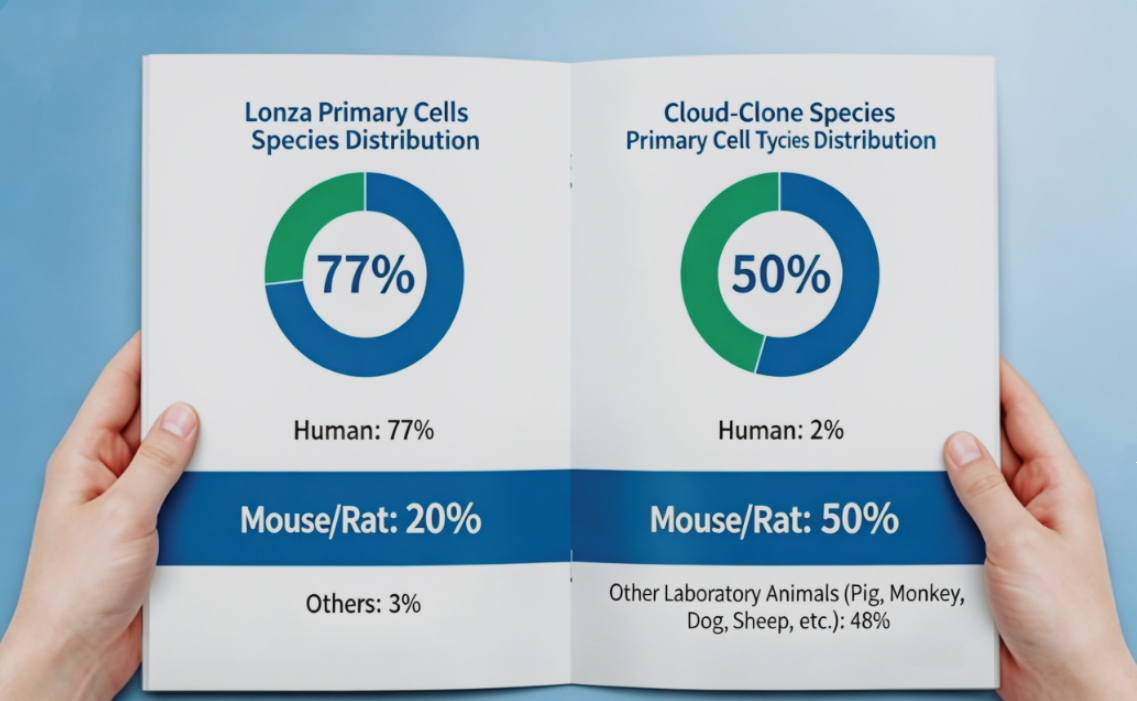
Lonza, PromoCell and ScienCell, key international primary cell suppliers, focus their product offerings predominantly on human primary cells. According to the official product list of Lonza, the company provides more than 200 types of primary cells, among which nearly 200 are human-derived cells. Rodent cells (mouse and rat) account for approximately 20% of its total products, while cells sourced from other animal species make up 3%.
Cloud-Clone and Procell, two China-based primary cell suppliers, offer a broad spectrum of primary cells from various animal species. Its product range covers mice, rats, rabbits, goats, horses, pigs, cats, dogs and other laboratory animals. Statistically, mouse and rat primary cells take up 50% of its total primary cell products; cells from pigs, monkeys, dogs, sheep and other large laboratory animals account for 48%, and human primary cells constitute 2% of its portfolio.
Figure 1. Species Differences in Primary Cells Offered by Different Suppliers
Objective Analysis of Factors Leading to Divergent Product Layouts
Multiple interrelated factors including market demand, regional regulatory rules, ethical standards, supplier qualifications and corporate development strategies jointly shape the current product distribution pattern across global primary cell suppliers.
1. Market Demand Structure
Biomedical research targeting human diseases drives steady demand for human primary cells. Such cells feature high similarity to human physiological conditions and support research progress in clinical transformation and pharmaceutical development. Due to technical barriers in independent cell isolation, research laboratories rely heavily on commercial suppliers for human primary cell products.
Mouse and rat primary cells are widely applied in basic life science research for biological mechanism and disease pathway exploration, forming the second largest market demand. Primary cells from large animals serve segmented industrial and research scenarios. Limited animal sources, high breeding and experimental costs, and technical difficulties in cell isolation restrict large-scale production and inventory turnover of large animal-derived primary cells. Only qualified suppliers with mature technical platforms launch related products selectively.
2. Regional Regulatory and Ethical Frameworks
Regulations and ethical norms for human tissue collection and laboratory animal utilization vary across regions.
In Europe and the United States, standardized ethical guidelines and complete licensing systems such as AATB, AOPO and EBAA have been established for human tissue acquisition. Relevant tissue bank operation licenses enable local suppliers to carry out stable supply of human primary cells. Meanwhile, the widely implemented 3R principles (Replacement, Reduction, Refinement) and animal welfare policies increase the cost of laboratory animal breeding, ethical review and transportation, resulting in a relatively limited supply of animal-derived primary cells in these regions.
In China, regulatory requirements for laboratory animal breeding, management and utilization are clearly defined. Enterprises holding valid Laboratory Animal Production License and Laboratory Animal Use License can ensure stable supply of animal tissues for primary cell preparation. Meanwhile, the acquisition of human tissues is subject to strict supervision, and relevant ethical supporting documents are not universally available among local suppliers.
3. Supplier Qualifications and Hardware Conditions
Supplier qualifications and hardware facilities further consolidate differentiated product layouts.
International suppliers including Lonza hold complete certifications related to human tissue collection and management. The company owns Maryland tissue bank operating license and New York State non-transplant anatomical tissue bank license. Human tissues are sourced from professional tissue recovery agencies, qualified third-party suppliers and standardized donor programs operated by the company itself.
Cloud-Clone has built independent facilities for laboratory animal rearing. The company operates a total animal housing area of 2,500 square meters, including 800 square meters of SPF-grade animal rooms, and holds full sets of valid laboratory animal operation licenses to guarantee stable supply of animal tissues.
4. Corporate Strategic Positioning
Based on their respective qualifications, technical foundations and regional market environments, primary cell suppliers adopt differentiated business strategies.
International suppliers with mature technologies, full compliance certifications and stable human tissue channels focus on developing standardized, traceable human primary cell product lines to serve pharmaceutical R&D and clinical translation projects.
Many regional suppliers choose to focus on laboratory animal-derived primary cells. The accessible raw material sources, relatively low production costs and mature supporting technologies make rodent primary cells the core product for basic academic research. Large animal-derived primary cells are positioned for niche market demands. The above strategic choices have formed the current diversified landscape of the global primary cell industry.
Industry Outlook and User Recommendations (Statement from Cloud-Clone Corp.)
“Regulatory policies will remain the core factor influencing the global primary cell supply market in the near future,” a spokesperson from Cloud-Clone Corp. commented.
Globally, supervision over human tissue collection and human primary cell application will stay rigorous, and no major relaxation is expected in the short term. The supply capacity of human primary cells will grow steadily alongside the standardization of tissue sourcing channels. In Europe and the United States, regulations on laboratory animal utilization will continue to be strictly enforced, and the supply of conventional animal-derived primary cells will operate within the existing regulatory framework.
In the Chinese market, mouse and rat primary cells will remain the mainstream choice for basic biomedical research. Related products will move toward higher quality, standardization and full traceability. Driven by high-end R&D demands, the supply stability and delivery efficiency of human primary cells will improve gradually, though such products are not expected to become mainstream in the short run due to regulatory constraints.
For research users, we suggest selecting primary cells based on specific research goals. Researchers engaged in basic studies are advised to adopt compliant and traceable conventional animal primary cells to ensure experimental stability. Teams conducting clinical-related research that requires human primary cells shall prioritize suppliers with legal tissue sourcing channels and complete compliance certifications to control regulatory risks.
About Cloud-Clone Corp.
Cloud-Clone Corp. specializes in the research, development and production of immunoassay reagents and biomedical research solutions. Focusing on antibody engineering, multi-index detection technology and cross-platform product compatibility, the company delivers research tools supporting precision medicine and advanced biomedical research worldwide.
Its core product and service portfolio includes proteins, antibodies, ELISA kits, primary cells, multi-factor cytokine detection kits and professional CRO services, covering diversified demands in biomedical research and related fields.
For more information, please visit the official website: www.cloud-clone.com
Contact Information
Tel: 001-832-538-0970, 0086-27-8425-9552Email: mail@cloud-clone.com, sales@cloud-clone.us
Social Media Accounts:LinkedIn: https://www.linkedin.com/company/cloud-clone-corp/Instagram: https://www.instagram.com/cloudclonecorp2023/TikTok: https://www.tiktok.com/@cloudclonecorp
SuKi Duan
Cloud-Clone Corp
cro@cloud-clone.com
Visit us on social media:
LinkedIn
Instagram
TikTok
X
Legal Disclaimer:
EIN Presswire provides this news content "as is" without warranty of any kind. We do not accept any responsibility or liability for the accuracy, content, images, videos, licenses, completeness, legality, or reliability of the information contained in this article. If you have any complaints or copyright issues related to this article, kindly contact the author above.
