


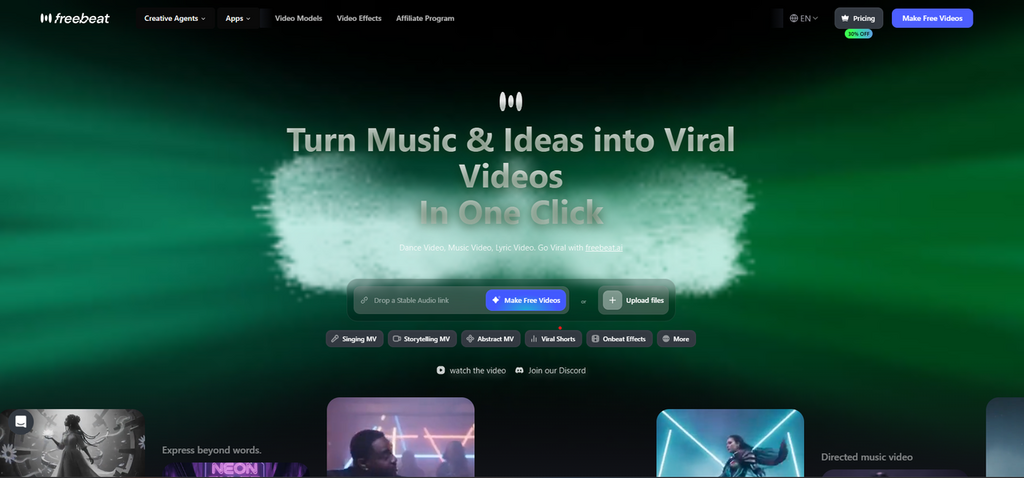
Free Beat described the platform as a music-first video system built around finished songs. The service accepts a link to a hosted audio file or a direct audio upload, analyses beat, tempo, structure and energy, and automatically assembles a storyboard before generating a complete, beat-synchronised music video. The company noted that some creators receive a finished output in as little as five minutes, depending on clip length and selected output settings. The platform’s workflow and feature set are organised specifically for projects that place a song at the centre of the visual narrative rather than for general-purpose video production.
The company said the platform applies more than 40 distinct video and image models and selects different models for individual scenes rather than relying on a single model for an entire video. That multi-model approach is employed alongside a character consistency mechanism designed to keep animated performers and avatars visually consistent across dozens of shots, a capability the company described as applicable across 80 or more discrete shots within a single video. Free Beat also reported that its lip-sync technology achieves approximately 90 percent accuracy across more than 100 languages, enabling animated characters to move and form lyrics in a way intended to match the sung or spoken words of a track rather than only matching broad rhythmic cues.
Free Beat outlined several output formats supported by the platform, including lip-synchronised performance videos, narrative or storytelling music videos, abstract visualisers and album-cover-based videos. The company emphasised that the system is optimised for full-song outputs and for projects that require continuity of character and narrative across a complete track, and that those design decisions influence the platform’s feature set and target use cases.
The company described its commercial model as tiered, with a free entry-level plan and paid plans that begin at under $5 per week for creators who require faster processing times and higher-resolution exports. Free Beat provided usage scope data alongside the pricing information, reporting the one billion seconds of generated content figure and stating that creators from more than 200 countries have used the platform. The company also said it has been named an official partner in a creator pass programme, a designation the company cites as part of broader institutional engagement with creator-focused initiatives.
Free Beat positioned the milestone within a broader shift in how independent musicians approach visual content. The company noted that a growing ecosystem of tools now enables musicians who record at home, in small studios or with AI-assisted composition platforms to generate accompanying visuals without traditional camera crews or extensive manual editing. Free Beat identified the Album Name Generator as an ancillary, free feature intended to help musicians name an album or EP, a task the company described as commonly difficult for creators once the music itself is complete. The company framed that tool as one part of a wider set of services designed to reduce technical and cost barriers for artists seeking polished visual outputs.
The company also addressed limits and recommended precautions. Free Beat acknowledged that the platform’s music-centred design makes it less suitable for creators seeking a general-purpose video generator for non-music projects. The company reiterated that copyright ownership, commercial usage rights and source-material restrictions can vary between services and jurisdictions, and that creators should review terms of use and licensing before publishing commercial releases that include AI-generated content.
Free Beat said the adoption milestone reflects both demand for music-first automation and the practical effects of improved technical capabilities, such as character consistency and scene-by-scene model selection. The company cited those elements as factors that enable the creation of coherent, full-length music videos from a single song rather than from a sequence of unrelated short clips, and linked the platform’s usage figures to a wider trend of independent artists incorporating visual assets into release plans more readily than in previous years.
About Free Beat
Free Beat is a music-first video technology company founded in 2024 by a team of Stanford alumni. The company provides an AI Music Video Generator and related creative tools designed to turn finished songs into synchronized visual outputs for creators. Free Beat offers a tiered pricing model including a free plan and paid plans for higher-resolution exports and faster processing.
Website: https://freebeat.ai/
Media Relation
Free Beat
contact@freebeat.ai
Legal Disclaimer:
EIN Presswire provides this news content "as is" without warranty of any kind. We do not accept any responsibility or liability for the accuracy, content, images, videos, licenses, completeness, legality, or reliability of the information contained in this article. If you have any complaints or copyright issues related to this article, kindly contact the author above.
