



RegulatingAI Podcast
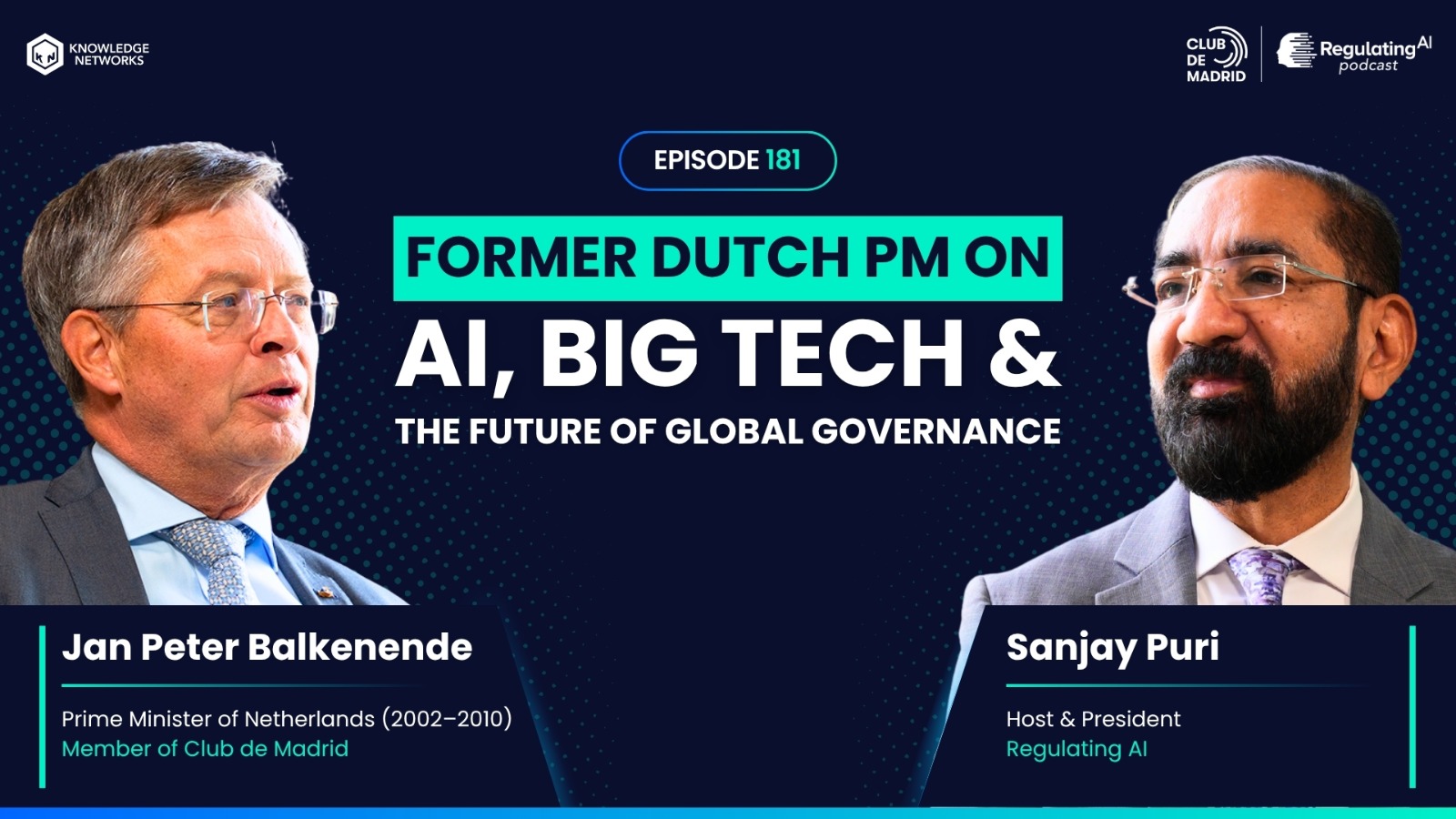
Jan Peter Balkenende, Former Dutch Prime Minister with Sanjay Puri, President of RegulatingAI
Former Dutch PM Jan Peter Balkenende urges responsible AI governance, stronger regulation, and human-centered innovation to ensure no one is left behind.
Balkenende positioned Europe as a distinct voice between the market-driven approach of the United States and the state-led model of China. He argued that Europe's tradition of cooperation between governments, businesses, and social partners gives it a unique opportunity to shape AI development around human values. While acknowledging concerns that Europe risks falling behind in innovation, he said the continent must develop a new vision built on human dignity, inclusivity, sustainability, and collaboration. According to Balkenende, Europe has already demonstrated leadership in regulation but now needs greater investment in research, innovation, and public-private partnerships. He called for a "new European dream" that combines technological competitiveness with social responsibility, ensuring that economic progress benefits society as a whole.
The former prime minister also expressed concern about the growing concentration of power among a handful of AI companies. He noted that several technology firms now possess financial resources and influence that rival those of many nations, creating unprecedented challenges for policymakers. While he emphasized that companies should voluntarily act responsibly, Balkenende argued that governments cannot ignore the implications of such concentrated power. Drawing parallels with earlier periods of economic history when antitrust measures were introduced to curb corporate dominance, he suggested that policymakers may need to rethink regulation, governance structures, and even ownership models. He warned that unchecked concentrations of wealth and influence could undermine inclusive economic growth and weaken public confidence in democratic institutions.
Addressing the rapid deployment of AI technologies, Balkenende highlighted concerns about employment, social stability, and quality of life. While acknowledging the enormous benefits AI can bring to productivity, research, and information access, he cautioned that technological advances could displace workers and create uncertainty, particularly among younger generations. He argued that businesses developing AI should share responsibility for helping workers adapt to changing labor markets and for ensuring that innovation creates opportunities rather than exclusion. According to Balkenende, public debates about AI too often focus on technology itself while neglecting its broader societal consequences. He called for greater attention to the future of work, social cohesion, and the need to preserve hope and opportunity for future generations.
The discussion also turned to the need for stronger international governance mechanisms. Balkenende suggested that the world may require new institutions capable of providing oversight and accountability in the AI era, similar in principle to organizations that govern other globally significant technologies. He argued that societies function best when power is balanced by effective checks and balances and warned that existing institutions have not kept pace with the rise of large technology companies. In his view, governments, universities, civil society organizations, journalists, and businesses all have a role to play in shaping AI's future. He called for a broader international conversation that extends beyond technical innovation and includes ethical, social, and democratic considerations.
Reflecting on lessons from the 2008 global financial crisis, Balkenende warned that policymakers should not repeat the mistake of underestimating systemic risks associated with rapidly evolving technologies. Just as financial innovations once outpaced regulators' understanding, he said AI could create unforeseen consequences if governments and corporations fail to act responsibly. He voiced concern about growing geopolitical tensions and the fragmentation of international cooperation, contrasting today's environment with earlier periods when nations worked together to address global challenges. Looking ahead to upcoming United Nations discussions on AI governance, Balkenende urged world leaders to focus on humanity's shared interests rather than national rivalries. His central message was clear: technological progress should ultimately serve people, strengthen societies, and create a future in which no one is left behind.
Upasana Das
Knowledge Networks
email us here
Visit us on social media:
LinkedIn
Instagram
Facebook
YouTube
X
Legal Disclaimer:
EIN Presswire provides this news content "as is" without warranty of any kind. We do not accept any responsibility or liability for the accuracy, content, images, videos, licenses, completeness, legality, or reliability of the information contained in this article. If you have any complaints or copyright issues related to this article, kindly contact the author above.
