


BODY COMPOSITION MARKERS FOR PREDICTING CHRONIC HEPATITIS B-RELATED CIRRHOSIS DECOMPENSATION ACROSS DISEASE STAGES.
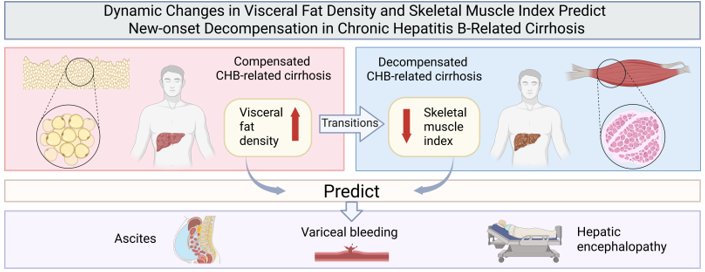
FAYETTEVILLE, GA, UNITED STATES, July 20, 2026 /EINPresswire.com/ -- Researchers tracked longitudinal alterations in adipose and muscle tissue through routine CT scans. Worsening visceral fat tissue degeneration predicts complications for compensated chronic hepatitis B-related cirrhosis, while sustained muscle loss signals risk in decompensated patients.
Each year, millions of people live with chronic hepatitis B that slowly develops into cirrhosis. Once cirrhosis patients suffer decompensation issues including fluid buildup in the belly and dangerous esophageal bleeding, their risks of repeated hospital stays and early death rise sharply.
Clinicians mostly judge liver risk through one-time liver blood tests, which miss gradual whole-body tissue changes that drive disease deterioration. In a study published in Hepatobiliary Communications, researchers from The First Hospital of Lanzhou University uncovered clear, stage-specific tissue patterns from standard CT scans to predict upcoming severe liver complications.
“We found that visceral fat and muscle shifts carry totally different warning meaning based on how advanced a patient’s cirrhosis is,” shares co-lead author Xiaoyue Zhang. “For patients with compensated early-stage cirrhosis, gradual degeneration of visceral fat signals a significantly higher risk of complications, and for those who have already experienced severe hepatic decompensation events, persistent muscle wasting serves as the primary warning marker.”
The researchers confirmed tracking long-term tissue shifts delivers much more accurate risk alerts than isolated examinations. “Above all, these fat and muscle changes can be spotted on routine abdominal CT scans that every cirrhosis patient already undergoes, with no extra expensive or invasive testing needed,” adds Zhang.
According to senior and corresponding author Junfeng Li, the team’s findings addressed an unmet clinical demand in daily liver disease management. “Past research rarely split cirrhosis patients by disease stage to sort out these tissue warning signals,” explains Li. “This easy CT monitoring method allows clinicians to launch personalized nutritional and metabolic support early, effectively slowing liver damage and lifting long-term survival chances for hepatitis B cirrhosis patients.”
References
DOI
10.1016/j.hbc.2026.100003
Original Source URL
https://doi.org/10.1016/j.hbc.2026.100003
Funding Information
This work was supported by the National Natural Science Foundation of China [Grant no. 82360132]; the National College Students Innovation and Entrepreneurship Training Program [Grant no. 20250000009]; the Gansu Province College Students Innovation and Entrepreneurship Training Plan Project [Grant no. 20250060289]; the Excellence Program of Lanzhou University [Grant no. 20240060001]; the Lanzhou University College Students Innovation and Entrepreneurship [Grant nos. 20250020069, 20250020072]; the Gansu Province Joint Research Fund Project [Grant nos. 23JRRA1489, 24JRRA911]; and the Major Project of Scientific and Technological Innovation in the Health Industry of Gansu Province [Grant no. GSWSZD2024-11].
Lucy Wang
BioDesign Research
email us here
Legal Disclaimer:
EIN Presswire provides this news content "as is" without warranty of any kind. We do not accept any responsibility or liability for the accuracy, content, images, videos, licenses, completeness, legality, or reliability of the information contained in this article. If you have any complaints or copyright issues related to this article, kindly contact the author above.
