



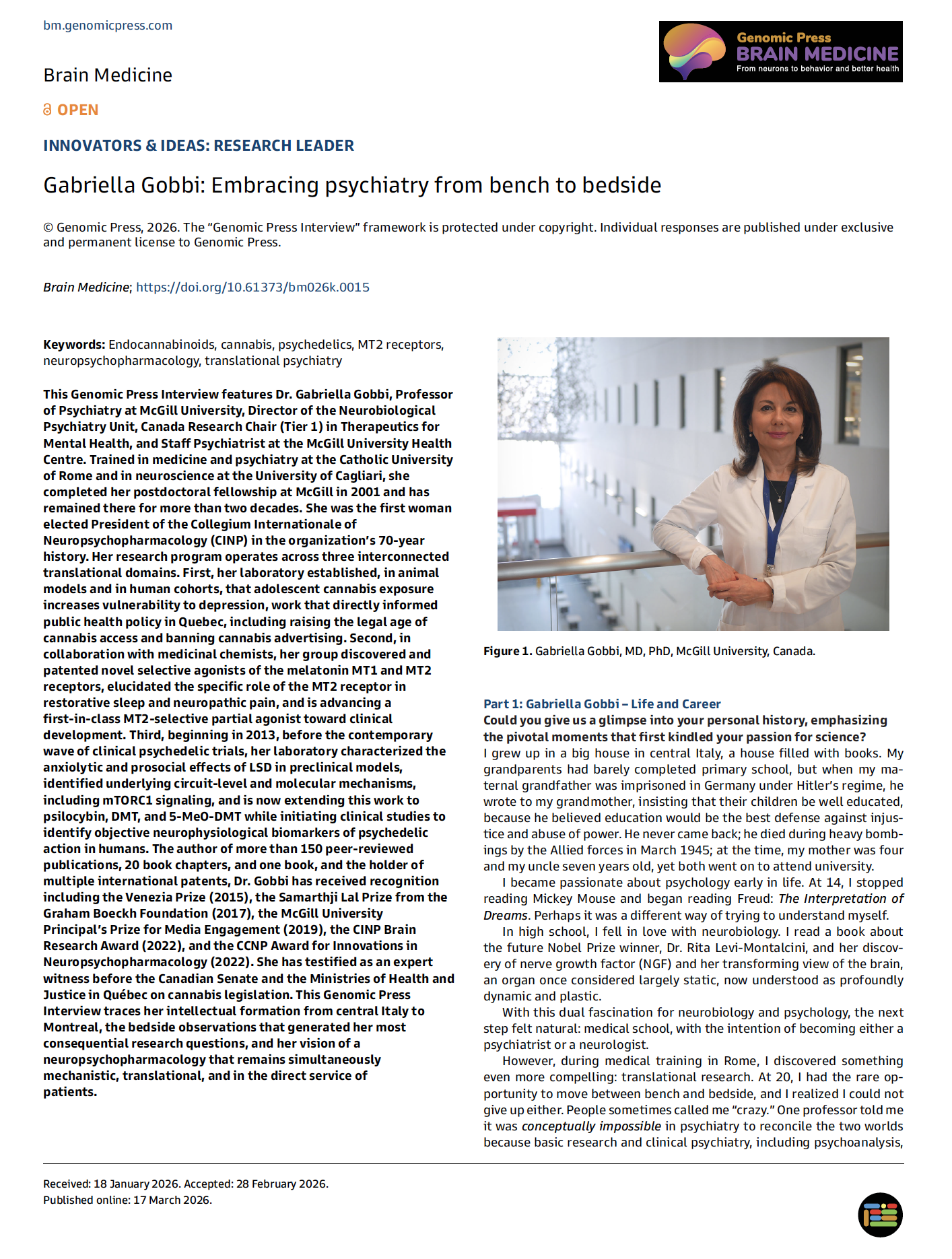
Gabriella Gobbi, MD, PhD, McGill University, Canada.

Dr. Gabriella Gobbi paddling on the Adriatic Sea at dawn.
Gabriella Gobbi: Embracing psychiatry from bench to bedside
Research links adolescent cannabis use to depression, advances a first-in-class sleep drug, and pioneers psychedelic neuroscience
The significance of Dr. Gobbi's research program has been recognized both in Canada and internationally. She holds a Canada Research Chair (Tier 1) in Therapeutics for Mental Health, the country's highest research distinction, and will become the first woman to serve as president of the CINP in the organization's 70-year history. Her work spans three major research lines: the link between adolescent cannabis exposure and depression, the role of the melatonin MT2 receptor in sleep and pain, and the neuroscience of psychedelics. "My greatest fear concerns the future of psychopharmacology and drug discovery," she states in the interview, "not because the science is failing, but because a greedy system oversees innovation today."
The clinical observation that drives her best-known research line is almost painfully simple. In the early 2000s, she kept seeing adolescents and young adults who smoked cannabis and who, in the years that followed, developed depression marked by profound anhedonia, the inability to feel pleasure. The bedside pattern became a bench question. In 2007 her laboratory reported one of the first links between cannabinoids, serotonin systems, and depression-related phenotypes. In 2010, animal-model studies demonstrated that adolescent cannabis exposure could increase vulnerability to later depressive-like outcomes. By 2019, supporting evidence had emerged in human cohorts. This body of work has now accumulated more than 1,700 citations and contributed directly to public-health decisions in Quebec. Dr. Gobbi also testified as an expert witness before the Canadian Senate and the Ministries of Health and Justice in Quebec on cannabis policy, contributing to legislation raising the legal age for cannabis access and to the regulation of cannabis advertising.
A second major research program, running in parallel since 2006, has focused on the melatonin MT2 receptor, a molecular target involved in sleep regulation that was poorly understood when her group began. Her laboratory contributed to defining MT2 receptor localization and elucidated its specific role in restorative NREM sleep (the deep, dreamless phase of the sleep cycle) and neuropathic pain. An MT2-selective partial agonist, a first-in-class candidate, is now moving from early discovery toward clinical development. "I have learned that in science, the projects that take the longest are often those that yield the most meaningful results," she observes in the interview. Her laboratory began investigating psychedelics in 2013, before the contemporary wave of clinical trials brought the field to prominence, characterizing the anxiolytic and prosocial effects of LSD in preclinical models and beginning to identify underlying molecular mechanisms including mTORC1 signaling (a cellular growth-signaling pathway). That work is now extending to psilocybin, DMT, and 5-MeO-DMT, while new clinical studies aim to identify objective neurophysiological biomarkers of psychedelic action in humans.
The intellectual hunger behind these research programs took root early. Dr. Gobbi grew up in a book-filled house in central Italy, the granddaughter of a man who died under Allied bombing in March 1945 after writing from a German prison to insist that his children receive the education he himself had been denied. That inheritance, part moral conviction and part intellectual hunger, runs as a thread through everything she has since done. At fourteen she put down comic books and picked up Freud. In high school she read about Rita Levi-Montalcini and the discovery of nerve growth factor, and understood that the brain was not fixed but plastic, a revelation that pointed her toward medicine. By twenty, during training in Rome, she had encountered translational research, the practice of moving continuously between laboratory bench and clinical ward, and found that she could not relinquish either world.
The path to independence was neither smooth nor linear. In Italy during the 1990s, academic positions were controlled by senior professors acting as gatekeepers, and Dr. Gobbi spent time working at a private psychiatric hospital in a small central-Italian town, applying to PhD programs and genuinely unsure whether she would ever gain entry to research. The turning point arrived on the evening of January 29, 1996, in the form of a telephone call. She was invited to sit a PhD entrance examination in Cagliari, in Sardinia, the following morning. She boarded a plane at eleven that night. At eight the next morning she sat the exam, and she won. That examination opened the door to work with Professor Gianluigi Gessa, a neuroscientist known for landmark contributions to the neurobiology of dopamine and addiction. Two years later, at a Biological Psychiatry meeting in Nice, a chance conversation with Professor Pierre Blier led to an invitation to join his laboratory at McGill. That single year in Montreal became more than two decades.
Gender inequality in academic science exacts what Dr. Gobbi calls a hidden tax on women, and she does not confine her scrutiny to drug-development economics. She speaks with notable directness about both overt harassment and a quieter structural erosion: unequal access to administrative support, diversion toward low-visibility service work, and a conference-invitation culture that disadvantages researchers who carry disproportionate caregiving burdens. "This is the cause that fires me up the most," she states, "changing the structure of our scientific culture so excellence is recognized without imposing an additional, hidden tax on women." In her current role as President-Elect of the CINP, she has heard such accounts repeatedly from accomplished women who have been isolated, evaluated inconsistently, or simply not invited to the table.
There is a letter from her mother, written before her death from glioblastoma in 2000, that Dr. Gobbi names as her most treasured possession. It is the kind of detail that resists elaboration. What she says about happiness is perhaps more revealing: her happiest moments have occurred in those rare instants in research when data suddenly align and something obscure becomes clear, "the feeling that nature has briefly lifted a corner of the veil, and that an experiment is no longer just results on a page but a story that finally makes sense." When she disconnects entirely, in summer, she paddles on the Adriatic Sea. In Quebec she skis in spring, when the light softens. Winter skiing here, she notes in the interview, is simply too cold.
Asked what she would change about herself, Dr. Gobbi does not cite a scientific limitation. She wishes she had sought mentorship and leadership education earlier. She began her career as an assistant professor without a mentor and without foundational training in management, grant-writing, or conflict resolution. The regret is characteristic: it is not personal but structural, a comment about what academic systems fail to provide rather than about what she personally lacks. Her life philosophy, offered at the interview's close, is unadorned: "Do your best, stay true to what matters, and trust what comes."
Dr. Gabriella Gobbi's Genomic Press interview is part of a larger series called Innovators and Ideas that highlights the people behind today's most influential scientific breakthroughs. Each interview in the series offers a blend of cutting-edge research and personal reflections, providing readers with a comprehensive view of the scientists shaping the future. By combining a focus on professional achievements with personal insights, this interview style invites a richer narrative that both engages and educates readers. This format provides an ideal starting point for profiles that explore the scientist's impact on the field, while also touching on broader human themes. More information on the research leaders and rising stars featured in our Innovators and Ideas -- Genomic Press Interview series can be found on our interview website: https://interviews.genomicpress.com/.
The Genomic Press Interview in Brain Medicine titled "Gabriella Gobbi: Embracing psychiatry from bench to bedside," is freely available via Open Access, starting on 17 March 2026 in Brain Medicine at the following hyperlink: https://doi.org/10.61373/bm026k.0015.
About Brain Medicine: Brain Medicine (ISSN: 2997-2639, online and 2997-2647, print) is a peer-reviewed medical research journal published by Genomic Press, New York. Brain Medicine is a new home for the cross-disciplinary pathway from innovation in fundamental neuroscience to translational initiatives in brain medicine. The journal's scope includes the underlying science, causes, outcomes, treatments, and societal impact of brain disorders, across all clinical disciplines and their interface.
Visit the Genomic Press Virtual Library: https://issues.genomicpress.com/bookcase/gtvov/
Our media website is at: https://media.genomicpress.com/
Our full website is at: https://genomicpress.com/
Ma-Li Wong
Genomic Press
mali.wong@genomicpress.com
Visit us on social media:
X
LinkedIn
Bluesky
Instagram
Facebook
Legal Disclaimer:
EIN Presswire provides this news content "as is" without warranty of any kind. We do not accept any responsibility or liability for the accuracy, content, images, videos, licenses, completeness, legality, or reliability of the information contained in this article. If you have any complaints or copyright issues related to this article, kindly contact the author above.
